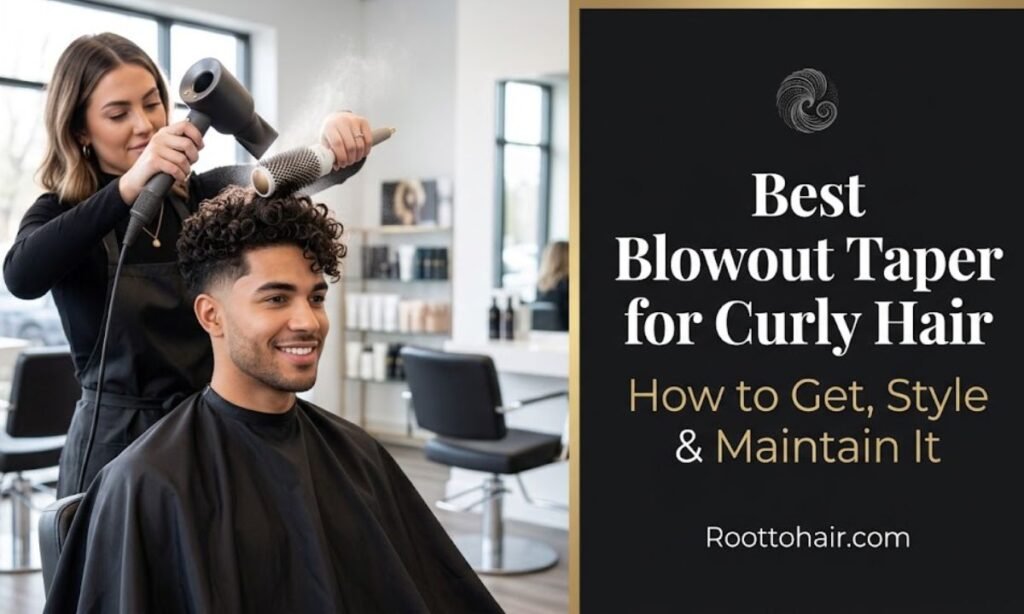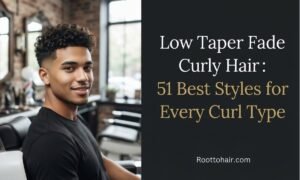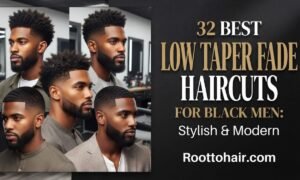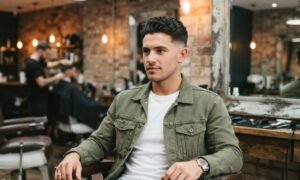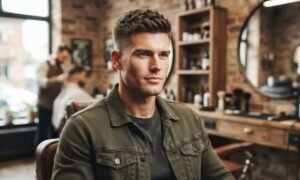
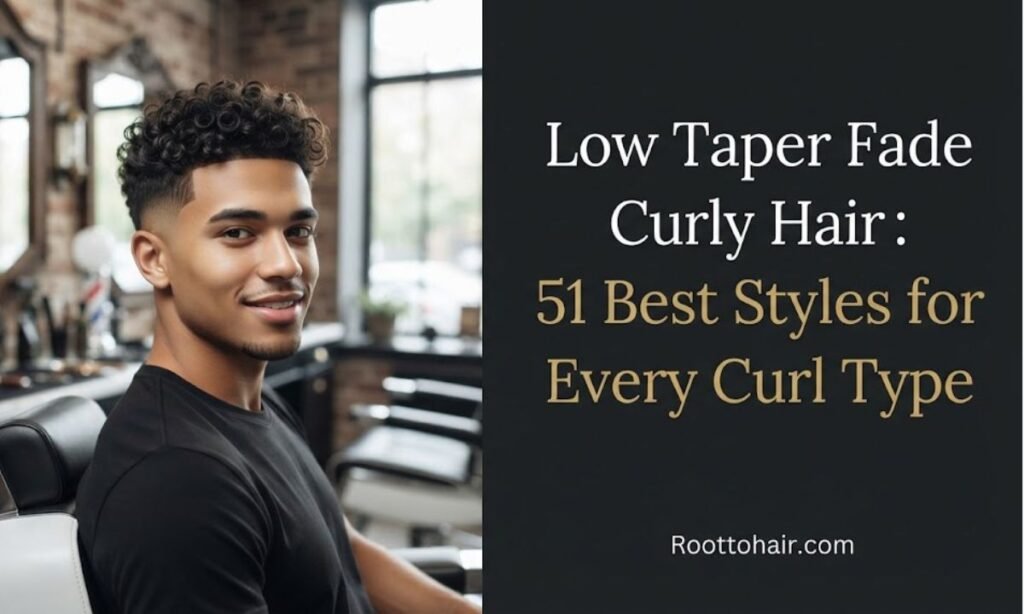
A low taper fade curly hair cut keeps your natural curls on top and gradually shortens the hair around the sideburns, temples and nape. The taper starts low, close to the ears and neckline, so the sides stay fuller than they would with a mid or high fade. The result looks neat without cutting into the shape of your curls.
Curly hair responds to a taper differently than straight hair. Curl pattern, density, texture and shrinkage all change how the same cut looks. Waves, loose curls, tight coils and Afro-textured hair can all work with a low taper, but each one needs a slightly different top length, side bulk and styling approach.
This guide covers 51 low taper fade styles, from classic curls to blowouts, Afro looks and hybrid cuts. You will also find advice on choosing by curl type and face shape, step-by-step home styling, maintenance, product categories and ready-to-use barber scripts.
What Is a Low Taper Fade on Curly Hair and Which Curl Types Does It Work For?
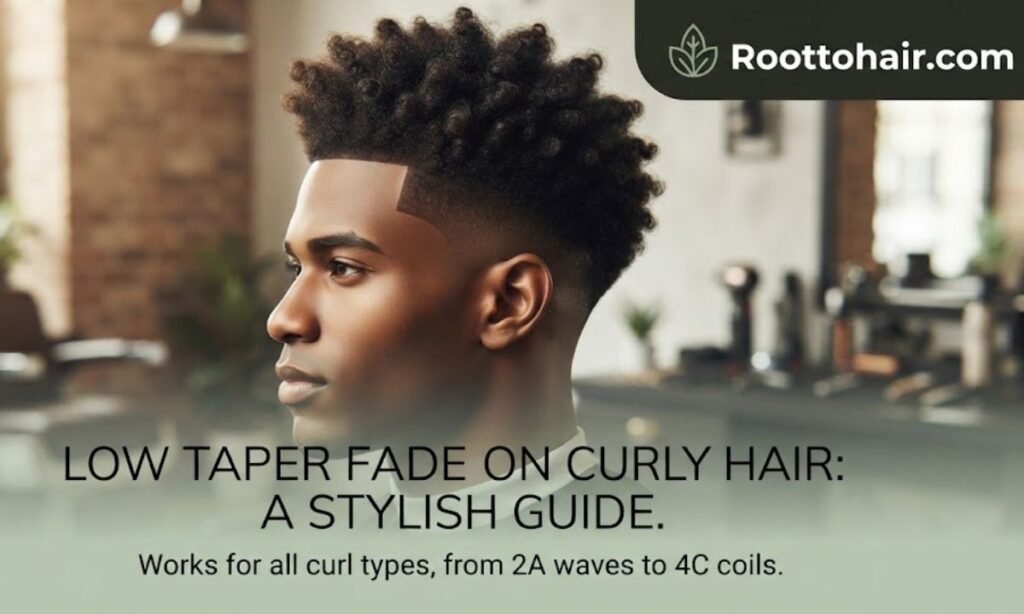
A low taper fade on curly hair is a haircut where the sides and back get shorter toward the hairline while the curls on top stay longer. It is one of the most flexible cuts for curls because it cleans up the edges without removing the bulk that gives curly hair its shape.
It can work across most textures, from loose waves to tight 4C coils. What changes is how the top is cut and styled, not whether the taper is possible.
- Wavy hair and Type 2 (2A–2C): Waves often lie flatter, so the top is usually left a bit longer to show movement.
- Type 3A–3C: Defined spirals and ringlets show clearly against a tapered edge. Looser 3A curls may need more length, while 3C curls form tighter, denser spirals.
- Type 4A–4C: Coily hair shrinks a lot, so a low taper can frame a twist-out, wash-and-go, mini afro or stretched blowout.
Curl typing is a general guide, not an exact science. Many men have two or three patterns on one head, for example looser curls at the front and tighter coils at the crown. Density, porosity, shrinkage and growth direction also shape the final result, so two men with the same curl type can still need different cuts.
What Is a Low Taper Fade on Curly Hair?
A low taper fade on curly hair is a gradual shortening of the sides and nape that begins low on the head. It looks softer and more natural than a high fade because the contrast is kept near the hairline rather than climbing toward the crown.
Below, we cover how it is built and why it suits curls so well.
The Low Taper Fade: A Precise Barbering Definition
A low taper is a short, gradual blend that follows the natural hairline. It usually starts around the sideburns and the back of the neck, and it keeps the length through the sides and back above that point. How short it goes at the edge depends on the client and the barber, which is why the taper can look classic and subtle or closer and cleaner.
Here is how the main areas are usually handled:
- Where it begins: Low, near the ear and the lower edge of the nape, instead of climbing up the sides.
- Temples: The hair is shortened gently, either following the natural temple shape or lightly cleaned up.
- Sideburns: They taper out smoothly. They can stay natural, be shortened or be shaped with a clean edge.
- Neckline: It can be left natural, softly tapered or cleaned with a sharper outline.
- Sides: Most of the length stays above the taper, so the sides keep some bulk.
Because there is no single universal clipper setup, the best approach is to tell your barber the look you want rather than a guard number. A fade is a technique, not a formula.
Why Curly Hair and the Low Taper Fade Are a Perfect Match
The taper and curls balance each other well. Curls add volume and movement on top, and the taper keeps the sides and neckline tidy so the shape reads as intentional instead of bulky.
The same low taper can look different depending on texture:
- On looser waves, the contrast is soft and the cut looks relaxed.
- On defined 3B or 3C spirals, the taper highlights the curl pattern.
- On 4A–4C hair, shrinkage can make the top look shorter than it is, so the top length is judged when the hair is stretched or after it dries.
The length on top matters just as much as the taper. Longer curls create a fuller, rounder outline and a more dramatic contrast. Shorter curls look cleaner and need less styling.
Compared with a higher fade, a low taper also tends to be easier to live with. It usually grows out more softly and can look acceptable a little longer between visits, though that depends on how fast your hair grows and how clean you like the edges.
Low Taper Fade vs. Other Fades: Which One Is Right for Your Curls?
The best fade depends on how much contrast you want and how much of your curl shape you want to keep. A low taper is the gentlest option. Mid and high tapers move the contrast higher up the head. A low fade is usually closer and more noticeable at the edges than a taper.
| Feature | Low Taper | Mid Taper | High Taper | Low Fade |
| Position | Low, near ears and nape | Around mid-side | Higher on sides | Low, but cut closer |
| Side Contrast | Soft | Moderate | Strong | Noticeable |
| Overall Look | Natural, classic | Balanced | Sharp, bold | Clean, sharper edge |
| Curl Preservation | Highest | Good | Lower on sides | Good |
| Maintenance | Lower | Medium | Higher | Medium |
When a low taper may suit you best: you want to keep the volume on the sides, you like a neat but natural outline, or you want a haircut that grows out gently.
When another fade may suit you better: if you want strong contrast or a sharper, more modern look, a mid or high fade may suit you better. If you want an exposed, skin-close finish at the edges, a low fade or low skin taper gives that without changing the overall shape much.
Hair that is very dense or very thick sometimes benefits from a bit more removal at the sides to control bulk, so a mid taper can be worth discussing. Your barber can show you how each option looks on your own texture.
51 Best Low Taper Fade Curly Hair Styles for Men
Each style below includes what it looks like, who it tends to suit, what to say to your barber, and how to care for it. Curl type and density change the results, so treat these as starting points rather than strict rules.
Classic & Essential Styles
1. Classic Low Taper Fade with Natural Curls
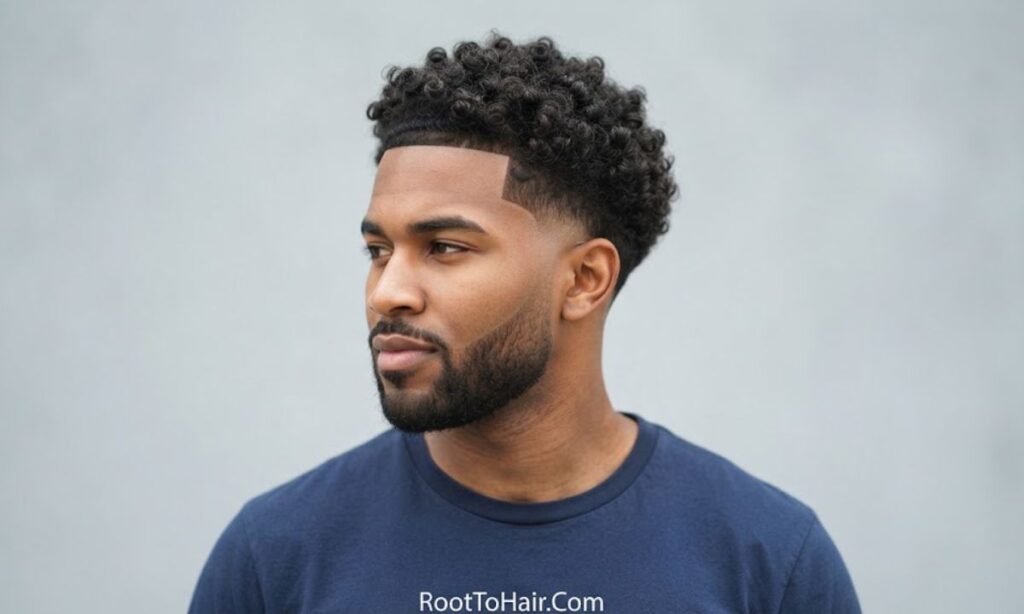
This is the base version: natural curls on top with a low taper around the ears and neckline. The top is cut to let curls fall in their own pattern, usually a few inches long. It works for waves through 3C and for anyone who wants a clean, no-fuss look.
Ask your barber: “Low taper around the ears and neck, leave my natural curls on top, and don’t cut them too short.”
Care: Apply leave-in conditioner and a curl cream to damp hair, then air-dry or diffuse.
Tip: Show your barber how your curls look when dry, not just wet.
2. Low Taper Fade with Tight Coils
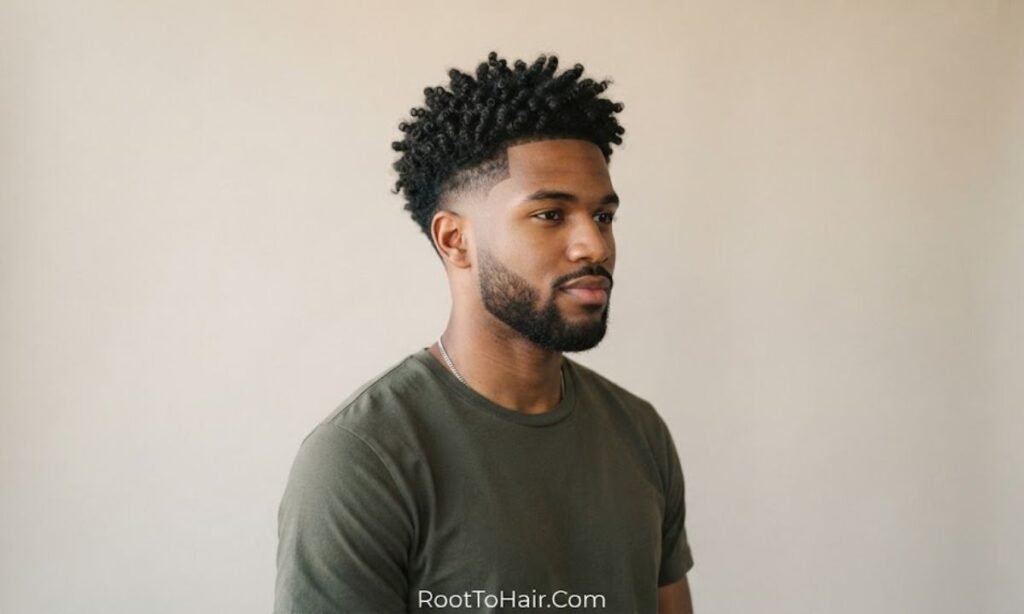
Tight coils (often Type 4A to 4C) stand upright and look dense. A low taper keeps the outline tidy while leaving the coil shape visible. The top can be short or medium, and the coils usually look best when moisturised so they stay springy instead of dry.
Ask your barber: “Low taper with tight coils left natural on top. Please leave a bit of extra length because they shrink.”
Care: Use a water-based moisturiser and a light cream or gel for definition.
Tip: Finger-coil a few spots at the front to keep the pattern uniform.
3. Low Taper Fade with Wavy Hair
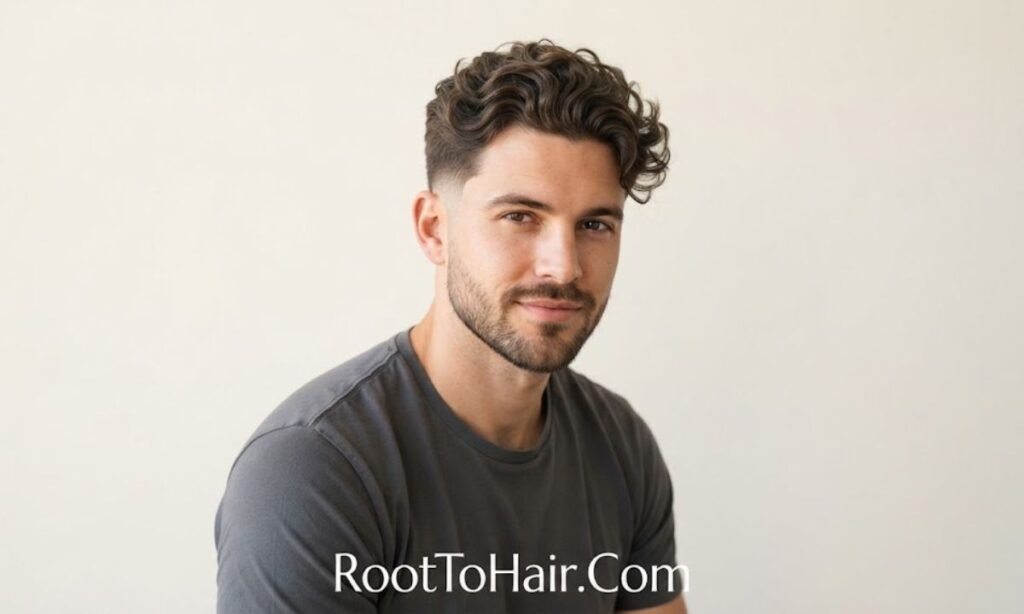
Wavy hair is looser and flatter than curls, so this style keeps the top longer to show the S-shaped movement. The taper stays soft and low so the waves have room to move. It is a good entry point if you are not sure whether your hair counts as curly.
Ask your barber: “I have waves, so leave some length on top and keep the taper low and soft.”
Care: A light mousse or sea-salt-style spray adds texture without weighing waves down.
Tip: Avoid heavy creams, which can flatten fine waves.
4. Low Skin Taper Fade with Curly Top
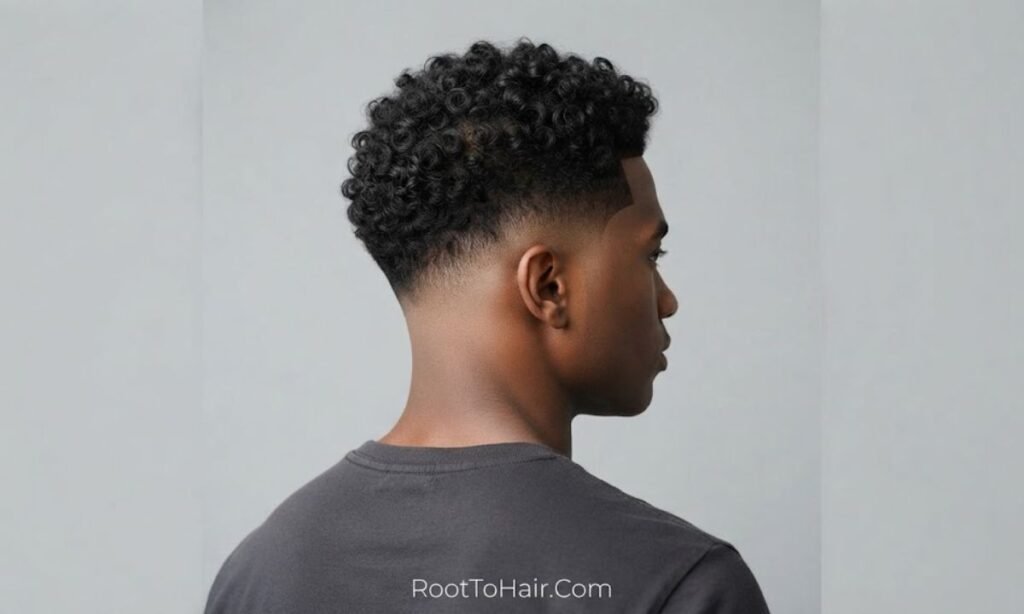
A low skin taper takes the hair at the very edge down to the skin around the ears and nape, giving more contrast than a standard low taper. The curls on top stay full. It has a sharper, more modern look, but it grows out faster than a softer taper.
Ask your barber: “Low skin taper at the ears and nape, natural curls on top, and a clean but natural neckline.”
Care: Moisturise the scalp and keep the skin areas clean so they look smooth.
Tip: Book a quick edge-up between full cuts to keep the skin areas crisp.
5. Low Taper Fade with Hard Part
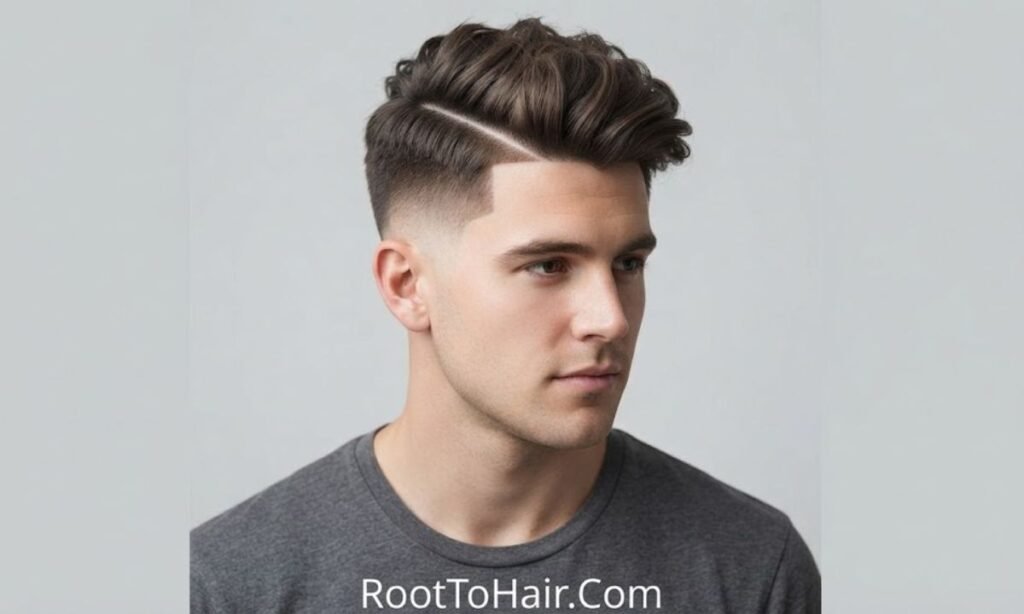
A hard part is a shaved or razored line in the hair, usually on one side. Paired with a low taper, it gives curly hair a defined parting and a polished look. The curls are styled away from the line to make it stand out.
Ask your barber: “Low taper with a hard part on the left. Keep the curls natural on top.”
Care: Brush or comb curls gently away from the part with a curl cream.
Tip: Make sure the part follows your natural parting direction to avoid awkward flipping.
6. Low Drop Taper Fade with Curly Hair
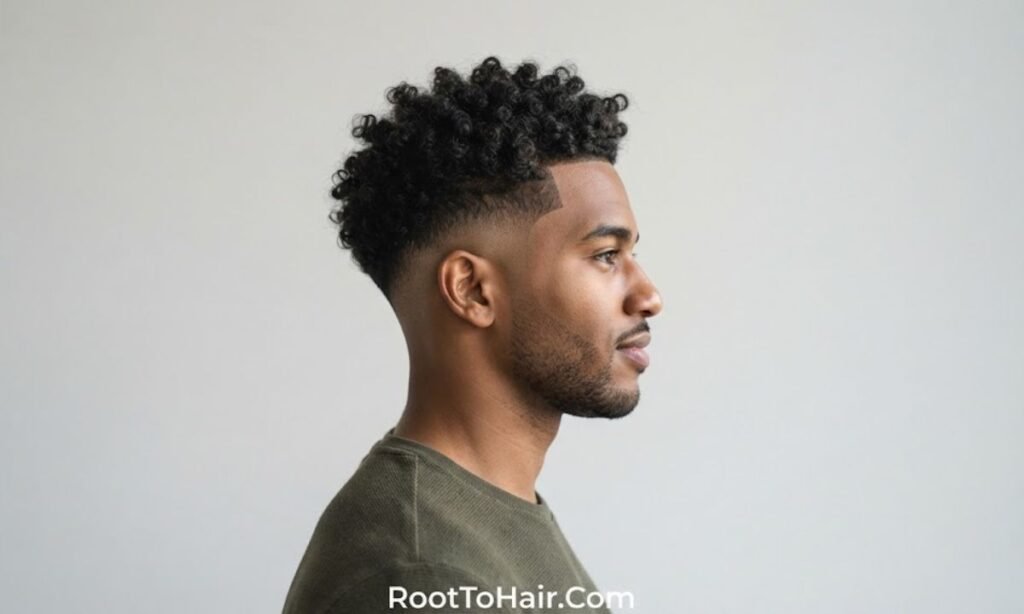
A drop taper curves downward behind the ear instead of following a straight line. On curly hair it follows the shape of the skull and makes the nape look more rounded. It suits men who want a tapered outline that feels less boxy.
Ask your barber: “Low drop taper that curves behind the ear, with curls left longer on top.”
Care: Use a light gel to hold the top curls so the curve of the taper stays visible.
Tip: Check the back view, since the drop shape is most obvious there.
7. Short Curly Hair Low Taper Fade
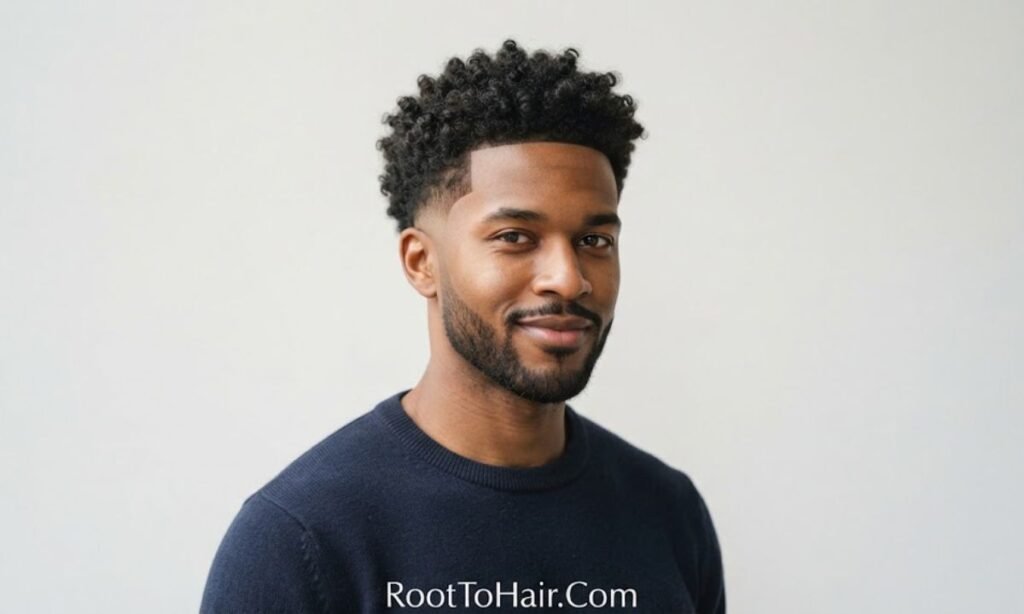
This version keeps the curls short, roughly an inch or two, which makes it easy to style and manage. Curls look tighter and denser. It works well for work, sport and busy mornings, and it is easy to maintain.
Ask your barber: “Short curls on top, about an inch or two, and a low taper on the sides and back.”
Care: A small amount of curl cream is usually enough.
Tip: Short curls can look unruly when dry, so use a little product to define them.
8. Long Curly Hair with Low Taper Fade
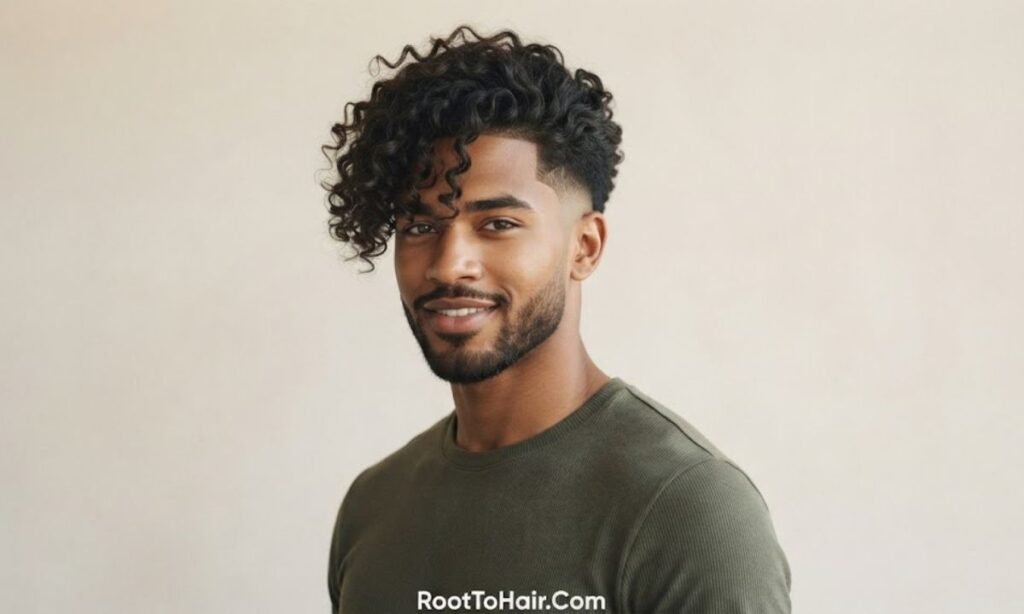
Long curls fall past the ears or toward the shoulders while the sides stay tapered low. The contrast gives a controlled outline for long hair. Because the weight of the curls pulls them down, the pattern can look looser than it does when shorter.
Ask your barber: “Keep the length on top and taper the sides low so the curls still look full.”
Care: Detangle gently with a wide-tooth comb and keep long curls well conditioned.
Tip: Ask for light layering so the top does not become heavy.
9. Low Taper Fade with Defined Ringlets
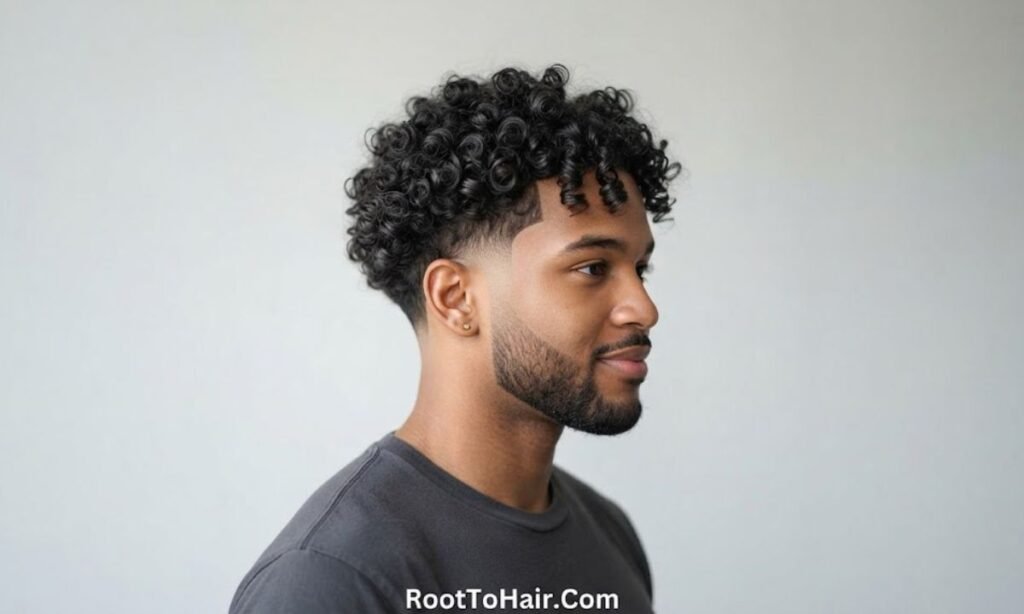
Ringlets are well-formed, spiral-shaped curls, most common in 3A to 3C hair. This style highlights them against a neat taper. The top is left long enough for the spirals to complete a full turn, which is what makes them look defined.
Ask your barber: “Low taper and keep enough length that my ringlets can form properly.”
Care: Apply curl cream and gel on soaking-wet hair, then scrunch and diffuse.
Tip: Avoid touching the curls while they dry so they set without frizz.
10. Low Taper Fade with Natural Volume
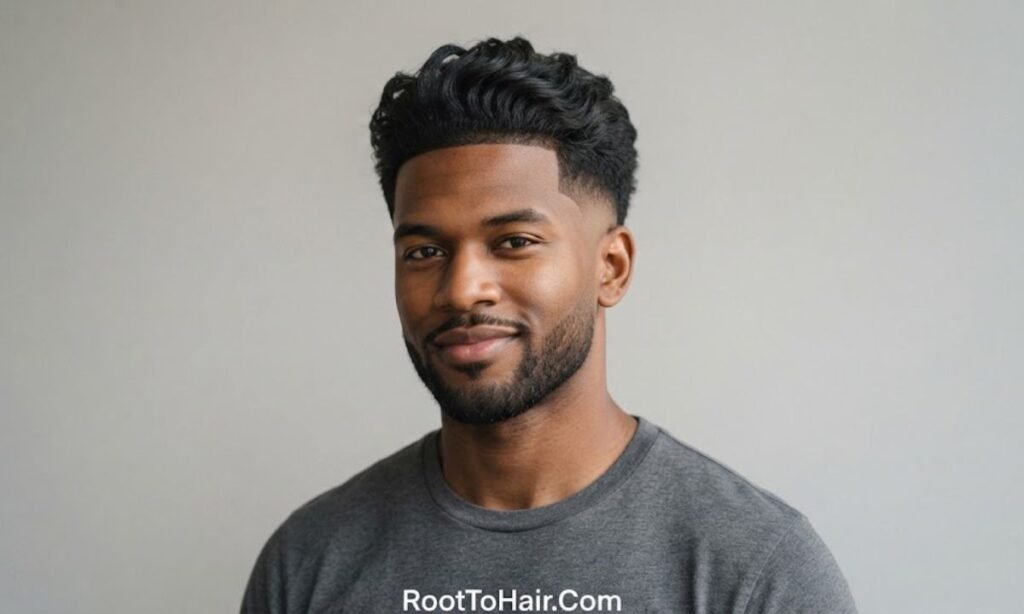
This style leaves the top big and rounded for a fuller silhouette. The taper pulls the eye toward the top and keeps the shape balanced. It suits dense or high-volume curls, and it is good if you like a statement shape without extra styling.
Ask your barber: “Low taper and keep the top full and rounded. Trim only what is needed to shape it.”
Care: Pick the curls out gently at the roots with fingers or a pick.
Tip: Trim split ends and the outer edge, not the crown, to keep volume.
Curly Top & Fringe Variations
11. Low Taper Fade with Curly Fringe (Bangs)
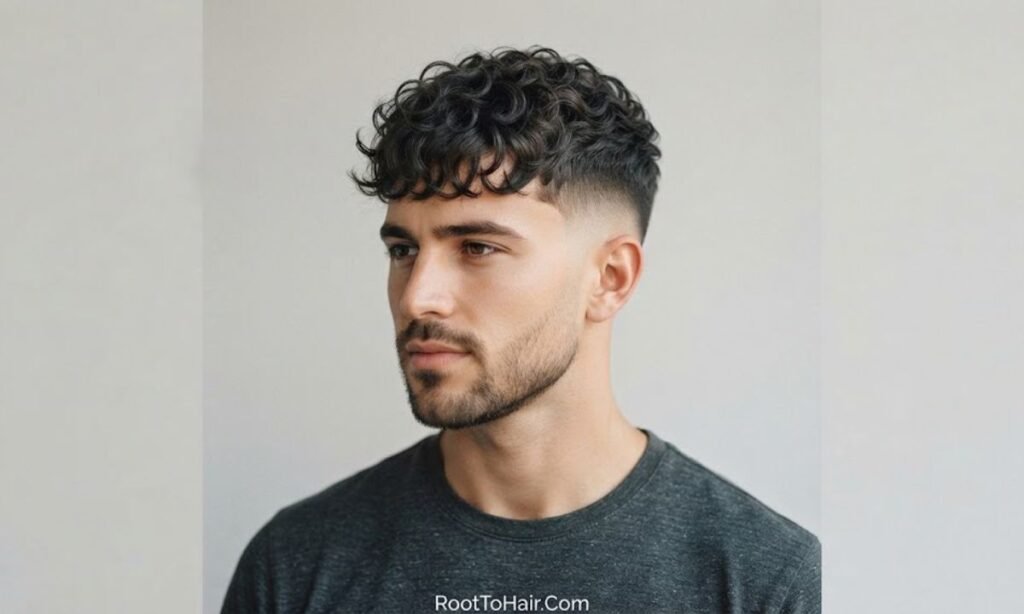
Curls fall forward over the forehead while the sides are tapered low. The fringe softens the face and adds a youthful look. The length matters: too short and curls spring up, too long and they get into the eyes. Medium curl types usually handle this best.
Ask your barber: “Leave the front long enough to fall forward, and keep a low taper on the sides.”
Care: Style curls forward using a curl cream and let them dry in place.
Tip: Cut the fringe dry or check it dry, because curls spring up once they dry.
12. Broccoli Cut with Low Taper Fade
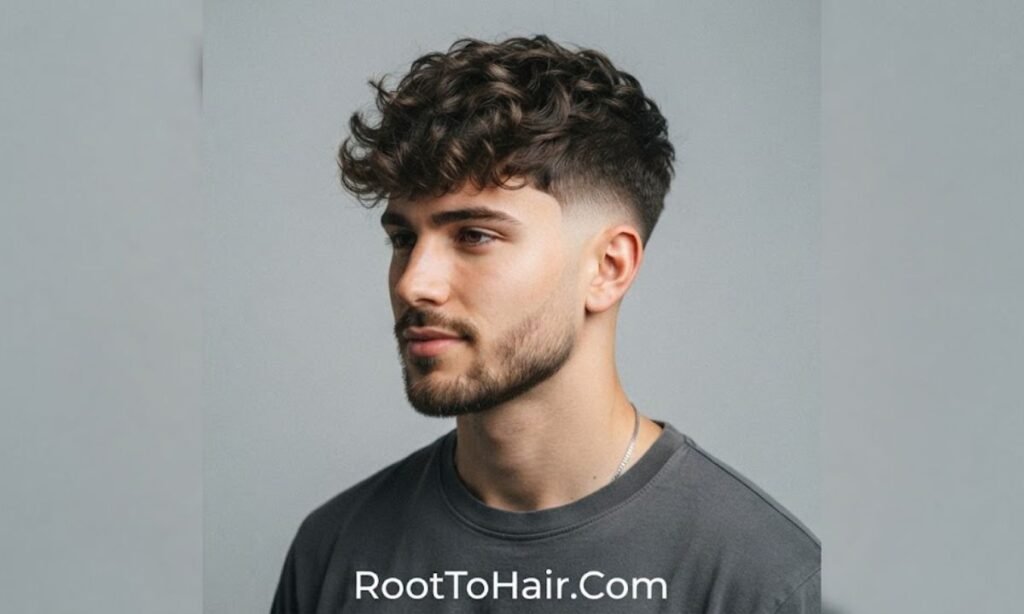
Also called the broccoli cut, this has a rounded mass of loose, bouncy curls on top that resembles a floret. The low taper keeps the sides short and clean, so the top stands out more. It suits looser curls and thick, springy hair.
Ask your barber: “A rounded curly top like a broccoli cut with a low taper on the sides.”
Care: Use a lightweight mousse and diffuse for lift and bounce.
Tip: Keep the shape rounded by trimming evenly around the top.
13. Textured Curly Fringe with Low Taper
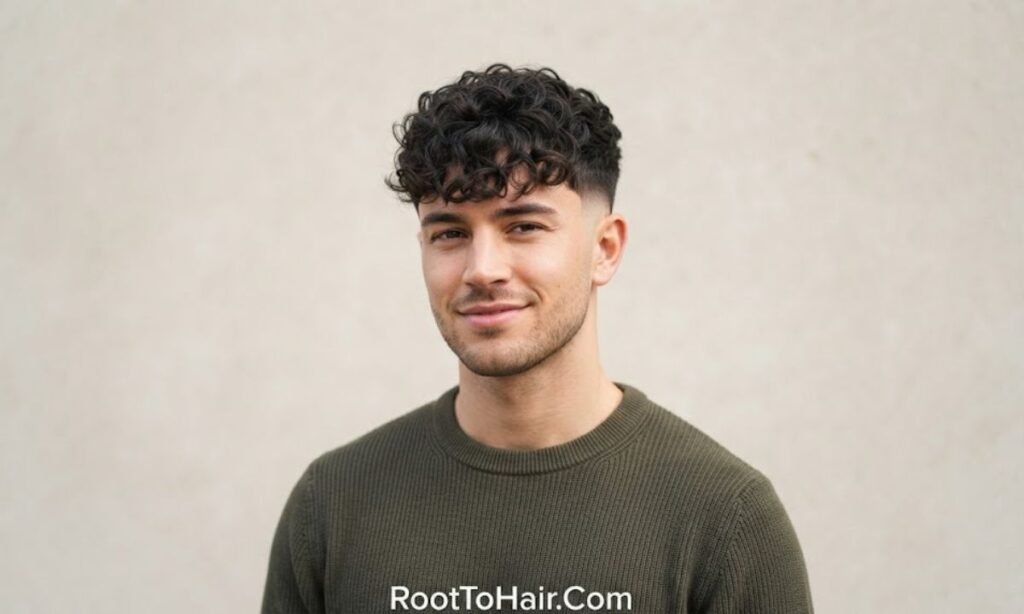
Here the fringe is cut with texture, so the ends look uneven and lived in. It has more movement than a clean fringe and is less structured. It works well on wavy to medium-curly hair and can hide uneven curl patterns.
Ask your barber: “Add texture through the fringe so it looks natural, with a low taper at the sides.”
Care: Rake a little paste or cream through the fringe and let it dry loose.
Tip: Avoid heavy gel, which flattens the textured effect.
14. Messy Fringe Low Taper Fade
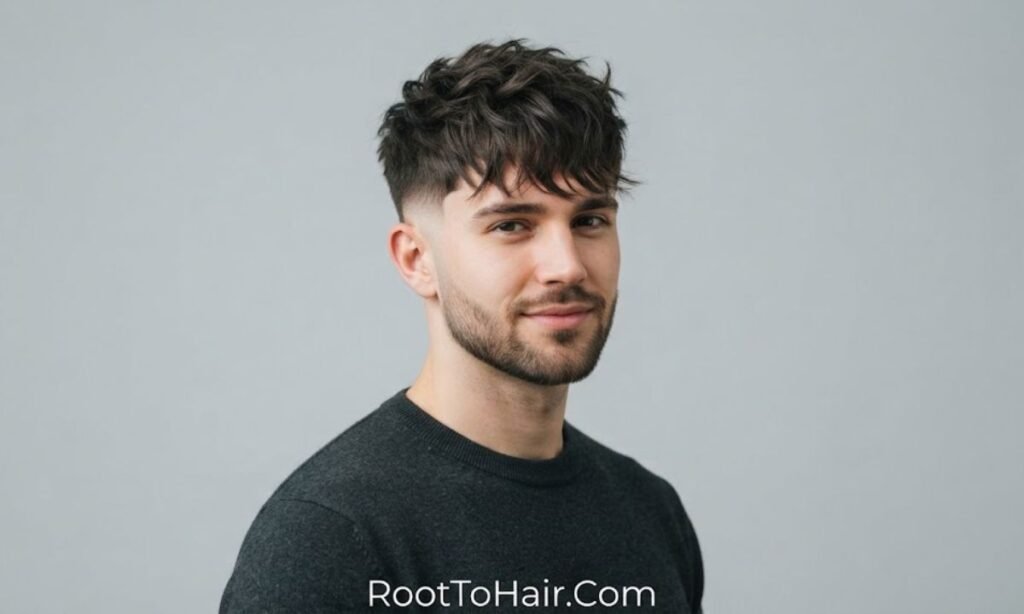
The messy fringe is deliberately undone, with curls pointing in different directions. The low taper keeps the sides neat so the messiness looks intentional. It is relaxed, fits casual style, and requires little precision when styling.
Ask your barber: “Keep the fringe messy and uneven, and a clean low taper around the edges.”
Care: Use a texturising spray or sea-salt spray and scrunch.
Tip: Let some pieces fall naturally instead of forcing them into place.
15. Deep Curly Fringe with Low Skin Taper
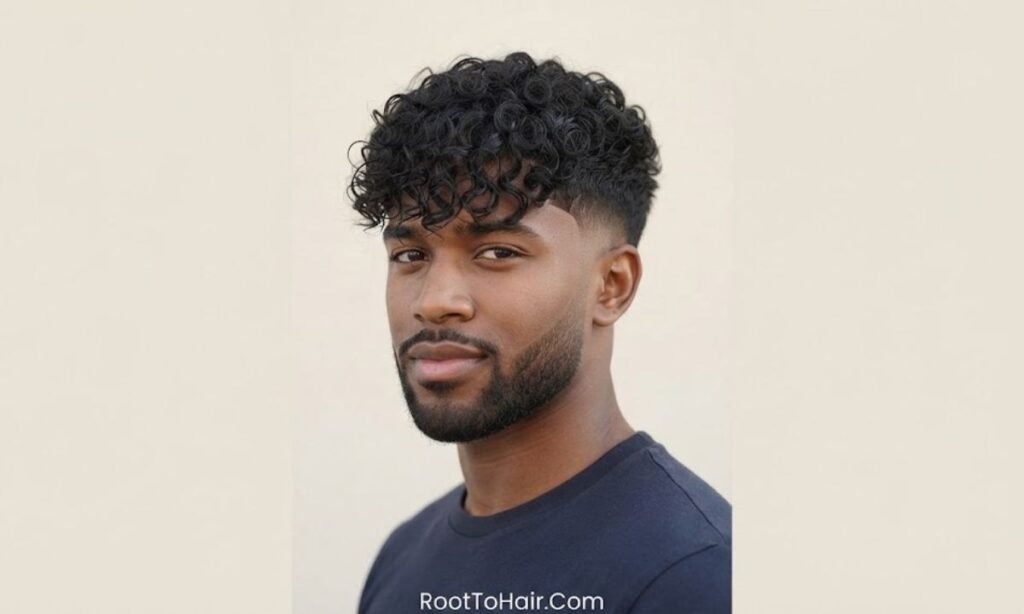
A deeper fringe extends lower on the forehead, sometimes to the eyebrows, with a skin taper for sharp contrast. The long fringe against bare skin makes the shape look dramatic. It suits men with a higher forehead or a longer face.
Ask your barber: “Keep a deep fringe down to my eyebrows and a low skin taper on the sides.”
Care: Keep curls hydrated and trim split ends often since the fringe is prominent.
Tip: Test the length when the curls are dry so it does not end up too short.
16. Side-Swept Curly Fringe with Low Taper
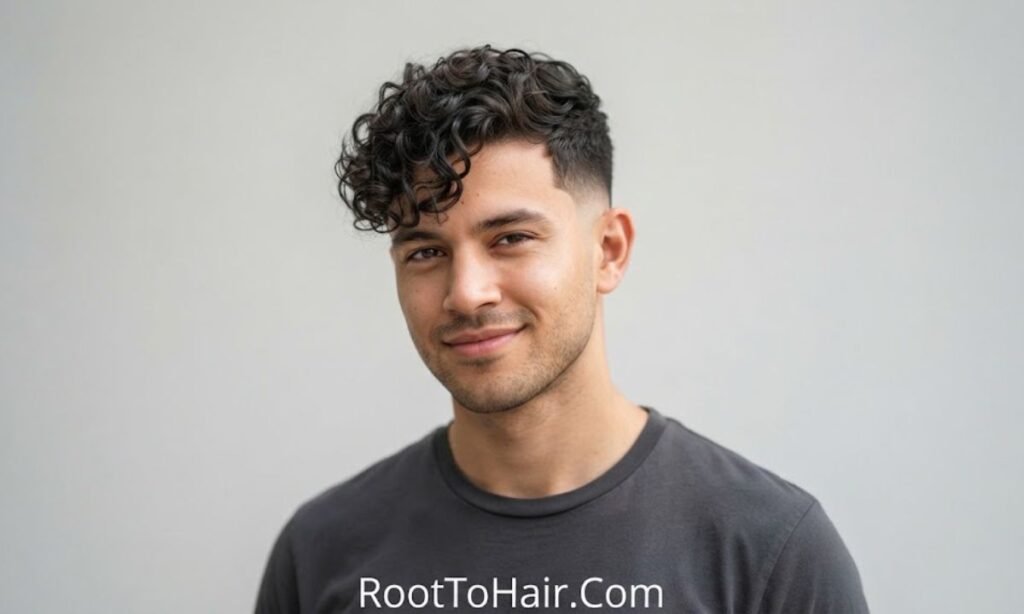
The curls sweep diagonally across the forehead rather than falling straight forward. It shows more of the face than a straight fringe and gives a polished look. A natural parting direction helps the curls stay in place.
Ask your barber: “Sweep the fringe to the side, following my natural parting, with a low taper.”
Care: Style with a curl cream and a light gel, then shape with your fingers.
Tip: Part your hair when it is damp so the direction dries correctly.
17. Curly Curtains with Low Taper Fade
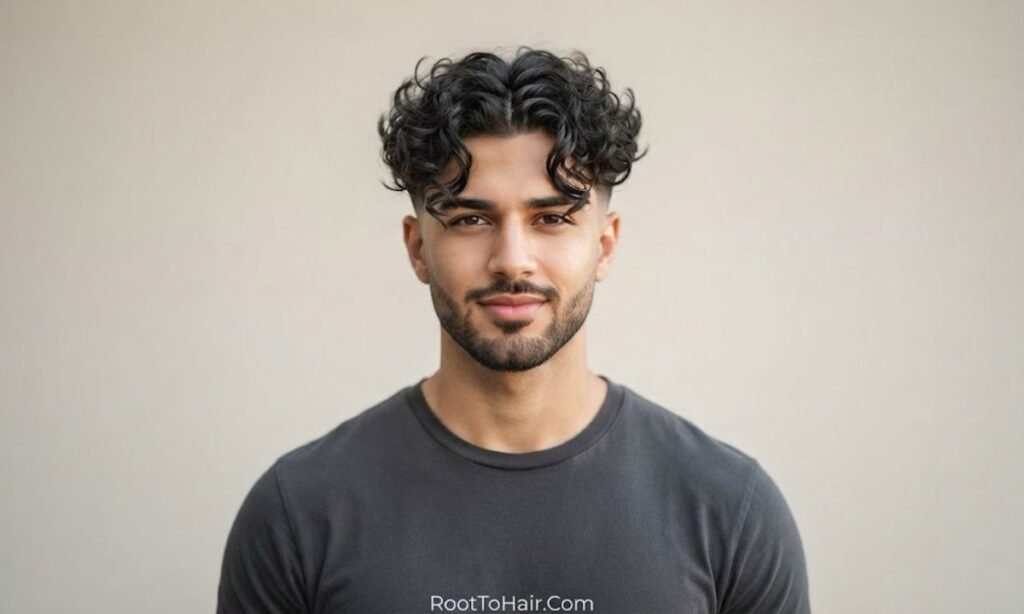
Curtains split the curls at the centre and let them fall to each side. With a low taper, the style looks retro but clean. It works best with loose to medium curls and a crown that grows evenly. Tight coils usually need more length to part cleanly.
Ask your barber: “Curtains parted in the middle with curls falling to each side and a low taper.”
Care: Keep the centre part defined with a comb while the hair dries.
Tip: Check your crown first, because a strong cowlick can pull the part off-centre.
18. Curly Textured Crop with Low Taper
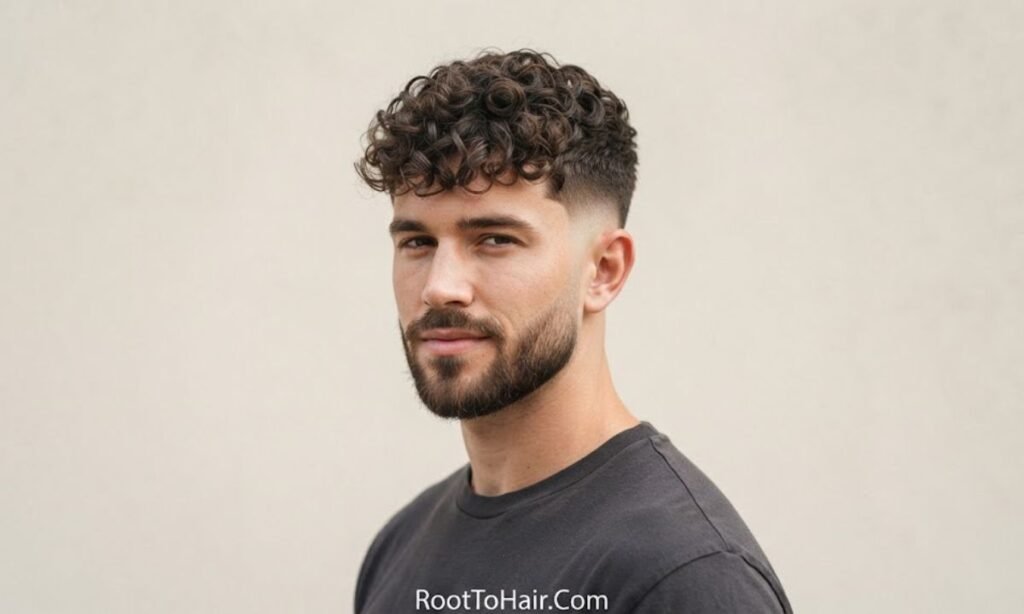
The crop is short and neat, with curls cut to a similar length across the top. It has a structured, modern look and is easy to manage. The low taper gives a gentle finish. It suits tight curls and busy schedules.
Ask your barber: “Short textured crop on top with a low taper around the sides and neckline.”
Care: Use a dab of curl cream and shake out the curls.
Tip: Ask for slight texturising on top so the crop does not look flat.
19. Forward-Styled Curly Fringe Low Taper
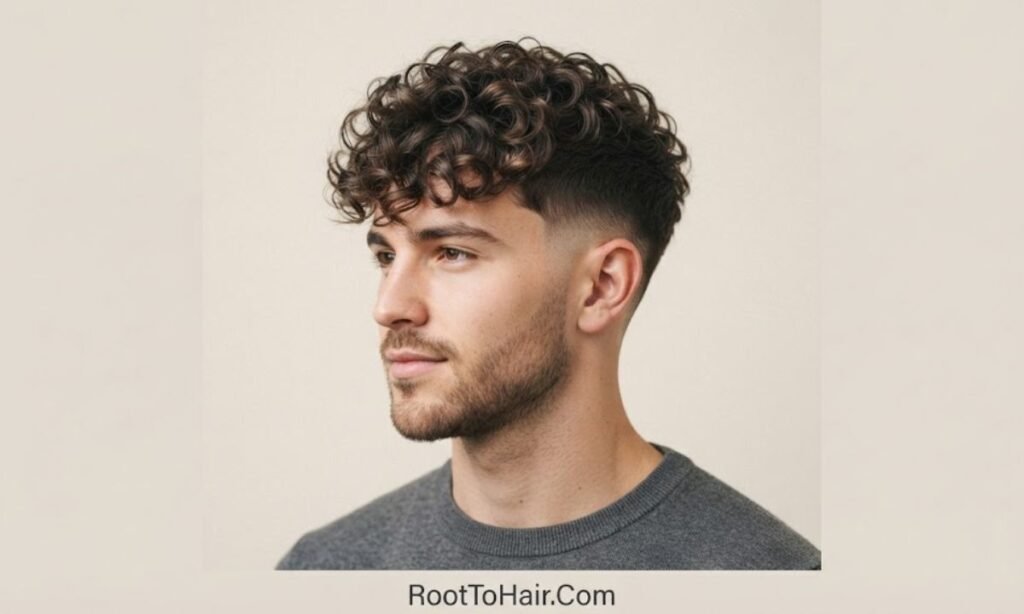
Curls are brushed forward and sit across the front hairline. It can soften a receding hairline visually, in a practical and non-medical way, because the front hair draws the eye away from the temples. The low taper keeps the sides tidy.
Ask your barber: “Keep the front long enough to style forward and a low taper at the sides.”
Care: Apply cream and coax the curls forward while drying.
Tip: Avoid cutting the front too short, or curls will not reach forward.
20. Fluffy Curly Top with Low Taper Fade
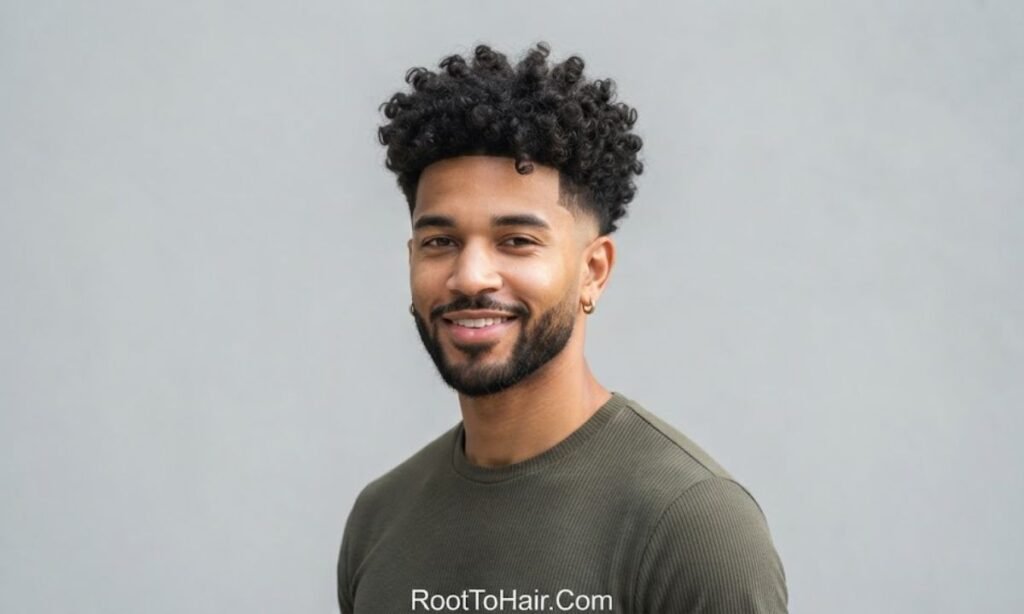
The top is full, soft and airy with a cloud-like shape. The low taper contrasts with the soft top and keeps the edges clean. It works for medium-density curls and wavy-to-curly textures, and it is easier on hair that is not heavily coiled.
Ask your barber: “Keep the top fluffy and soft with a low taper around the edges.”
Care: Diffuse with a light mousse to maximise lift, and avoid heavy products.
Tip: Air-dry the roots lightly before diffusing so the fluff stays soft, not crispy.
Blowout Low Taper Fade Variations
21. Classic Blowout Low Taper Fade
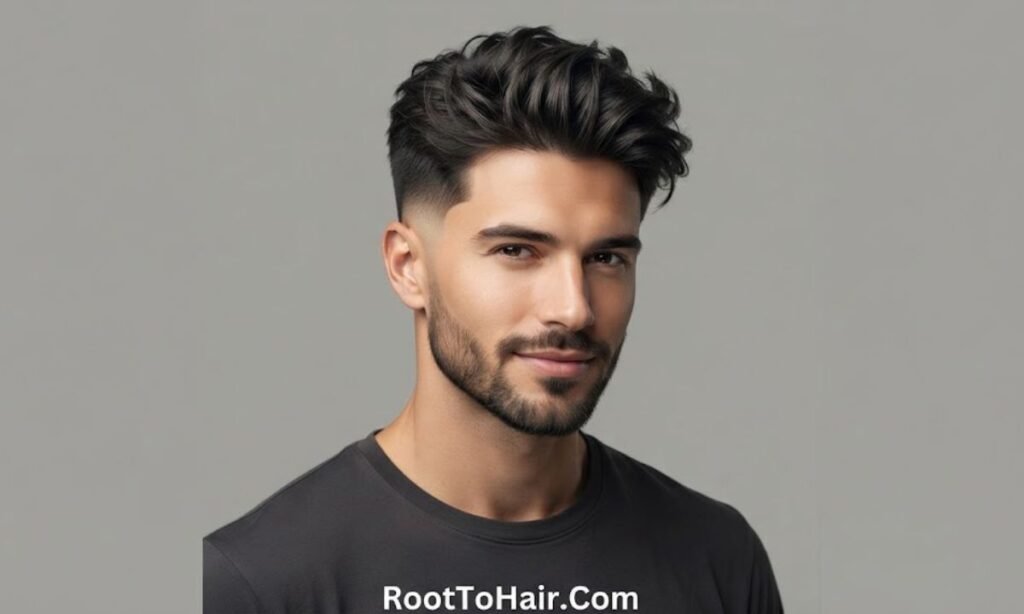
The classic blowout lifts curls upward and outward with a brush and a blow-dryer, creating a full, rounded top. The low taper keeps the sides neat, so the volume looks deliberate. It works on looser curls through to coily hair, though heat styling should be used carefully.
Ask your barber: “Low taper with the top kept long enough to blow out into a full, rounded shape.”
Care: Use a heat protectant, dry on a medium setting and lift from the roots.
Tip: Do not blow-dry bone-dry every time. Give the hair a rest between heat days.
22. Blowout Low Taper Fade with Defined Curl Texture
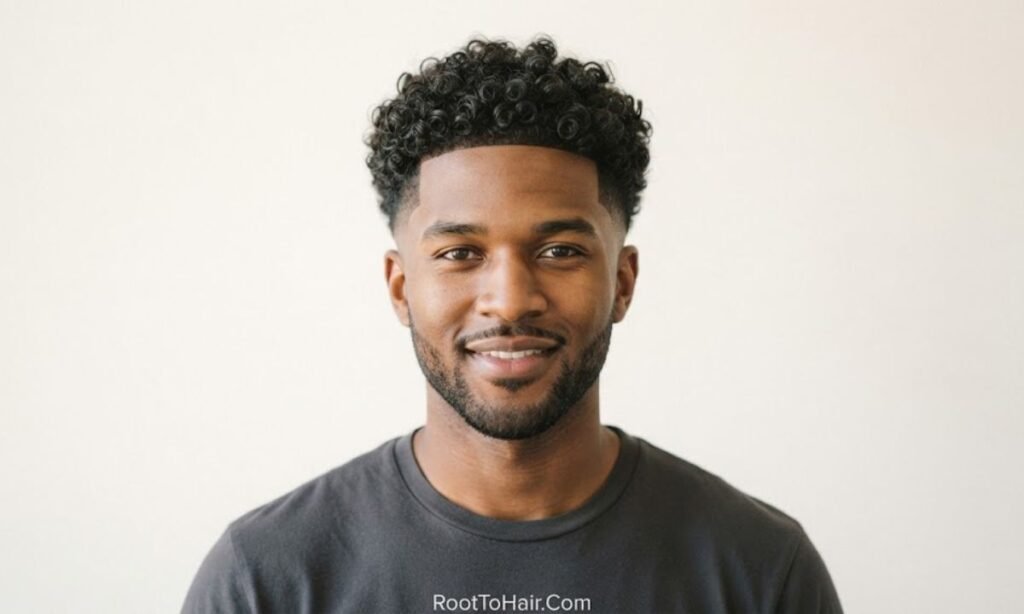
This is a softer blowout, where the volume is kept but the curl pattern is still visible. Instead of fully stretching the hair, it is dried loosely so the curls hold their shape. It is a good middle ground between a smooth blowout and a natural wash-and-go.
Ask your barber: “Blow out the top for volume but leave my curl pattern visible, with a low taper.”
Care: Use a curl cream, then dry on a diffuser and lightly pick out the roots.
Tip: Stop the dryer while the hair is still slightly damp to protect definition.
23. Tapered Blowout with Low Skin Fade
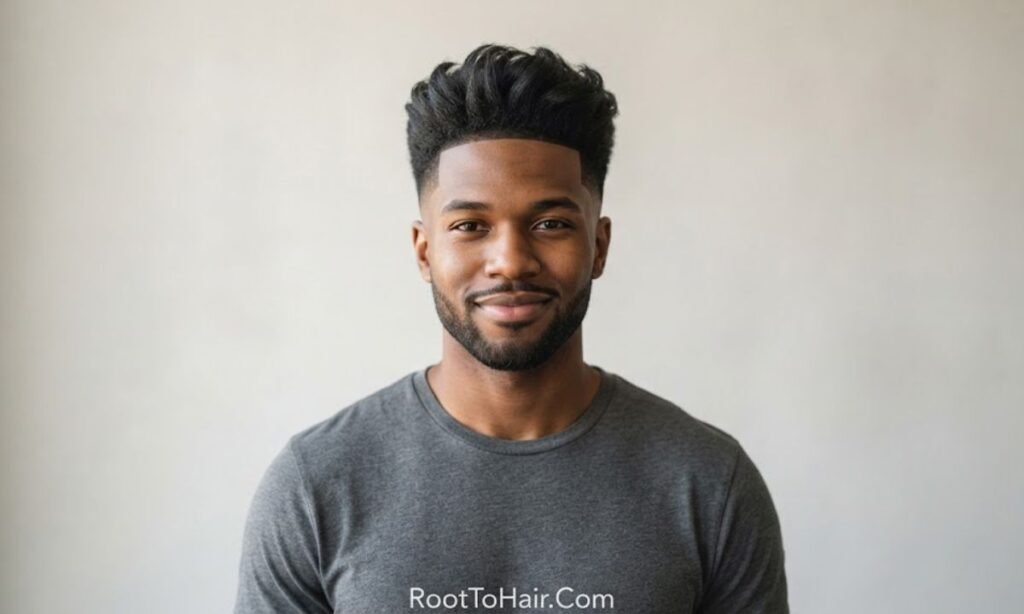
This version pairs the big blowout with a closer, skin-level finish at the edges. The contrast is stronger, which makes the volume look even taller. It is a bold look that needs regular edge-ups to stay crisp.
Ask your barber: “Low skin fade at the edges, with the top left long for a blowout.”
Care: Moisturise the exposed skin areas and keep the top conditioned.
Tip: Plan visits earlier than you would for a softer taper, because the contrast grows out quickly.
24. Blowout Low Taper Fade with Hard Part
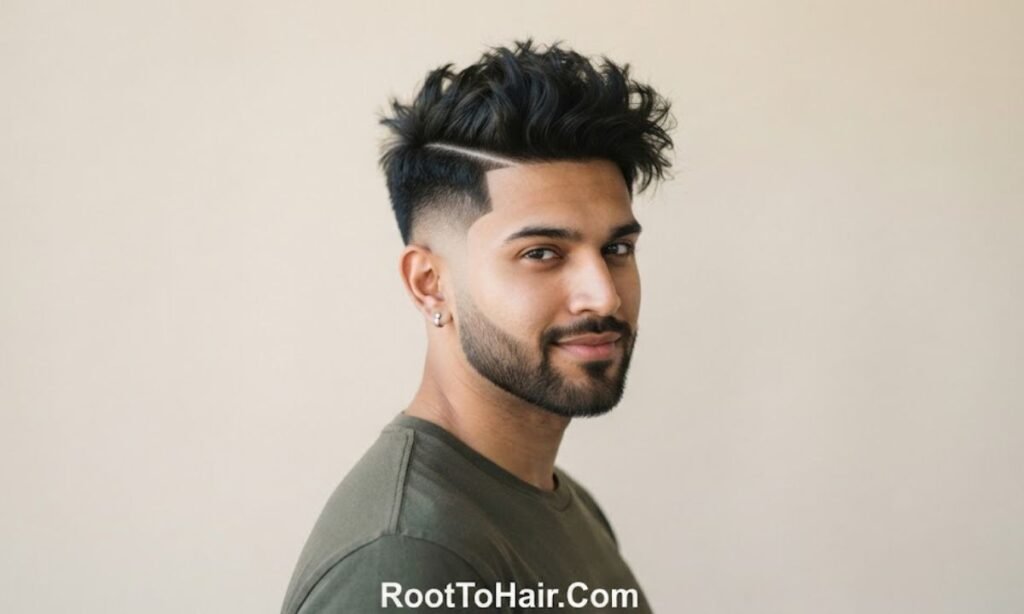
A hard part cuts a sharp line through the blowout, adding structure to the volume. It can look polished and intentional on a big, fluffy top. The part works best when the hair is stretched enough to reveal a clean line.
Ask your barber: “Blowout top with a low taper and a hard part on the right.”
Care: Brush the hair away from the part and set it with a light-hold product.
Tip: Bring a reference photo so the part height and direction are clear.
25. Short Blowout Low Taper Fade
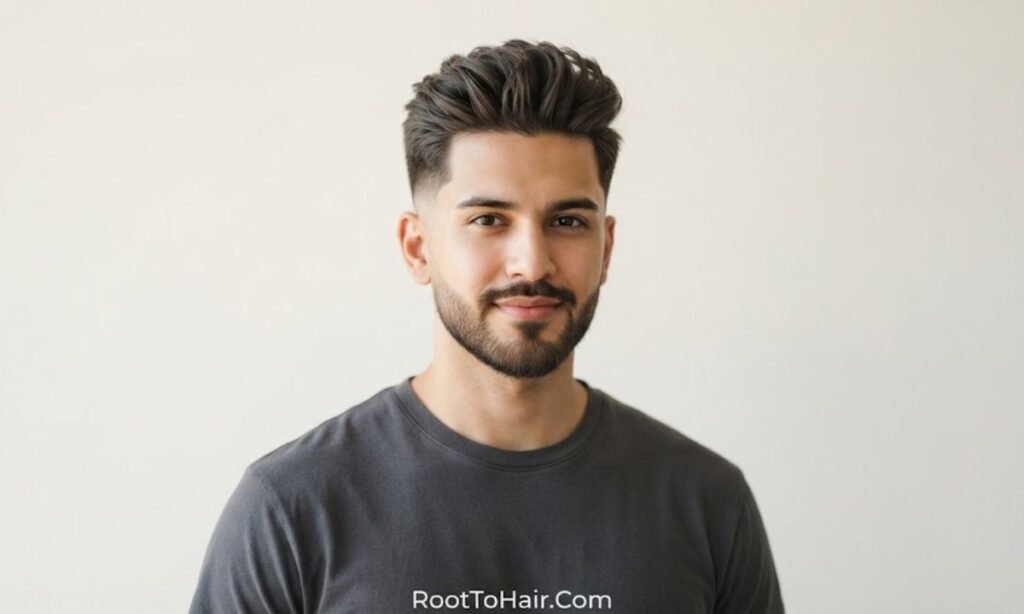
A short blowout keeps the top around two to three inches while still lifting it upward. It is lower-maintenance than a tall blowout and works well for professional settings. Tighter curls give a rounded, compact shape.
Ask your barber: “A short top I can blow-dry upward, with a low taper on the sides.”
Care: Dry in sections with a comb attachment or a pick.
Tip: Do not cut too short, or there will be little to lift.
26. High-Volume Blowout Low Taper Fade
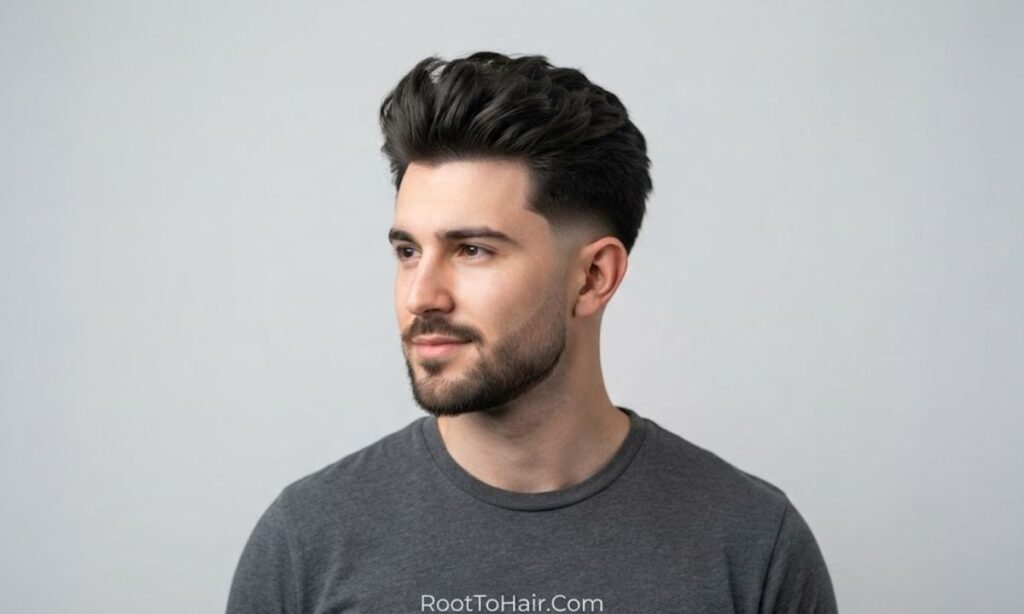
The goal here is maximum height. Longer curls are stretched, lifted and shaped into a tall, dramatic crown. The low taper gives the sides a clean base to support it. It takes time to style and does best with dense, springy hair.
Ask your barber: “Keep the top long for a tall blowout and a low taper that does not remove side bulk.”
Care: Use heat protectant and blow-dry in stages, lifting from the root.
Tip: Work in small sections to avoid frizz and uneven volume.
27. Blowout Taper with Beard Lineup
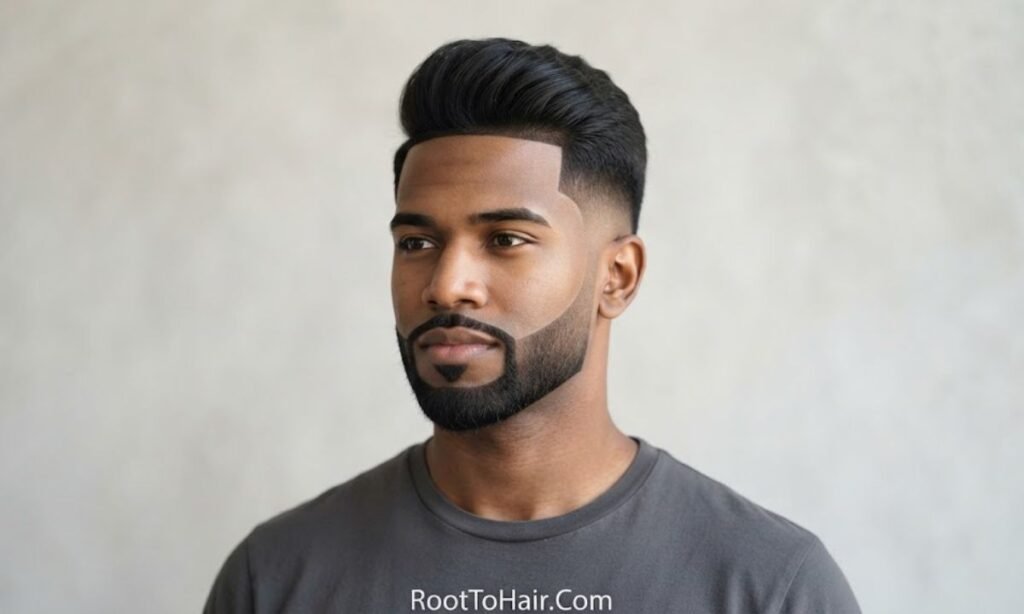
The blowout is joined with a beard that is lined up at the cheeks and neckline. Together they frame the face with sharp lines. The taper should flow into the beard so there is no abrupt change between hair and beard.
Ask your barber: “Low taper blowout with a beard lineup, blended at the sideburns.”
Care: Use a beard oil or balm so the beard looks as groomed as the hair.
Tip: Ask your barber to match the sideburn and beard blend before shaping the lineup.
28. Blowout Low Taper Fade with Drop Fade
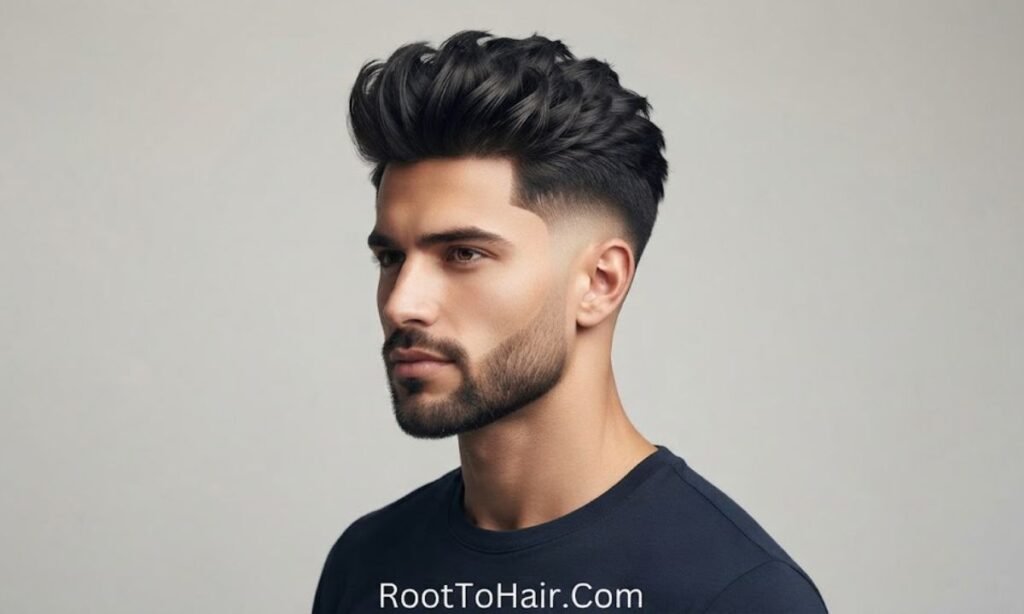
The drop curve behind the ear gives the blowout an angled, flowing outline. It works well for rounded heads and gives a more unique shape than a straight taper. The curve makes the nape look fuller.
Ask your barber: “Drop the taper behind my ear and keep the top long for a blowout.”
Care: Keep the nape clean with regular trims since the curve is visible from the back.
Tip: Look at the cut from the side and back in the mirror before leaving.
Afro & Black Men’s Curly Low Taper Styles
29. Low Taper Fade Afro
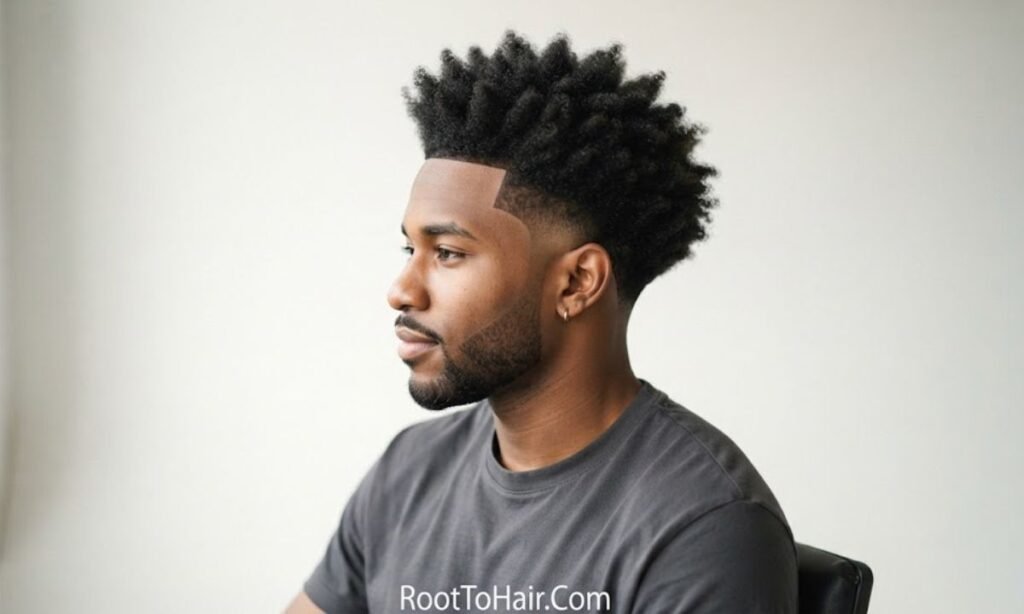
The Afro is a rounded shape of natural coily hair, and the low taper cleans up the sideburns, temples and nape. It keeps the shape intact while adding structure. Length varies from a short, compact Afro to a fuller, larger one.
Ask your barber: “Shape my Afro evenly and add a low taper around the ears and neck.”
Care: Moisturise regularly and pick the Afro out gently to shape it.
Tip: Judge the roundness with your hair stretched, since shrinkage hides the real length.
30. Low Taper Fade with Coily 4C Crown
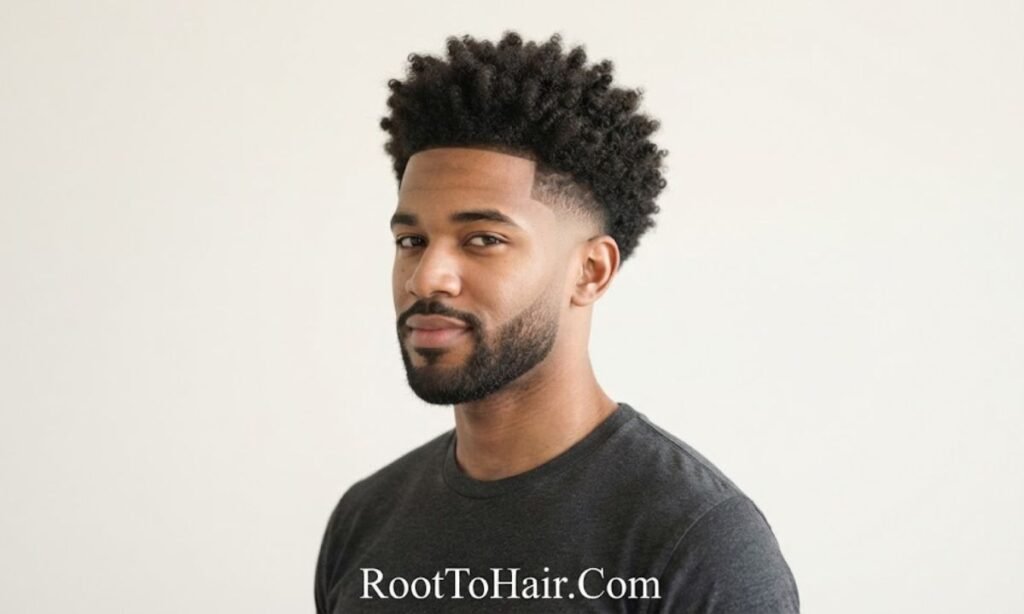
This style celebrates 4C coils at the crown, with a fuller top and a low taper. The coils are usually kept natural, with a light trim to keep the shape even. It suits dense, tightly coiled hair and works well with minimal products.
Ask your barber: “Keep my 4C coils natural on top and apply a low taper at the edges.”
Care: Layer a water-based leave-in, an oil or butter, and a light styler.
Tip: Moisture is the most important step because 4C hair dries out quickly.
31. Curly Afro Low Taper with Hard Part Line-Up
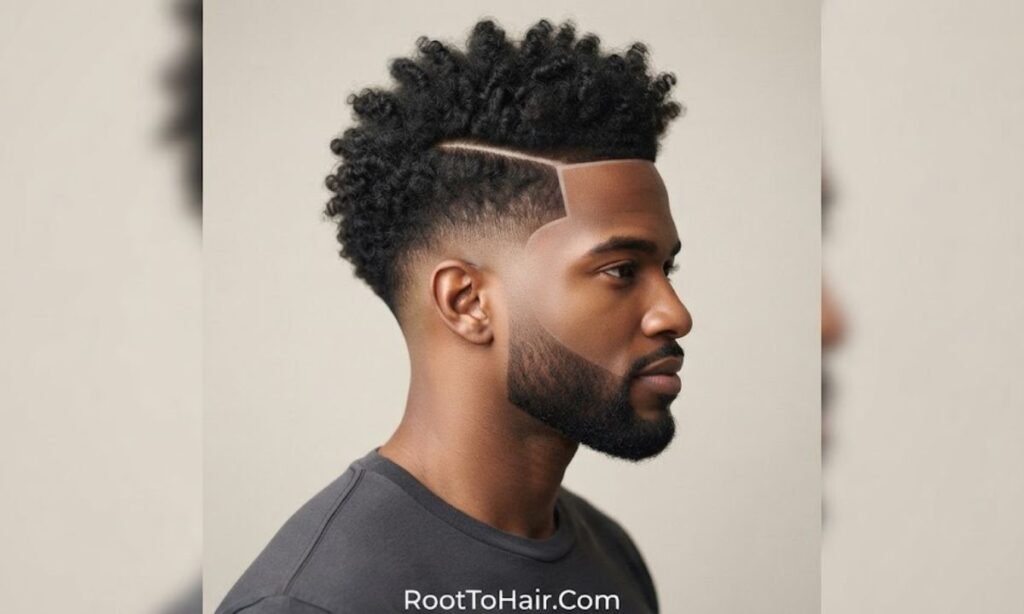
A hard part is carved into the Afro with a crisp line-up at the hairline. It combines a natural shape with clean, sharp lines. It is popular for events and special occasions, but it needs a skilled barber to keep the lines even.
Ask your barber: “Line up my hairline, add a hard part on the left and keep a low taper.”
Care: Protect the lines by wearing a satin cap or scarf when you sleep.
Tip: Do not shave the part into hair that has not been shaped; ask the barber to check the guide first.
32. Low Taper Fade with Twist-Out
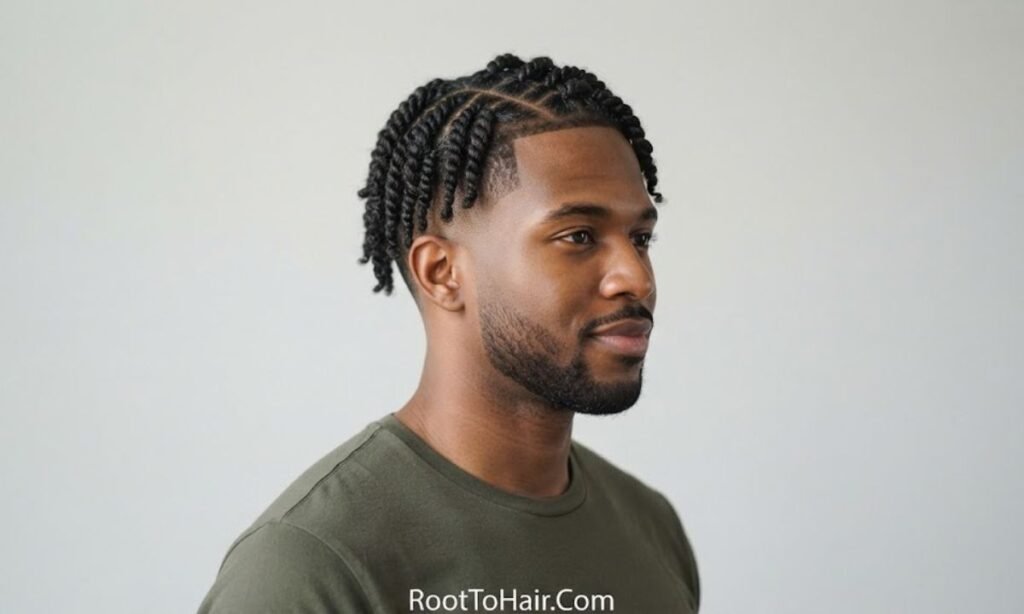
A twist-out is made by twisting damp hair into sections, letting them dry, then unravelling them for defined, stretched waves. Together with a low taper, it makes coily hair look neat but textured. It needs some planning because the twists take time to dry.
Ask your barber: “I will wear a twist-out, so please keep the top long enough, with a low taper.”
Care: Twist on damp hair with a cream, let it dry fully, then separate with oil on your fingers.
Tip: Avoid separating twists until they are completely dry to limit frizz.
33. Low Taper Fade with Wash-and-Go Coils
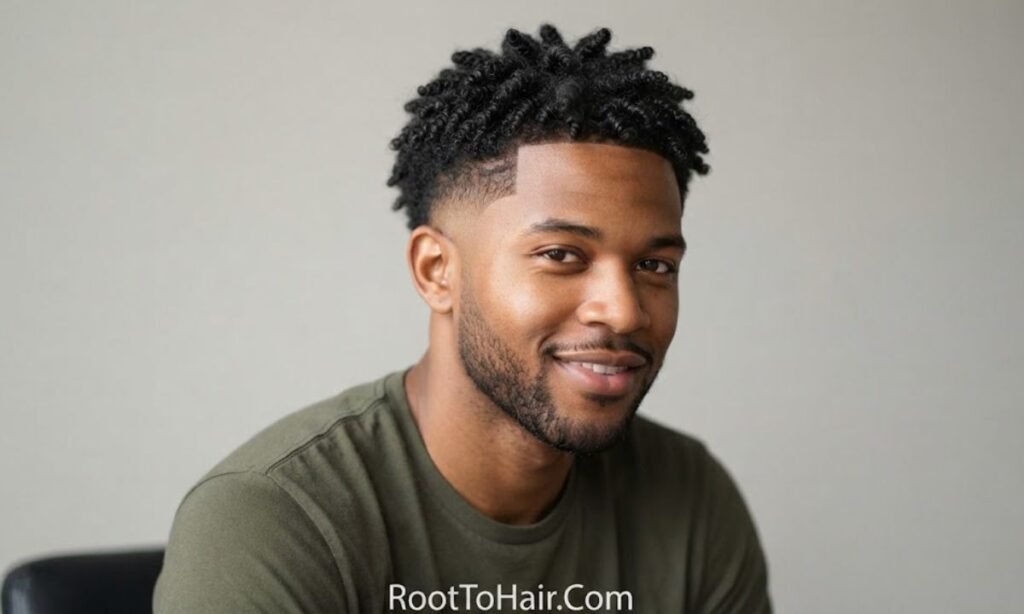
A wash-and-go means washing, conditioning and styling the curls with product, then letting them dry naturally. It is a low-effort method that suits coils. The low taper keeps the sides clean, and the coils stay springy and defined.
Ask your barber: “Low taper and keep my coils long enough for a wash-and-go.”
Care: Style on very wet hair with a curl cream and gel, and let it air-dry or diffuse.
Tip: Rake product through in sections to get even definition.
34. Low Taper Fade with Mini Afro
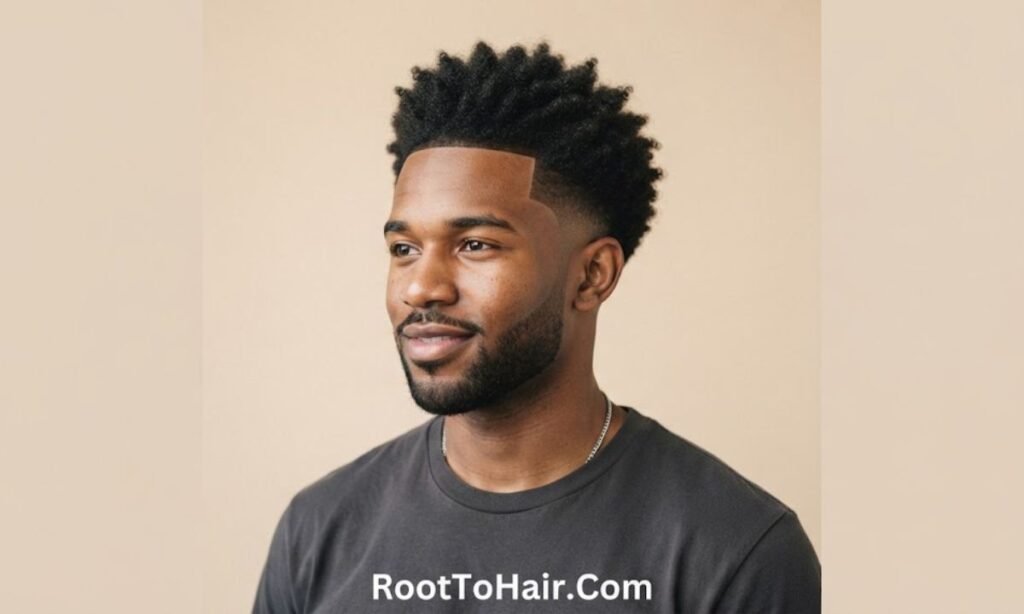
The mini Afro is short, rounded and compact, usually just a couple of inches on top. It looks neat and is simple to maintain. The low taper helps the small shape appear defined instead of fuzzy.
Ask your barber: “Give me a compact mini Afro and a low taper to keep the outline neat.”
Care: Moisturise and pick lightly after washing.
Tip: Shape the outline every few weeks so the round shape stays even.
35. Low Taper Fade with Afro Blowout (Stretched)
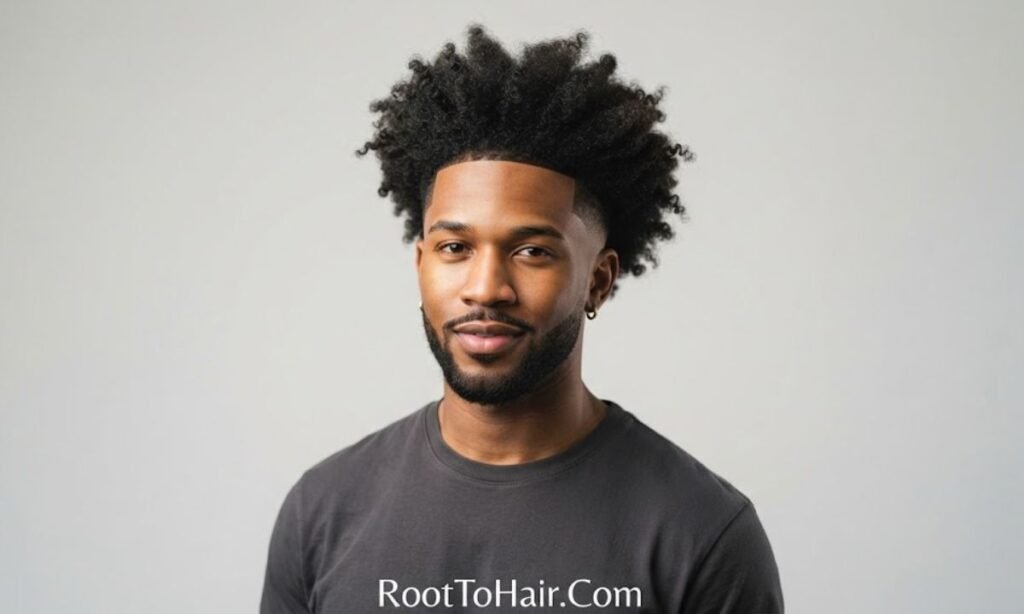
The hair is stretched with a blow-dryer, a comb attachment or other methods, which makes the Afro longer, softer and fluffier. The low taper balances the larger shape. It is not required for everyone, and some people prefer to keep their natural, unstretched texture.
Ask your barber: “Low taper and a stretched Afro blowout. Please tell me how much length it will show.”
Care: Use a heat protectant and keep heat on a moderate setting.
Tip: Let the hair cool before picking it out to keep the stretch.
36. Low Taper Fade with High-Top Afro Curls
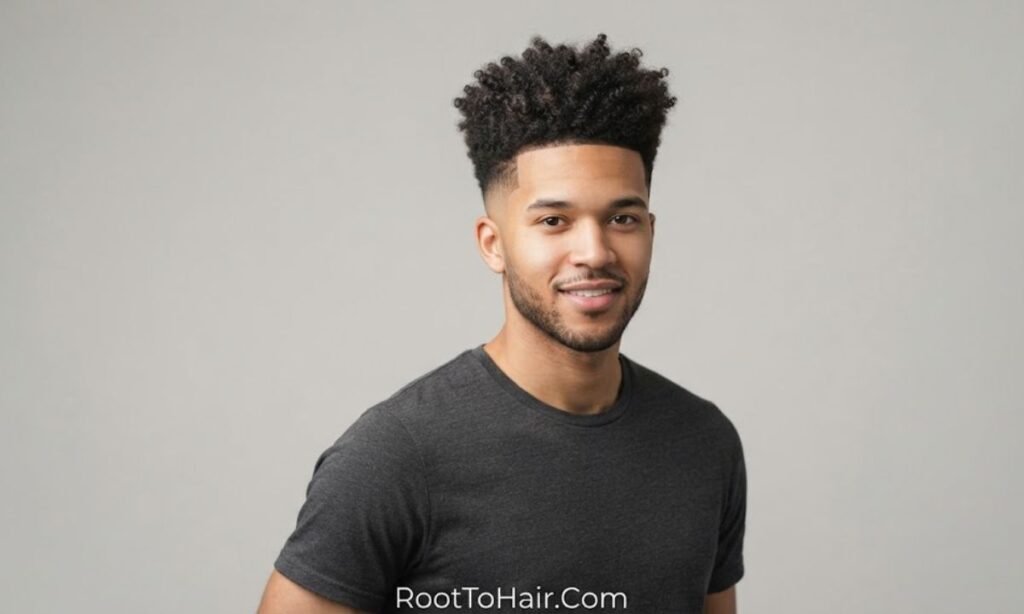
The top is grown tall and flat or rounded, like a high-top. The low taper leaves plenty of side bulk and gives the shape a firm base. The look is bold and retro-inspired. It needs sufficient growth and regular shaping.
Ask your barber: “Keep the top tall, shape it into a high-top and apply a low taper.”
Care: Pick upward and trim only the edges to maintain height.
Tip: Let the top grow before the first shape-up, so the barber has enough length to work with.
Specialty & Hybrid Style Variations
37. Curly Mullet with Low Taper Fade
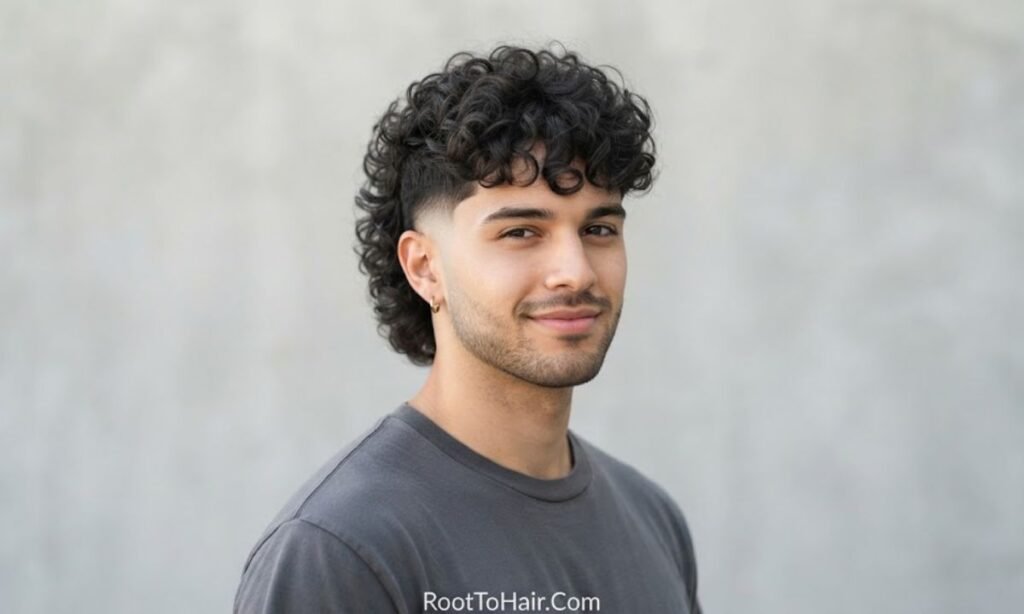
The curly mullet is short on top and sides and longer at the back. A low taper keeps the sides tidy, while the back curls flow longer. It suits wavy to 3C hair that has enough movement. Very tight coils can work too, but the shape will be more compact.
Ask your barber: “Curly mullet with a low taper on the sides and longer length at the back.”
Care: Condition the back lengths well because they are older and drier.
Tip: Decide in advance how long you want the back, so the barber does not remove too much.
38. Curly Man Bun with Low Taper Fade
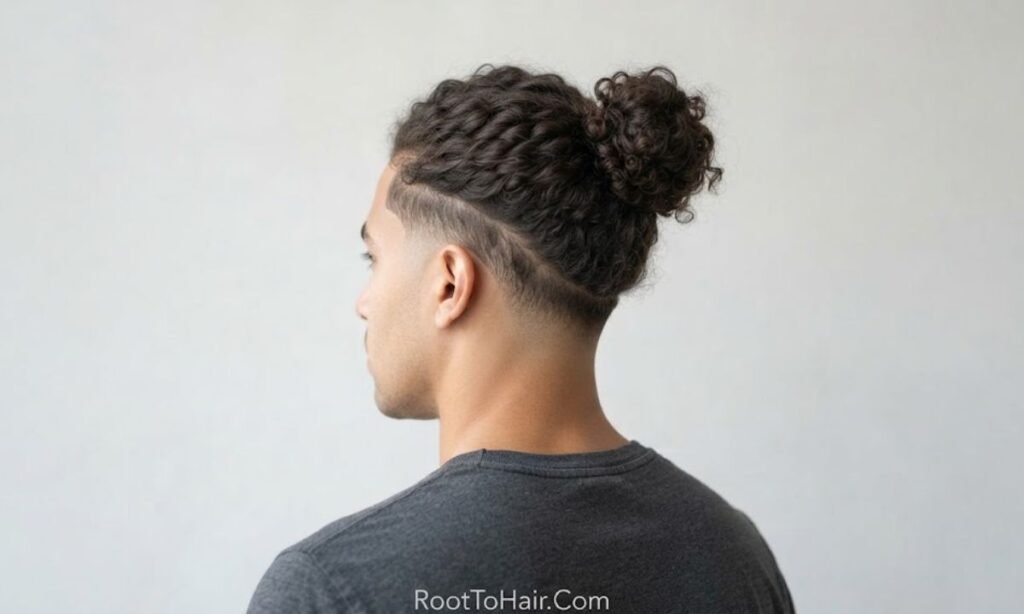
Longer curls on top are gathered into a bun, and the low taper keeps the sides and neck neat. It is a practical way to wear long curly hair. Tighter coils may need more length to tie up, while looser curls tie more easily.
Ask your barber: “Keep the top long enough for a bun and a low taper on the sides.”
Care: Use a soft hair tie and loosen the bun regularly to avoid tension.
Tip: Vary the bun position so the same hair is not pulled all the time.
39. Curly Comb-Over with Low Taper Fade
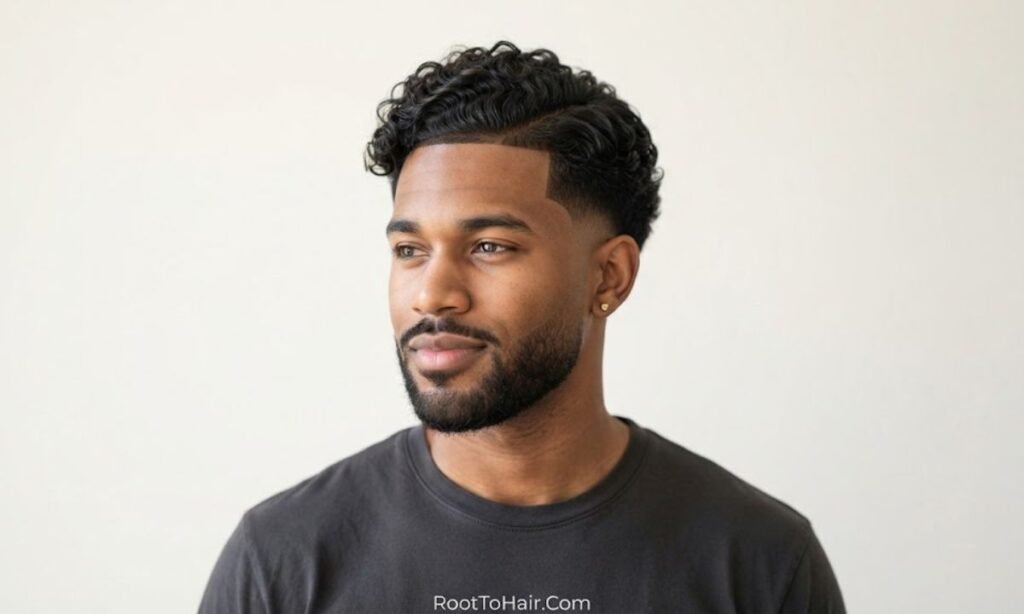
Curls are combed across to one side to create a neat, professional look. The low taper keeps the sides smooth. Curls can resist combing, so gel or cream usually helps. Waves and loose curls respond better than very tight coils.
Ask your barber: “Comb-over with a defined side part and a low taper, with the curls kept soft.”
Care: Comb gently with a wide-tooth comb while damp and use a light gel.
Tip: Start with a hard part guide so the comb-over has a clear direction.
40. Edgar Cut with Low Taper Fade Curly Hair
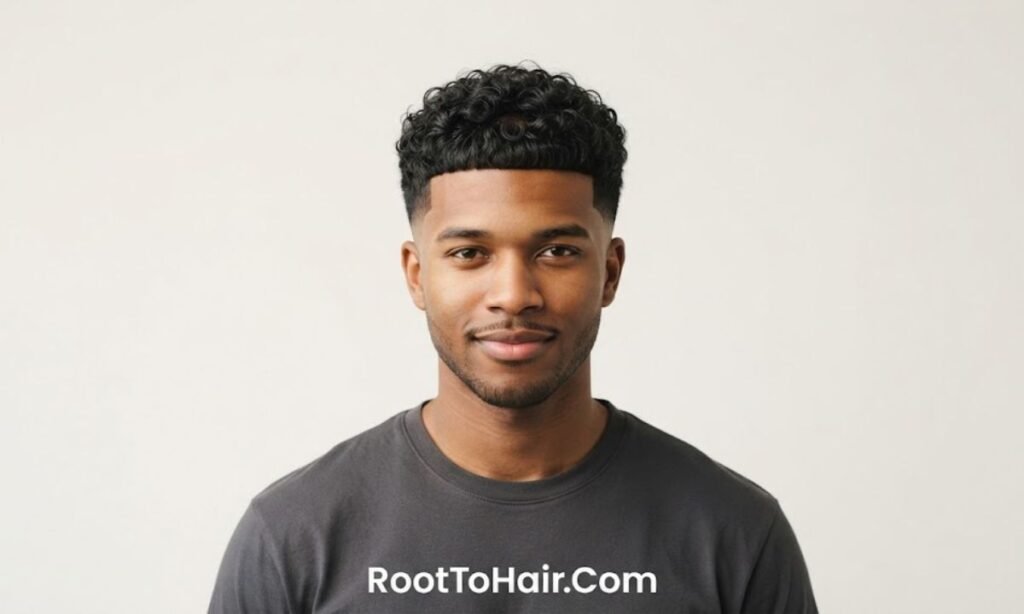
The Edgar cut has a straight, blunt fringe cut across the forehead. On curly hair, the fringe looks thicker and blockier. The low taper keeps the sides tight. It is very sharp-looking, but it is easy to cut too short if curls spring up, so communication matters.
Ask your barber: “Edgar cut with a straight fringe. Leave extra length because my curls shrink.”
Care: Use a light gel to keep the fringe edge crisp.
Tip: Ask the barber to cut the fringe dry or check it dry for accurate length.
41. Curly Pompadour with Low Taper
The pompadour sweeps the hair up and back from the forehead into a tall, curved shape. Curls add natural volume, so the style needs less backcombing. A low taper keeps the sides neat. It works best on medium-length curls and moderate density.
Ask your barber: “Keep the top long for a pompadour, with a low taper on the sides.”
Care: Blow-dry the front upward and set with a flexible-hold product.
Tip: Avoid very stiff products that turn curls rigid and crunchy.
42. Low Taper Fade with Curls and Beard
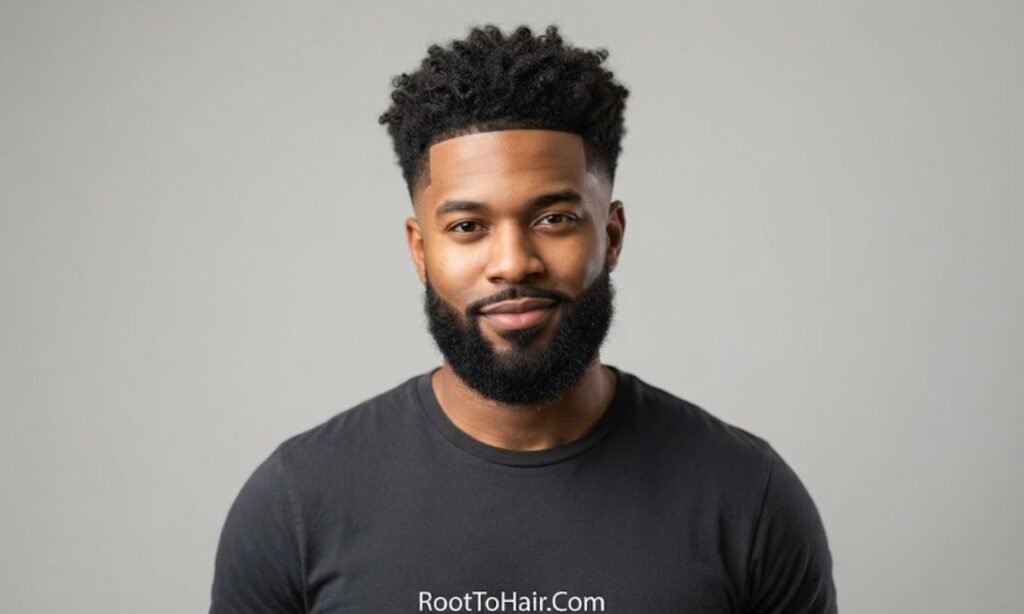
A beard adds structure to curls and balances the volume on top. The taper should flow into the sideburns and then the beard so there is no sharp break. Beard length, thickness and shape can be adjusted to suit your face.
Ask your barber: “Low taper blended into my beard at the sideburns, with curls left natural on top.”
Care: Wash and condition both beard and hair, and use beard oil.
Tip: Keep the beard in proportion with the hair. A very full beard with short curls can look unbalanced.
43. Low Taper Fade with Curly Locs
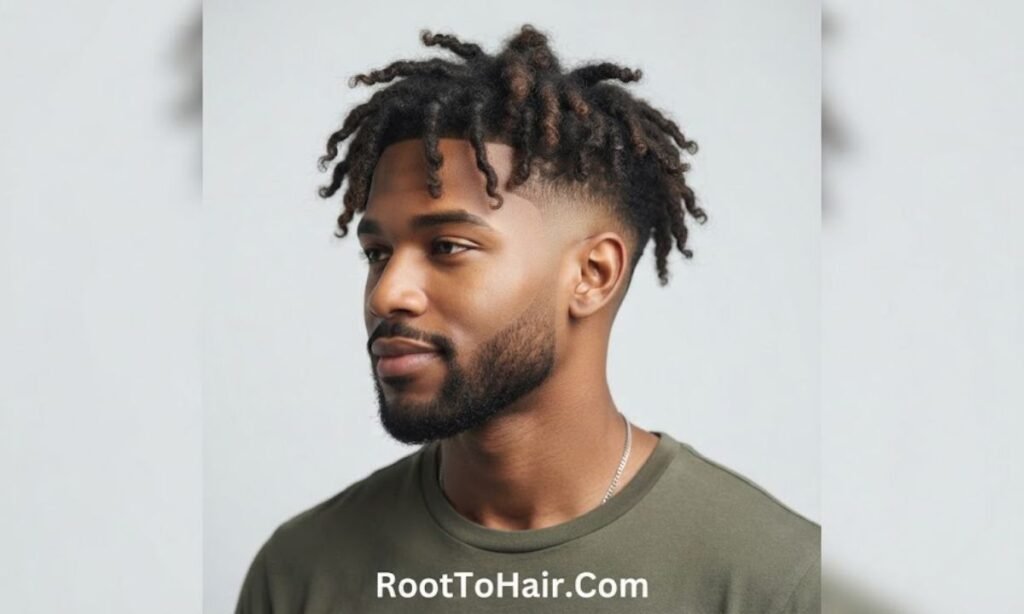
Locs are sections of hair that have matured into rope-like strands. The low taper keeps the sides and neckline fresh while the locs stay long or medium. This style is a mix of a long-term hair choice and regular grooming, and it suits dense, coily or curly hair that can form locs.
Ask your barber: “Keep my locs and add a low taper around the sides and neckline.”
Care: Retwist or maintain locs as advised by a loc specialist and wash with residue-free shampoo.
Tip: Locs are a long-term commitment, so speak to someone experienced before starting.
44. Curly Mohawk with Low Taper Fade
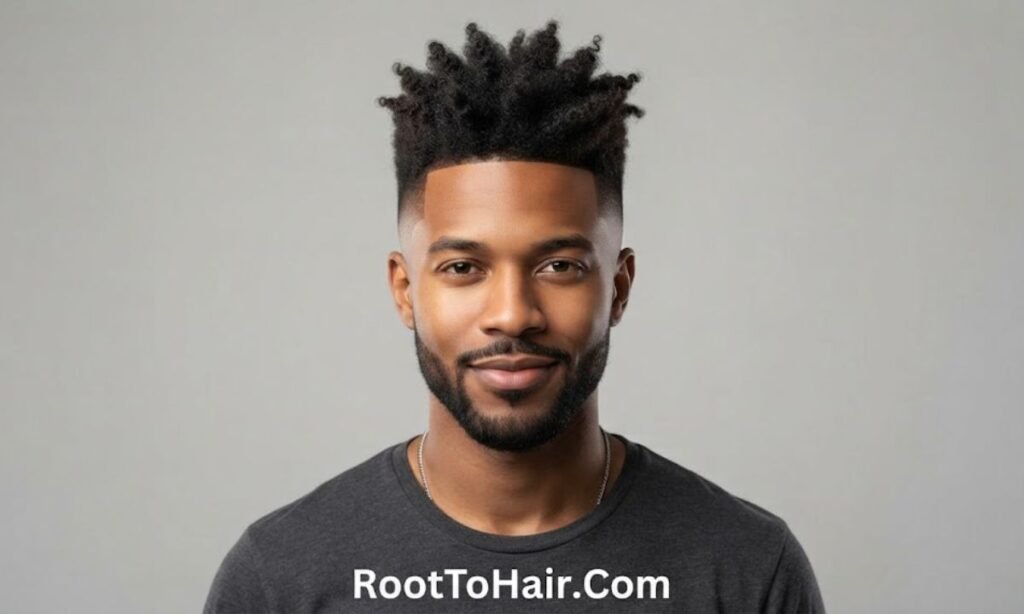
A mohawk keeps a strip of curls running from front to back, while the sides are cut shorter. A low taper gives a softer transition than a harsh shave. It is bold and works with many curl types, but the strip needs enough length to stand up.
Ask your barber: “Curly mohawk with a low taper on the sides, not a hard shave.”
Care: Use a firm gel or cream to lift the centre and define the curls.
Tip: Check how wide you want the strip before the cut.
45. Low Taper Fade with Two-Tone Curly Color
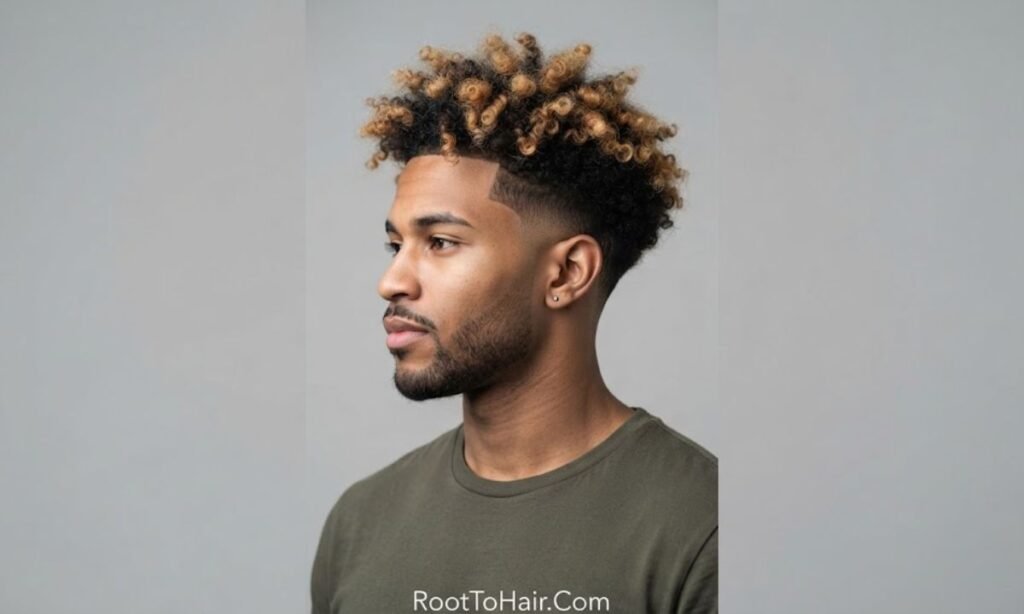
Two-tone colour uses one shade at the root and another toward the ends, or colour on sections of the top. Curls make colour look dimensional, and the taper shows off the contrast. Colouring can dry the hair, so a skilled colourist helps.
Ask your barber: “Low taper with two-tone colour on the top curls. Please keep the sides natural.”
Care: Use colour-safe shampoo and deep condition regularly.
Tip: Do a strand test and discuss damage risks with your colourist.
46. Low Taper Fade with Bleached Curly Tips
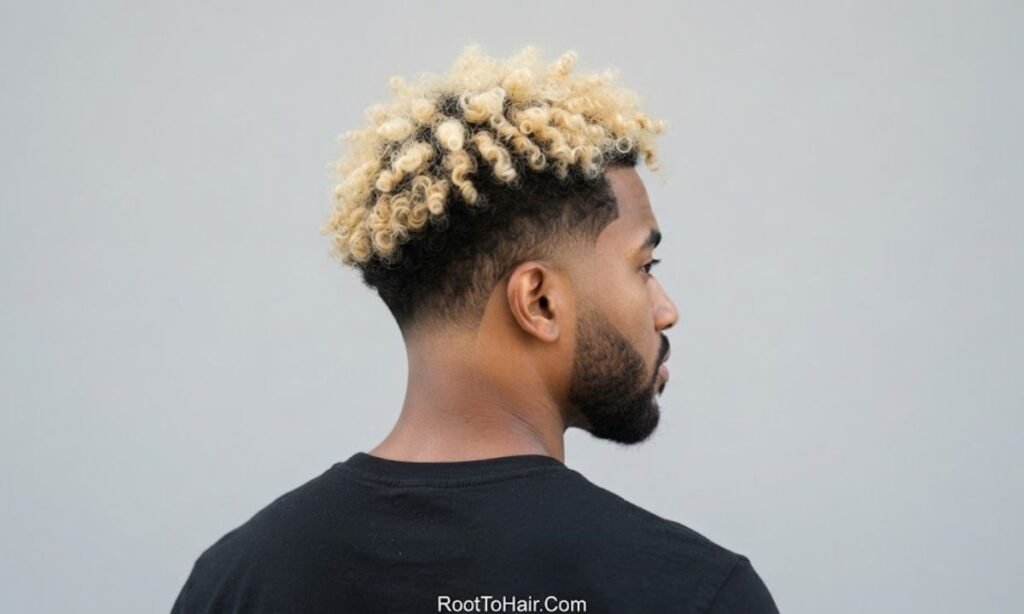
Only the tips of the curls are bleached, which makes them light against darker roots. It is a popular trend, especially on defined curls. Bleaching can weaken curls and dry the hair, so extra moisture is important. Keep the tips light and the roots healthy.
Ask your barber: “Low taper with just the curl tips bleached. I would like to keep the roots natural.”
Care: Use bond-repair treatments and deep conditioners as recommended by a professional.
Tip: Skip frequent heat styling to avoid more damage.
47. Low Taper Fade with Line Design / Carved Part
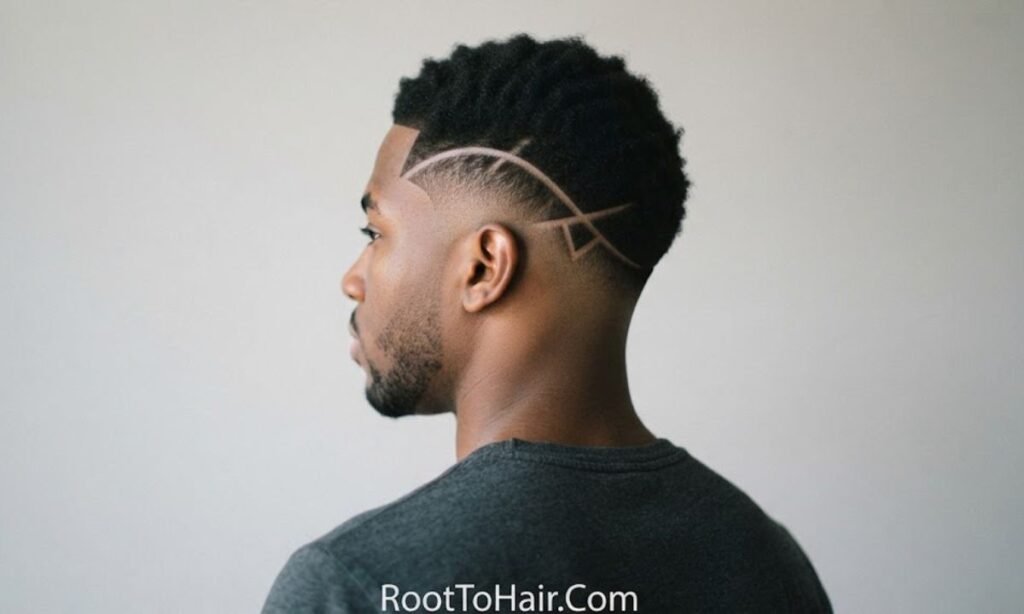
A thin line or small shape is carved into the hair, often near the temple or side. Curly hair can hide fine details, so bolder lines work better. The low taper keeps everything tidy. It is a creative option for men who want a unique detail.
Ask your barber: “Carve a simple line design near my temple and keep a low taper.”
Care: Refresh the lines every couple of weeks, depending on how fast your hair grows.
Tip: Keep the design simple; fine details can disappear in thicker or tighter curls.
48. Curly Undercut with Low Taper
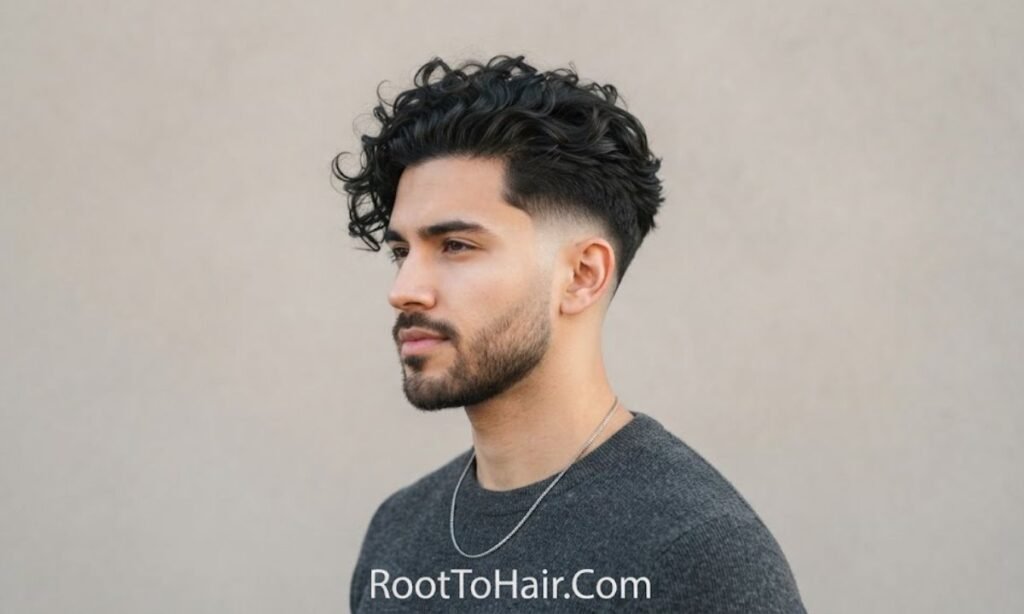
An undercut has a sharp contrast between long hair on top and very short sides. With a low taper, the transition is softened, which can be a good compromise. The curls can sit over the undercut or be pushed back.
Ask your barber: “Undercut with a low taper so the transition stays soft, curls long on top.”
Care: Use curl cream and tidy the sides regularly.
Tip: Be clear about whether you want a hard disconnection or a blended look.
49. South of France with Low Taper and Curly Top
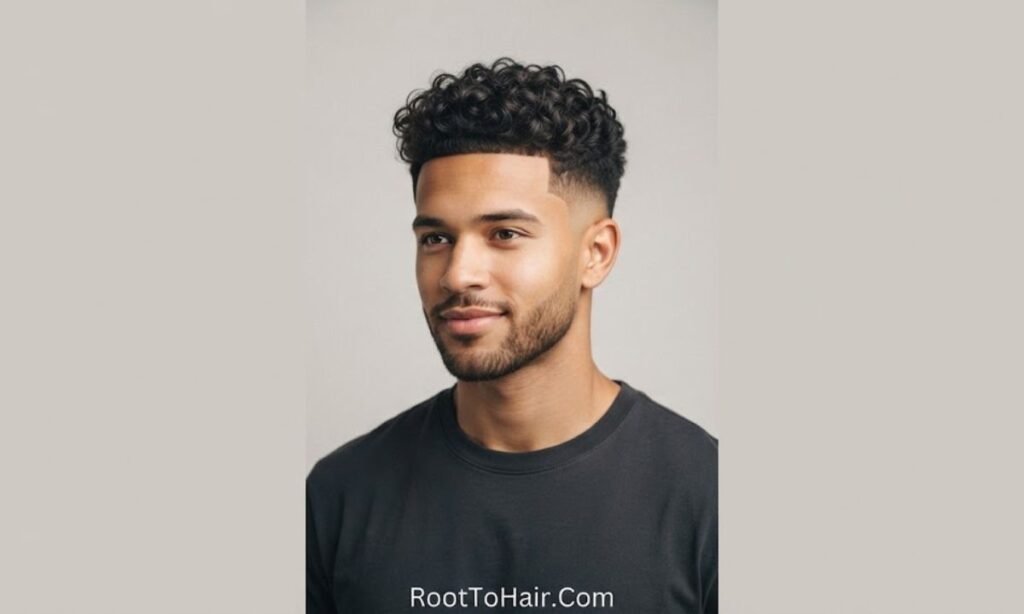
The South of France cut has short sides, a longer top and a slightly textured, brushed-back or forward look that feels casual and Mediterranean. Curls add natural texture. With the low taper, it looks clean but relaxed. It suits wavy to curly hair.
Ask your barber: “South of France style with a low taper and my curls left natural on top.”
Care: Air-dry with a light cream for an easy, tousled look.
Tip: Keep the top slightly messy; styling too neatly loses the relaxed feel.
50. Low Taper Fade with Mixed Texture Curly Hair
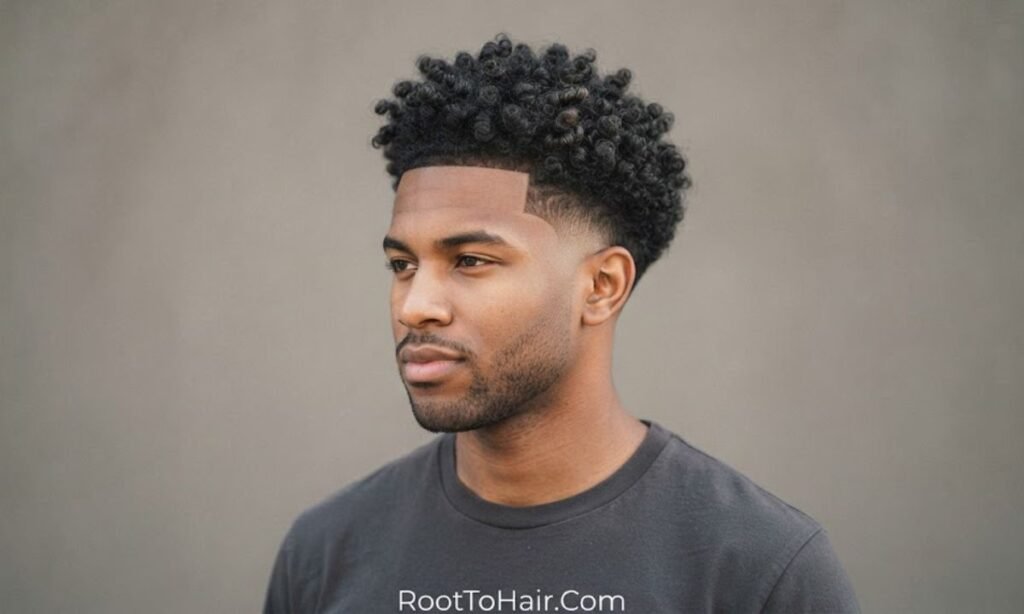
Mixed texture means more than one curl pattern, like waves at the front and tighter curls at the back. Instead of forcing the hair into one pattern, the cut works with both. The low taper keeps it tidy. A barber who understands texture is important here.
Ask your barber: “I have mixed curl patterns. Please cut with my natural growth and apply a low taper.”
Care: Use different amounts of product on different sections.
Tip: Point out where your curls change pattern so the barber can plan around it.
51. Low Taper Fade with Curly Textured Top and Temple Detail
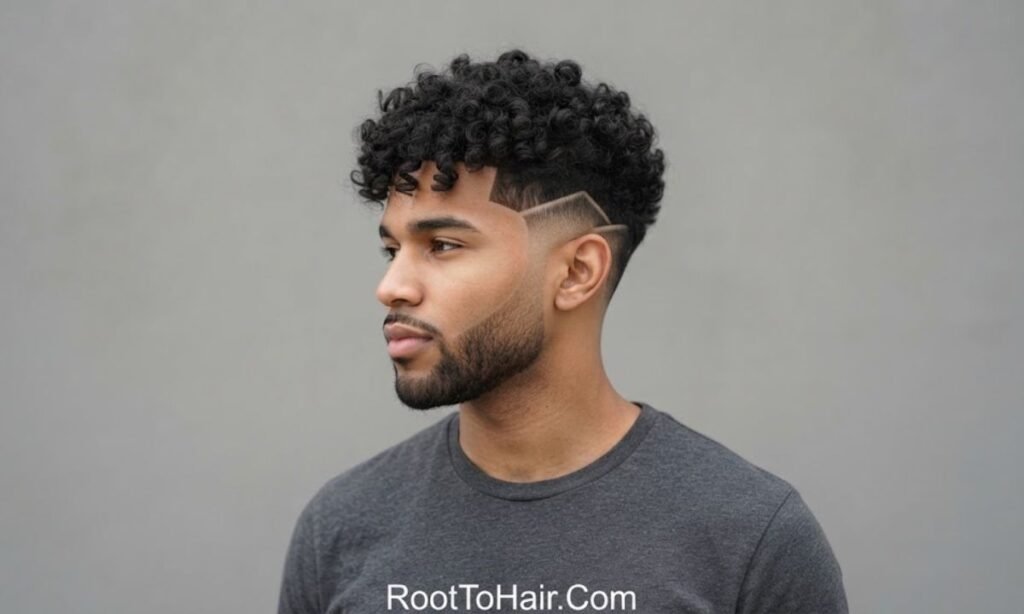
Textured curls on top are paired with a small detail at the temple, such as a slight edge-up or a short line. It is a subtle design that adds polish. The taper blends into the temple, and the top stays soft and natural. It works across most curl types.
Ask your barber: “Textured curls on top, a low taper and a clean detail at the temples.”
Care: Use a light cream on the top and clean the temple area to keep it sharp.
Tip: Keep the temple detail small so it enhances the curls instead of competing with them.
How to Choose the Best Low Taper Fade for Your Curl Type
Start with your curl pattern, then adjust for tightness, density, shrinkage, length and how much time you want to spend styling. Curl type is a general guide only, and many men have more than one pattern. Always judge your own hair, not just the label.
Key points to think through:
- Curl pattern and tightness: Looser waves need more length to show movement. Tighter coils show shape at shorter lengths.
- Shrinkage: Coily hair can shrink a great deal, so the top will look shorter once dry.
- Length: Short tops are easy to manage. Longer tops show more curl pattern but need more care.
- Styling time: Wash-and-go styles take less effort than blowouts or twist-outs.
- Volume: Decide whether you want a compact shape or a big, rounded one.
- Setting: Neater tops and cleaner necklines usually read as more professional. Looser, textured tops feel more casual.
| Curl Type | Suggested Top Approach | Taper Approach | Styling Focus |
| 2A–2C | Medium length to show waves | Soft, low taper | Light texture, avoid weight |
| 3A | Medium length for loose curls | Low, natural blend | Curl cream, scrunch |
| 3B | Medium to long for spirals | Low taper, tidy edges | Definition and moisture |
| 3C | Short to medium dense curls | Low taper, watch bulk | Hydration, frizz control |
| 4A | Short to medium coils | Low taper with clean edges | Gel or cream for coil shape |
| 4B | Short to medium, zigzag pattern | Low taper, allow for shrinkage | Moisture, stretching if wanted |
| 4C | Short or fuller shape | Low taper or soft blend | Heavy moisture, gentle handling |
These are starting points, not rules. Taper height can vary depending on your head shape and how you like the edges to look.
Density Is Separate from Curl Type
The curl pattern describes the shape of each strand. Density describes how many strands you have per area. You can have tight curls with low density or loose curls with high density.
| Hair Density | Recommended Taper Approach | Why It Can Work | Styling Consideration |
| Low Density | Soft, low taper with more length on sides | Keeps sides from looking thin | Use light products, avoid weight |
| Medium Density | Standard low taper | Balanced and flexible | Most methods work |
| High Density | Low taper with controlled side bulk | Helps manage thickness | Section hair, use more product |
Porosity also plays a role in how well hair holds moisture, so two people with the same curl type and density can still need different routines.
Low Taper Fade for Every Face Shape: Your Complete Matching Guide
Top volume and taper placement both change facial proportions. Taller volume adds length to the face, while fuller sides add width. A low taper keeps the sides softer, so it is a flexible base for most face shapes, but the top should be adjusted.
Use the table as a guide, not a rule. Hair growth, hairline and personal taste matter just as much.
| Face Shape | Suggested Taper Approach | Top Style | Why | Consider Avoiding |
| Oval | Standard low taper | Most curly styles | Balanced proportions | Few limits |
| Round | Low taper, slightly closer sides | Height on top, textured crop | Adds length | Very wide, flat tops |
| Square | Soft low taper | Textured fringe or loose curls | Softens angles | Very boxy, blunt cuts |
| Heart | Low taper with some side bulk | Side-swept fringe, medium curls | Balances narrow chin | Very tall tops |
| Diamond | Low taper with fuller sides | Fringe or forward curls | Softens cheekbones | Very tight sides |
| Oblong | Low taper with fuller sides | Curly fringe, shorter top | Reduces length | Extra height on top |
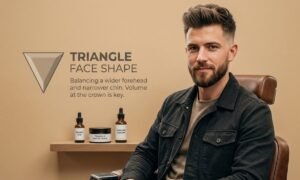
| Triangle | Low taper, keep top fuller | Volume on top, textured crop | Balances wider jaw | Flat, tight tops |
Communicating with your barber: Describe how you want the shape to look, for example: “I would like a bit more height on top and a soft low taper to keep my face from looking longer.” Bring a reference photo when possible.
How to Style a Low Taper Fade with Curly Hair at Home (Step-by-Step)
A simple routine works for most curl types: clean the hair, condition it, apply product to damp hair, shape the curls, dry them gently and finish with a light touch. Adjust the products and amounts to your own texture.
- Wash gently. Use a sulfate-free or gentle shampoo, focusing on the scalp.
- Condition. Apply conditioner through the lengths and detangle with fingers or a wide-tooth comb.
- Keep your hair wet. Style while the hair is still dripping or very damp so curls clump.
- Add leave-in and styler. Use a leave-in conditioner, then a cream or gel.
- Define. Scrunch, rake or finger-coil, depending on your curl type.
- Dry. Air-dry, diffuse or blow out.
- Finish. Once dry, gently break up any gel cast and shape with your fingers.
- Refresh on later days. Lightly mist with water and a little cream, then reshape.
| Styling Method | Best For | Main Benefit | Effort |
| Air Dry | All types, especially defined curls | Least heat, natural look | Low |
| Diffuser | Waves to coils needing definition | Faster drying, more volume | Medium |
| Blowout | Type 3C–4C wanting height | Stretched, voluminous shape | Medium/High |
For a Natural, Effortless Look (Air-Dry Method)
Air-drying uses the least heat and works well if you do not mind waiting. The aim is to limit touching so the curls can set.
- Wash and condition, then leave the hair soaking wet.
- Apply leave-in conditioner from ends to roots.
- Smooth in a curl cream with your hands, then add a light gel for hold.
- Scrunch gently upward to encourage curl clumps.
- Part the hair where you want it, then leave it alone.
- Allow it to dry fully. Do not touch the curls while drying.
- Once dry, break up any hard gel feel by scrunching gently with your hands.
- Fluff the roots softly with your fingers for natural volume.
To control frizz, avoid rubbing with a towel. Use a soft T-shirt or microfibre towel and press the water out.
For a Polished, Defined Look (Diffuser Method)
A diffuser spreads the airflow so curls dry without being blown apart. It gives more definition and root lift than air-drying alone.
- Apply a heat protectant to damp hair, along with your curl cream or mousse.
- Set the dryer on a low or medium heat setting with a low-to-medium airflow.
- Flip your head to the side if it helps, and cup sections of hair in the diffuser.
- Move the diffuser upward toward the scalp for root volume, then turn it off or move away.
- Dry in sections and avoid disturbing curls with your fingers.
- Dry until the hair is nearly dry, then finish with cool air if your dryer has it.
- Gently scrunch out any cast.
Using less heat protects your hair. If your hair feels dry or rough, reduce heat frequency.
For Maximum Volume (Blowout Method: For Type 3C–4C)
A blowout stretches tighter curls so they dry longer and fuller. It is optional, and not every Type 3C–4C head needs to be heat-styled. Many people keep their natural texture.
- Wash and condition thoroughly, then apply a leave-in and a heat protectant.
- Detangle gently and divide the hair into four or more sections.
- Use a comb attachment or a brush on medium heat, pulling each section taut but not harshly.
- Work from the back to the front, lifting at the roots for height.
- Direct the hair upward and outward to build the shape you want.
- Finish with a pick or wide-tooth comb to shape.
- Allow the hair to cool before touching.
Keep heat low where you can, and leave extra time between blowouts so the curl pattern and moisture level stay healthy.
How to Maintain a Low Taper Fade with Curly Hair: The Complete Care Routine
Maintenance has two parts: keeping the edges fresh and keeping the curls healthy. The taper needs regular barber visits, while the curls need hydration, gentle washing, conditioning and protection during sleep.
Key habits:
- Visit your barber when the edges start to look soft.
- Wash with a gentle cleanser and condition after.
- Watch for product buildup, which can make curls look dull or heavy.
- Refresh curls with water and a bit of cream on non-wash days.
- Sleep on a satin pillowcase or wear a satin bonnet or scarf.
Barber Maintenance Schedule
A low taper usually needs less frequent upkeep than a higher fade because the contrast is softer. The areas around the neckline, sideburns and temples tend to show growth first, so those are usually the first to need a refresh.
| Maintenance Area | General Schedule | Why It Matters |
| Barber Visit | Around every 2–4 weeks | Keeps taper and neckline clean |
| Curl Refresh | Every 1–2 days as needed | Restores shape and moisture |
| Deep Conditioning | Weekly or every other week | Supports hydration |
| Product Buildup Check | Every 2–4 weeks | Keeps curls light and defined |
These schedules are general guidance. Hair growth speed, curl type, product use and personal taste will change what you need.
At-Home Curl Care Schedule
There is no single correct routine. This is a simple starting point you can adjust.
- Wash day: About once or twice a week for many people, or less often for very dry or coily hair.
- Conditioning: Condition after every wash.
- Deep condition: Use a mask every week or two if your hair feels dry.
- Midweek refresh: Mist with water, add a little cream, reshape.
- Night routine: Protect your curls with a satin bonnet, scarf or pillowcase.
Common Mistakes to Avoid
- Over-washing: Washing too often can dry out curls. Adjust to your hair and scalp.
- Excessive heat: Frequent high heat can lead to dryness and frizz. Use heat protectant and moderate settings.
- Too much product: Layering too much can leave buildup and weigh curls down.
- Ignoring shrinkage: Curls look shorter when dry. Plan top length with this in mind.
- Cutting without considering natural shape: Curls should be cut with their pattern and growth direction in mind.
- Taking too much off the top: Curly hair can shrink and spring up, so a cut that looks right wet can turn out too short dry.
- Not explaining taper height: Tell your barber exactly where you want the taper to start.
- Using the wrong styling method: A method that suits 3B waves may not suit 4C coils. Choose based on your texture.
What to Tell Your Barber: Low Taper Fade Curly Hair Scripts
Clear communication matters more than the exact clipper setup. Describe the taper height, top length, edge style and finish. A photo helps, but remember that your curl pattern may not match the photo.
| Feature | What to Tell Your Barber |
| Taper Position | “Start the taper low, around my ears and neckline.” |
| Top Length | “Leave enough length for my curls to form.” |
| Curl Length | “My curls shrink, so please cut conservatively.” |
| Temple Area | “Follow my natural temple shape.” |
| Sideburns | “Taper them softly or keep them natural.” |
| Neckline | “Keep it natural or lightly cleaned up.” |
| Finish | “I want a soft, natural finish, not harsh lines.” |
Universal Barber Script (All Curl Types)
“I would like a low taper fade with my curls left natural on top. Please start the taper low, around my ears and neckline, and keep some bulk on the sides. Leave enough length on top so my curls can form their pattern, since they shrink when dry. Blend the temples and sideburns softly, and keep the neckline natural. I would like to style it with curl cream at home.”
Adapt the details to your length, curl type and the finish you want.
Blowout Low Taper Fade Barber Script
“I would like a low taper fade with a blowout on top. Please leave the top long enough for me to blow-dry it upward and keep the sides tapered low. I want volume on top, so please do not remove too much length. Keep the temples and sideburns blended and the neckline clean. Can you show me the best way to style it with a blow-dryer at home?”
Afro / Type 4 Barber Script
“I have Type 4 coily hair and would like a low taper fade. Please shape my Afro or top evenly, and keep the length because my hair shrinks a lot when dry. Start the taper low around my ears and neck. Please be careful with the temples and hairline, and keep the shape rounded. Can you cut it with my natural texture in mind?”
If you wear twists, a wash-and-go or a stretched blowout, tell your barber in advance so the length and shape suit the style.
Key Questions to Ask Your Barber
- Where will the taper start?
- How much length will stay on top?
- How will my curl shrinkage affect the final length?
- Should the neckline be natural or sharper?
- Should the taper follow my temple shape?
- How much bulk should stay around the sides?
- What styling method will work with my curl pattern?
- How often should I come back to keep in shape?
Products Every Man with a Low Taper Fade Curly Hair Needs
You do not need every product. Pick categories based on what your hair needs: moisture, definition, hold, frizz control, heat protection and volume. Start with a leave-in and one styler, then add more if needed.
| Product Type | Main Purpose | Best For | How to Use |
| Leave-In Conditioner | Moisture and detangling | All curl types, especially dry hair | Apply to damp hair after washing |
| Curl Cream | Definition and softness | Waves to coils | Smooth through damp hair |
| Gel | Hold and frizz control | Defined curls, styles needing hold | Apply on wet hair, scrunch |
| Mousse | Light volume and lift | Fine or low-density curls | Apply to damp hair, diffuse |
| Heat Protectant | Heat damage protection | Anyone using a dryer or diffuser | Spray before heat styling |
Other helpful items include a wide-tooth comb, a pick for Afro shapes, a microfibre towel and a satin bonnet or pillowcase.
Check ingredients if you have sensitive skin or scalp, and test new products on a small area first. Heavy butters and oils can suit coily hair but may weigh down finer curls.
Frequently Asked Questions
What is a low taper fade for curly hair?
A low taper fade for curly hair is a haircut where the sides and neckline gradually get shorter near the ears and nape. The curls on top stay longer. It keeps your natural curl pattern while giving the edges a clean, tidy shape, and it grows out more softly than higher fades.
Is a low taper good for curly hair?
Yes, a low taper often works well for curly hair. It keeps volume on the sides while cleaning up the edges, so curls keep their shape. The result depends on your curl pattern, density and top length, so a barber who understands curls can adjust the cut to suit you.
What curl type works best with a low taper?
There is no single best curl type. Waves, 3A to 3C curls and 4A to 4C coils can all work with a low taper. The top length and styling should match your texture. Looser curls usually need more length, while tighter coils can look good shorter.
Is a low taper better than a mid fade for curls?
It depends on the look you want. A low taper is softer and keeps more side volume, while a mid fade gives more contrast. If you prefer a natural outline and easier grow-out, a low taper may suit you. For a bolder look, consider a mid fade.
How often should curly hair with a low taper be trimmed?
Many men visit every two to four weeks, but it varies. The neckline, sideburns and temples usually need refreshing first. A softer taper can look good a little longer than a skin fade. Your hair growth and how crisp you like the edges will decide the timing.
How do I maintain a curly low taper?
Visit your barber regularly for the edges and keep your curls hydrated at home. Wash gently, condition, and use a leave-in or curl cream. Refresh curls with water and a little product between washes, and protect your hair with a satin bonnet or pillowcase at night.
Can Type 4 hair get a low taper fade?
Yes, Type 4 hair can get a low taper fade. A low taper works well with 4A, 4B and 4C hair, particularly for twist-outs, wash-and-go styles, mini Afros or stretched blowouts. Tell your barber about shrinkage so they leave enough length on top.
How long should curly hair be for a taper?
Curly hair usually needs at least an inch or two on top to show its shape, but the right length depends on your curl type. Looser curls often need more length, while tight coils can look good shorter. Remember that curls shrink as they dry.
Can I style a curly low taper at home?
Yes, most men can style a curly low taper at home. Apply leave-in conditioner and a curl cream or gel to damp hair, then air-dry or diffuse. Blowouts take more practice. Use a heat protectant if you use any heat, and keep your routine simple.
Does a low taper make curly hair look thicker?
It can make the top look fuller because the shorter edges create contrast with the curls. Since a low taper keeps more length on the sides than a higher fade, the overall shape stays balanced. How thick your hair looks still depends on density and curl type.
What should I tell my barber for a curly low taper?
Tell your barber where you want the taper to start, how much length to leave on top, and whether you want a natural or sharper neckline. Mention that your curls shrink, and bring a reference photo. Ask what styling method suits your curl pattern.
How do I prevent frizz with a curly taper?
Keep your hair moisturised, avoid rough towel drying and apply a leave-in and cream or gel on wet hair. Do not touch curls while they dry. Use a diffuser on low heat if needed, and sleep with a satin bonnet or pillowcase to protect your curls.
A low taper fade curly hair cut works best when the taper, top length and styling all suit your own texture. Use the styles, tables and barber scripts above as a starting point, and adjust the details to your curl pattern, density and lifestyle.
Conclusion
The best Low Taper Fade Curly Hair style is the one that fits your curl pattern, density and daily routine, not the one that looks best in a photo. A low taper keeps the sides soft and the neckline clean while your curls stay the focus. Whether you wear loose waves, defined ringlets or tight 4C coils, the right top length and styling method make the cut look intentional. Use the curl type, density and face shape guides to narrow down your options before you book.
Good communication with your barber matters as much as the cut itself. Say where the taper should start, how much length to leave for shrinkage, and how you plan to style it at home. Then keep the curls hydrated, refresh the edges when they start to soften, and adjust your routine as you learn how your hair behaves. With these steps, a Low Taper Fade Curly Hair cut can look sharp and stay easy to manage between visits.