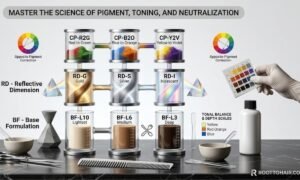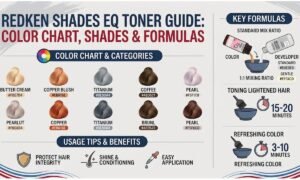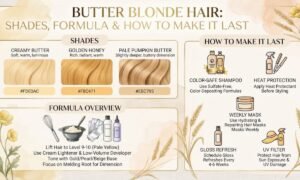
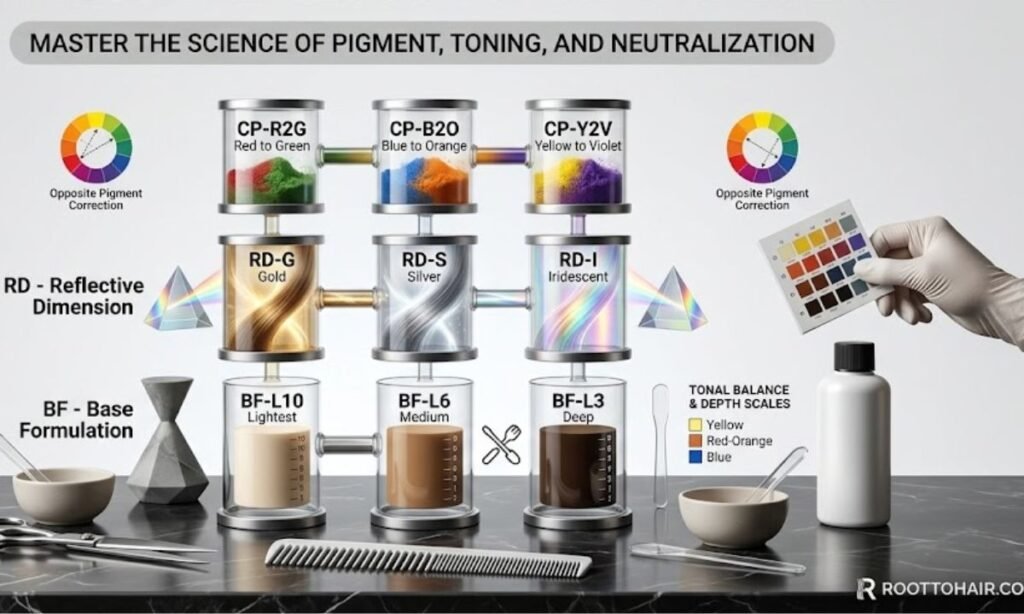
Every great hair color result starts with the same thing: a solid grasp of hair colorimetry basics. Before you pick a shade, a developer or a ratio, you need to know how color theory, hair color levels, underlying pigments and reflect codes work together. Get these right and your hair color formulas become predictable, repeatable and profitable. Get them wrong and you end up with brassy blondes, muddy browns and unhappy clients.
This guide walks you through the full system a professional hair colorist uses: reading the color wheel, identifying natural level, decoding color codes, choosing the right developer volume, neutralizing unwanted tones and building a formula step by step. Bookmark it, share it with your team and use it as your everyday colorimetry cheat sheet.
What is Hair Colorimetry
Hair colorimetry is the science and technique of predicting, mixing and controlling hair color. It combines three things:
- Color theory: how primary, secondary and complementary colors interact.
- Hair biology: how natural pigment (melanin) and underlying pigment behave when lightened or deposited over.
- Product knowledge: how dyes, developers and toners react together on a specific head of hair.
In practice, hair colorimetry answers one question: “What do I need to mix to take this hair from where it is to where the client wants it to be?” A colorist who understands colorimetry does not guess. They diagnose, calculate and formulate.
How Does Color Theory Apply to Hair Colorimetry?
Color theory is the foundation of every formula. The hair color wheel tells you what a tone will do when it meets another tone, which is how you build a shade and how you cancel one out.
Primary Colors
The three primary colors are red, yellow and blue. They cannot be created by mixing other colors, and every other color comes from them. In hair color, primaries are the base of all warm and cool pigments and explain why mixing the wrong two can turn a clean shade muddy.
Secondary Colors
Mixing two primaries gives a secondary color:
- Red + yellow = orange
- Yellow + blue = green
- Blue + red = violet
Secondary colors matter because they are exactly what shows up in the hair when it is lightened: orange and yellow tones are the unwanted “brass” you are usually asked to fix.
Complementary Colors
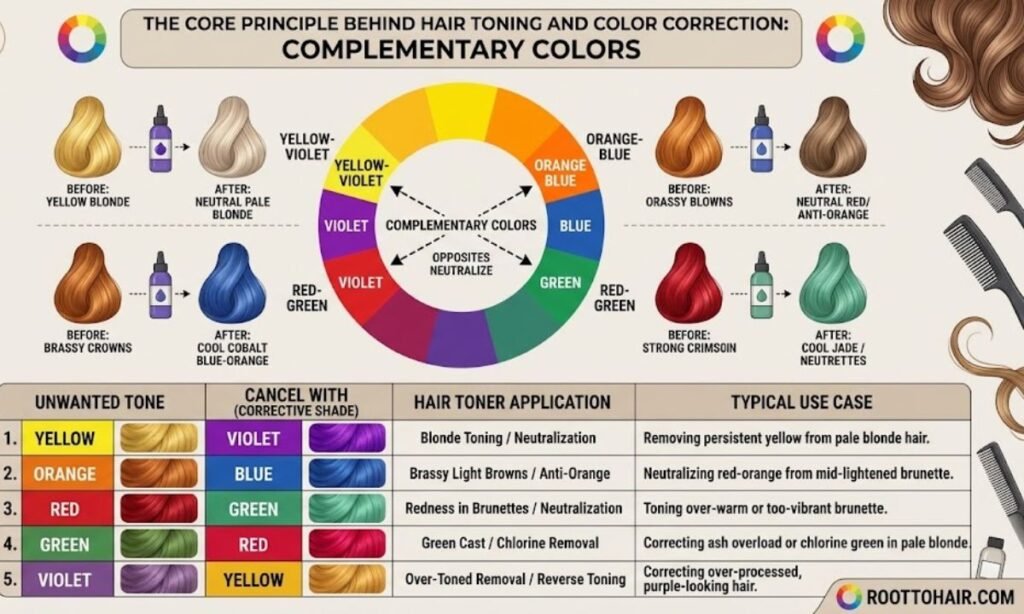
Complementary colors sit opposite each other on the wheel. When mixed in the right amount they cancel each other out and create a neutral tone. This is the core principle behind every toner and corrector.
| Unwanted tone | Cancel it with | Typical use |
| Yellow | Violet | Blonde toning, removing yellow from pale blondes |
| Orange | Blue | Brassy light browns, mid-lightened hair |
| Red | Green | Redness in brunettes, over-warm results |
| Green | Red | Green cast after chlorine or ash overload |
| Violet | Yellow | Over-toned, purple-looking blondes |
What Are Hair Color Levels and How Do You Use Them to Formulate?
Hair color levels measure how light or dark hair is, usually on a scale from 1 (black) to 10 (lightest blonde). Levels tell you where you are starting from, where you want to go and how far you must lift or deposit.
Level Chart with Underlying Pigments
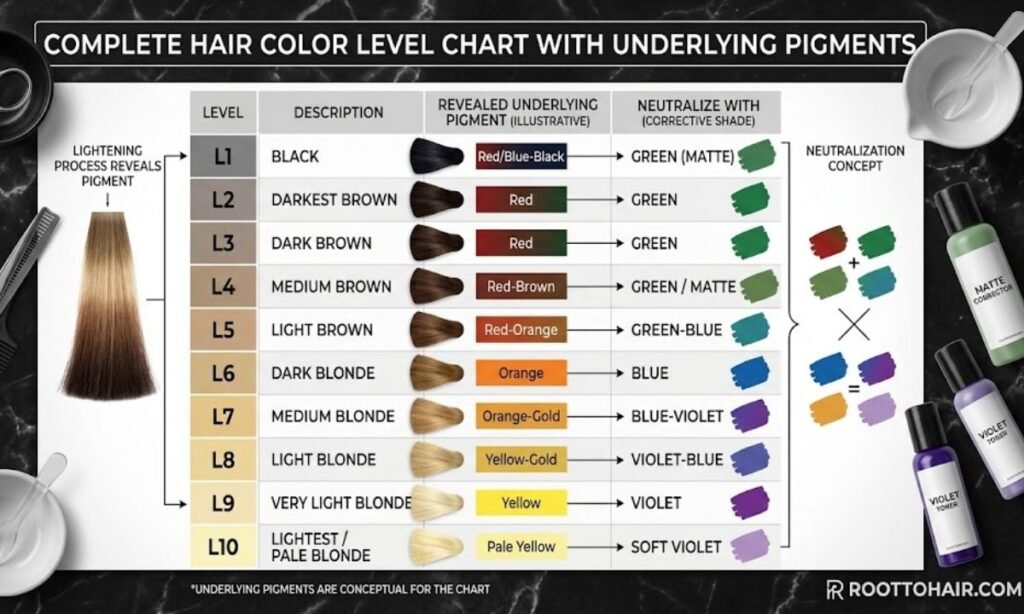
Every level reveals a predictable underlying pigment when hair is lightened. This is the pigment you must neutralize or embrace in the final formula. Use this hair color level chart as your quick reference:
| Level | Description | Underlying pigment revealed | Neutralize with |
| 1 | Black | Dark red / blue-black | Green (matte) |
| 2 | Darkest brown | Red | Green |
| 3 | Dark brown | Red | Green |
| 4 | Medium brown | Red-brown | Green / matte |
| 5 | Light brown | Red-orange | Green-blue |
| 6 | Dark blonde | Orange | Blue |
| 7 | Medium blonde | Orange-gold | Blue-violet |
| 8 | Light blonde | Yellow-gold | Violet-blue |
| 9 | Very light blonde | Yellow | Violet |
| 10 | Lightest / pale blonde | Pale yellow | Soft violet |
Note: exact pigments vary slightly with brand and hair history, but this is the standard professional model.
How to Identify Natural Level
Identifying natural levels correctly is the single most important diagnostic step.
- Compare the hair to a level swatch ring at the mid-lengths, not the ends.
- Check regrowth in natural light (or daylight-balanced lighting) to avoid salon lamps skewing what you see.
- Look at the hair away from the scalp, since heat from the head can make roots look slightly lighter.
- If the hair has been colored before, only trust the new growth for natural level.
How Many Levels a Tint Lifts in One Go
A permanent tint lifts only a limited number of levels in a single application, depending on developer strength and product type.
| Developer | Typical lift with permanent tint |
| 10 vol | 0 levels (deposit only, tone on tone) |
| 20 vol | 1 to 2 levels |
| 30 vol | 2 to 3 levels |
| 40 vol | 3 to 4 levels (high-lift tints only) |
If the client wants more lift than a tint can deliver, use lightener or bleach first, then tone.
What Do the Numbers After the Decimal Mean in Hair Color Codes?
A code like 7.1 is read as level 7, ash reflected. The number before the decimal is the level. The number(s) after the decimal are the reflections: the tones the dye will deposit.
Each Brand Numbers Its Reflects Its Own Way
There is no universal standard. One brand’s .3 can be gold while another’s .3 is violet-gold, and some brands use a slash (7/1) instead of a dot. Always read the brand’s own chart before formulating. This is why mixing brands is a classic formulation mistake.
How to Read Color Codes
Most professional lines follow this pattern:
| Position | Meaning | Example (7.13) |
| First number | Level | 7 = medium blonde |
| Second number | Primary (dominant) reflect | 1 = ash |
| Third number | Secondary reflect | 3 = gold |
Common reflect meanings (always verify against your brand):
| Reflect | Common meaning |
| .0 | Natural |
| .1 | Ash (blue-based) |
| .2 | Violet / iridescent |
| .3 | Gold |
| .4 | Copper |
| .5 | Mahogany / red-violet |
| .6 | Red |
| .7 | Matte / green-based or brown |
Reflect Mixing Rules
- The first number after the decimal is the dominant tone, the second is the supporting tone.
- Combine neighboring tones on the wheel (like gold + copper) for harmony.
- Avoid combining opposite tones at equal strength (like ash + copper), as they cancel into a dull, flat result.
- Use natural (.0) series as the base for coverage, and add reflects in small amounts to steer the tone.
Which Developer Volume Should You Use and Why Does It Matter?
The developer (oxidizing agent) controls how much lift and deposit you get. Choosing the wrong volume is one of the fastest ways to damage hair or end up with the wrong level.
Volumes and Lifting Power
| Volume | Hydrogen peroxide | Best for |
| 10 vol | 3% | Tone on tone, darkening, glazing, gentle toning |
| 20 vol | 6% | Standard permanent color, grey coverage, 1 to 2 levels of lift |
| 30 vol | 9% | 2 to 3 levels of lift on healthy hair |
| 40 vol | 12% | High-lift tints only, used with caution and never on a sensitive scalp |
A higher volume does not mean “better color.” It means more lift and more potential damage. Use the lowest volume that gets the result.
Dye to Developer Ratios
| Ratio | Typical use |
| 1:1 | Standard permanent color |
| 1:1.5 | Many lift formulas and demi-permanent lines |
| 1:2 | High-lift tints and some lighteners |
Mix according to the manufacturer’s instructions. Ratios change consistency, strength and processing behavior.
How Do You Neutralize Unwanted Tones in Hair Color?
Neutralizing is how you cancel brass, warmth or green and reach a clean, salon-perfect shade.
Basic Principle
Use the opposite color on the wheel. Whatever tone you see, you add its complement:
- See yellow, add violet.
- See orange, add blue.
- See red, add green.
Use correctors sparingly. A little goes a long way, and most formulas should not contain more than about a third corrector.
Practical Cases
| Situation | Underlying issue | Solution |
| Brassy light brown | Orange | Ash (.1) or blue-based reflect |
| Yellow blonde after bleaching | Yellow | Violet (.2) toner |
| Red tones on brunettes | Red | Matte (.7) or green-based reflect |
| Green cast after pool exposure | Green | Red-based or copper reflect to cancel |
| Over-purple blonde | Violet | Gold or warm natural reflect |
What Information Do You Need to Gather Before Formulating?
A formula is only as good as the information behind it. Collect these three things before you open a tube.
1. Hair History
Ask about previous color, bleach, henna, relaxers, perms and home dye. Metallic salts, box dye and henna can react unpredictably. History tells you what is already in the hair and whether there are layers of old color to deal with.
2. Current Condition
Check porosity, elasticity, density, scalp health and any damage. Porous or damaged hair grabs color faster and can end up darker or flatter. Fragile hair may need bond protection or a gentler developer.
3. Desired Result
Get the client to show reference photos and agree on a target level and tone. Words like “natural” or “warm” mean different things to different people, so photos remove the guesswork.
How Do You Build a Hair Color Formula Step by Step?
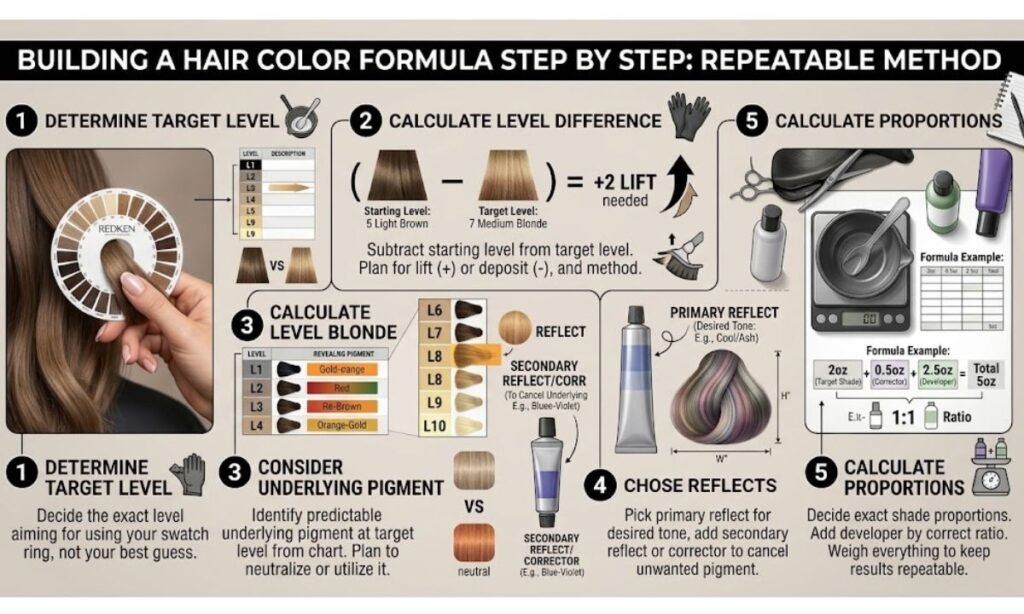
Use this repeatable method for any formula, from a simple tint to a full correction.
Step 1: Determine Target Level
Decide the exact level you are aiming for using your swatch ring, not your best guess.
Step 2: Calculate Level Difference
Subtract the starting level from the target level. This tells you how much lift (positive difference) or deposit (negative difference) is needed, and whether a tint will do or lighter is required.
Step 3: Consider the Underlying Pigment
Look at the level chart and identify what pigment will appear at the target level. Plan to neutralize it or use it in your favor.
Step 4: Choose Reflects
Pick the primary reflect for the tone the client wants, and add a secondary reflect or corrector to cancel any unwanted underlying pigment.
Step 5: Calculate Proportions
Decide how much of each shade goes in the bowl, then add developer by the correct ratio. Weigh everything on a scale to keep results repeatable.
Practical Example
Client: natural level 6, never colored.
Goal: neutral light blonde, level 8.
- Level difference: 8 – 6 = 2 levels of lift
- Underlying pigment at level 8: yellow-gold, so neutralize with violet and a touch of ash
- Developer: 30 vol (2 to 3 levels of lift)
| Component | Amount |
| 8.0 (natural level 8) | 30 g |
| 8.1 (ash) | 15 g |
| 8.2 (violet) | 5 g |
| 30 vol developer (1:1.5) | 75 ml |
Apply, process according to the brand’s timing and check the result against your strand test. Adjust the ratio of ash to violet next time if the tone needs fine tuning.
What Are the Most Common Color Formulation Mistakes?
1. Diagnosing by Eye
Lighting, hair texture and surrounding colors fool the eye. Always compare against a swatch ring in good light.
2. Ignoring History
Previous color, henna or box dye can change the result completely. Skipping the history consultation is the fastest route to a corrective appointment.
3. Excess Corrector
Too much green, blue or violet creates muddy, flat or tinted hair. Use correctors in small, measured amounts.
4. Not Doing Strand Tests
A strand test shows you exactly how the formula, timing and hair will react before the full application. It takes minutes and prevents hours of corrective work.
5. Mixing Brands
Each brand numbers its reflects and calibrates its pigments differently. Mixing brands in one bowl makes results unpredictable.
How Do You Formulate for the Most Common Salon Scenarios?
These are the situations you will see again and again. Use them as starting points and always adjust to the client’s hair.
| Scenario | Approach |
| Full grey coverage | Use a natural (.0) series at the target level with 20 vol; add warm reflects for dimension |
| Going darker than natural | Use a 10 or 20 vol developer; fill with a warm tone first if the hair is porous or very light |
| Lifting 1 to 2 levels | Permanent tint with 20 to 30 vol; choose reflects that cancel the revealed pigment |
| Lifting 3+ levels | Lightener or high-lift tint first, then tone to neutralize |
| Brassy blonde correction | Violet toner (.2) for yellow, ash/blue (.1) for orange, at 10 vol |
| Root touch-up | Mix the formula for the regrowth at natural level; refresh ends with a gloss or toner |
| Black or dark dye to light | Use color remover or bleach in stages, then tone; never rush in one session |
Frequently Asked Questions
How many levels can dye lift?
A permanent tint with the right developer lifts about 1 to 4 levels, depending on volume and product (20 vol around 1-2, 30 vol around 2-3, 40 vol around 3-4 with high-lift tints). Dye cannot lift previously dyed hair, which is why color remover or bleach is needed for bigger changes.
Why does orange appear when bleaching?
Hair is made of warm pigments that lighten in stages. Dark pigment goes first, then red, then orange, then yellow. Bleaching mid-level hair stops at orange or yellow if you do not lift far enough. You need to lift higher, then tone with blue (for orange) or violet (for yellow) to neutralize.
What’s the difference between .1 and .01 in color codes?
In most systems, .1 is ash (a cool, blue-based reflect), while .01 is a natural base with a hint of ash. The zero shows that the shade is anchored in natural pigment, which gives better coverage with a softer cool tone. Always check your brand’s chart, because numbering differs by line.
Can I mix developers of different volumes?
Yes, within the same brand and system you can blend volumes to get an in-between strength, such as 20 vol plus 30 vol for roughly 25 vol. Always follow the manufacturer’s guidance and use a strand test to confirm the result.
How long should I leave the dye on?
Follow the manufacturer’s processing time, which is typically 30 to 45 minutes for permanent color and 20 to 30 minutes for demi-permanent. Lighteners should be monitored visually and never left past the maximum recommended time.
What is the difference between permanent, demi and semi-permanent color?
Permanent color lifts and deposits and grows out. Demi deposits tone without lifting and fades over weeks. Semi coats the surface and washes out in a few shampoos.
How do I choose the right formula for grey hair?
Use a natural (.0) series at your target level with a 20 vol developer. Add reflects in small amounts to steer the tone.
Can dye make previously dyed hair lighter?
No. Tint can’t lift artificial pigment, so you need a color remover or lightener first, then tone.
How often should blonde hair be toned?
Every 4 to 6 weeks. Toner fades within 4 to 8 weeks, and a purple shampoo once a week helps in between.
Why does my color turn out darker than the chart?
Porous or previously colored hair grabs pigment faster, and a developer that’s too low for the lift you need also contributes. Always do a strand test first.
Conclusions
Mastering hair colorimetry basics is what separates a hair colorist who guesses from one who delivers consistent, beautiful results. Start with color theory, diagnose level and underlying pigment accurately, read your brand’s reflect codes, choose the right developer volume and always build your formula step by step. Add a strand test, avoid common mistakes and you will formulate with confidence on every client.
Save this hair color formula guide, share it with your team and revisit the level chart whenever you need a quick refresher. Better hair colorimetry means better color, happier clients and a stronger reputation behind the chair.