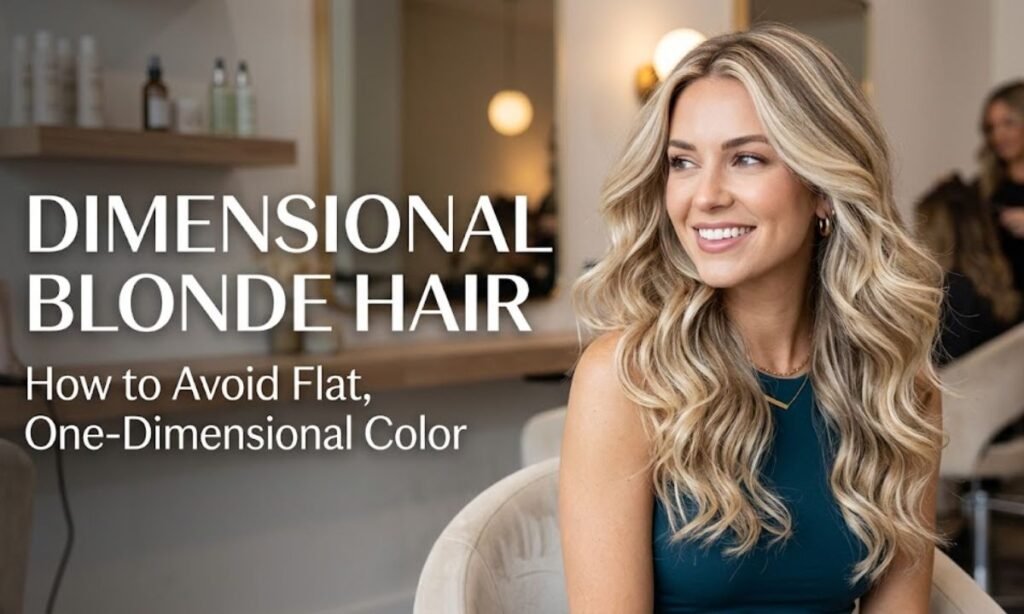
Dimensional blonde hair is the difference between a blonde that looks expensive and one that looks painted on. Instead of a single solid shade from root to tip, dimensional blonde layers have several tones and depths so the color catches light, moves with the hair, and grows out softly. This guide explains why blonde goes flat, the three core techniques colorists use to fix it, how to formulate a dimensional blonde step by step, and how to correct patchy or uneven results.
Flat blonde is one of the most common color complaints, and it’s easy to fix once you know the cause. Dimensional blonde hair layers several tones and depths so your color looks rich, natural and full of movement from root to tip.
Blonde turns one-dimensional when everything is lifted to the same level and covered with a single toner. Without shadow or contrast, even a perfectly bright blonde can look dull, heavy and overly uniform.
What Is Dimensional Blonde and Why Does It Matter?
Dimensional blonde is a color result built from at least two or three different tones or levels of blonde, placed deliberately so the hair looks multi-tonal rather than uniform. The lightest pieces sit where light naturally hits (around the face and through the mid-lengths and ends), while slightly deeper tones sit underneath and near the root to create shadow and depth.
It matters for three reasons:
- It looks more natural. Natural blonde hair is never one flat shade. Dimension mimics that variation.
- It grows out better. A softer root transition means fewer harsh regrowth lines and longer time between appointments.
- It makes hair look thicker. Contrast creates the illusion of density, which is especially useful for fine hair.
Why Blonde Goes Flat
Blonde turns flat when everything is lifted to the same level and covered with the same tone. Common causes include:
- Lightening the entire head to one level with a single application
- Using the same developer volume and processing time on every section
- Applying an opaque, uniform toner over all of the hair
- Skipping any deeper tones, so there is no shadow to give the light areas contrast
- Overlapping lightener on previously lightened hair, which pushes the ends to a uniform pale shade
- Fading, where toner washes out unevenly and leaves the hair looking one-note yellow or washed out
What Are the 3 Techniques to Create Dimensional Blondes?
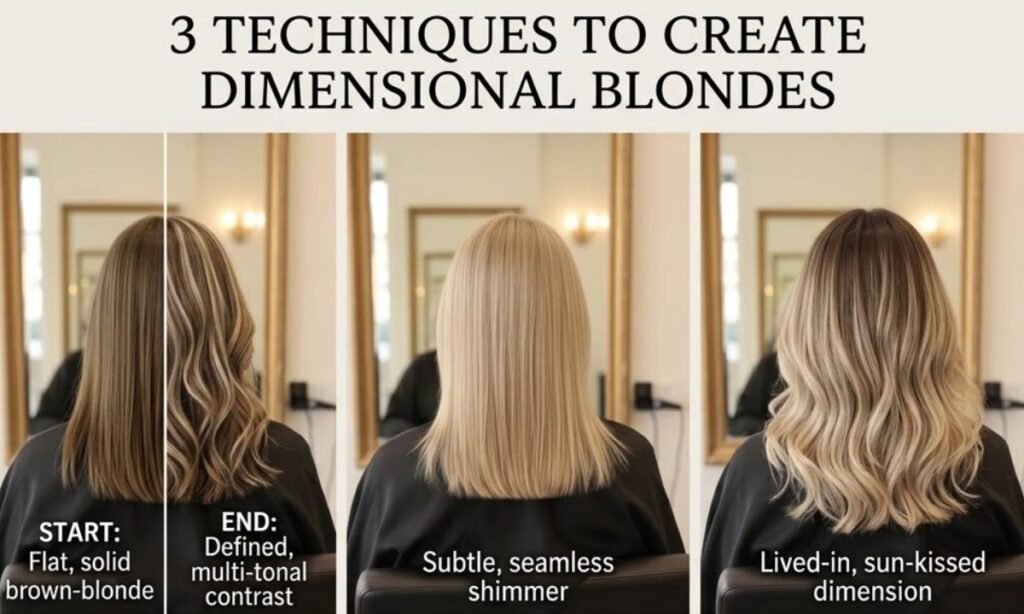
The three most reliable methods are highlights combined with lowlights, babylights, and a shadow root paired with balayage. Each creates dimension differently, so the right choice depends on your starting color, hair density and how much maintenance you want.
| Technique | Best For | Look | Typical Touch-Up |
| Highlights + Lowlights | Brunettes and dark blondes wanting visible contrast | Defined, multi-tonal | Every 8–12 weeks |
| Babylights | Fine hair, soft and natural results | Subtle, seamless shimmer | Every 10–14 weeks |
| Shadow Root + Balayage | Low-maintenance, lived-in blonde | Soft, blended, sun-kissed | Every 12–16 weeks |
1. Highlights + Lowlights Combined
Highlights lift selected strands lighter, while lowlights add strands that are slightly darker than the lightest areas. Using both is the most direct way to add contrast to a flat blonde.
- Highlights are placed where light naturally falls: the hairline, part, crown and ends.
- Lowlights are usually placed 1–2 levels deeper than the base and woven underneath or in the back and sides.
- The combination breaks up solid blocks of color and adds depth without lifting more hair than necessary.
This method suits those who already have blonde hair that looks heavy or flat and want definition without a full re-lightening.
2. Babylights for Natural Transition
Babylights are ultra-fine, delicate highlights woven in tiny sections, giving a soft shimmer rather than visible stripes. Because the sections are so small, the lightener blends with the natural base color and there is no obvious line where color starts.
- Ideal for fine or thin hair that can’t handle heavy foils
- Produces a soft, natural gradation that mimics a child’s sun-kissed hair
- Works well when combined with a few slightly deeper lowlights for extra depth
- Takes longer to apply, so appointments are longer than with traditional foils
3. Shadow Root + Balayage
A shadow root (also called a root smudge or root melt) deepens the color at the root by 1–2 levels, then blends it into lighter mid-lengths and ends. Balayage hand-paints the lightener in a sweeping motion so the lighter pieces fade softly.
- The darker root creates built-in depth and makes the lightest ends look brighter by contrast
- Regrowth is nearly invisible, so it’s the lowest-maintenance option
- Works on any length, though the effect is most visible on medium to long hair
How Do You Formulate a Dimensional Blonde Step by Step?
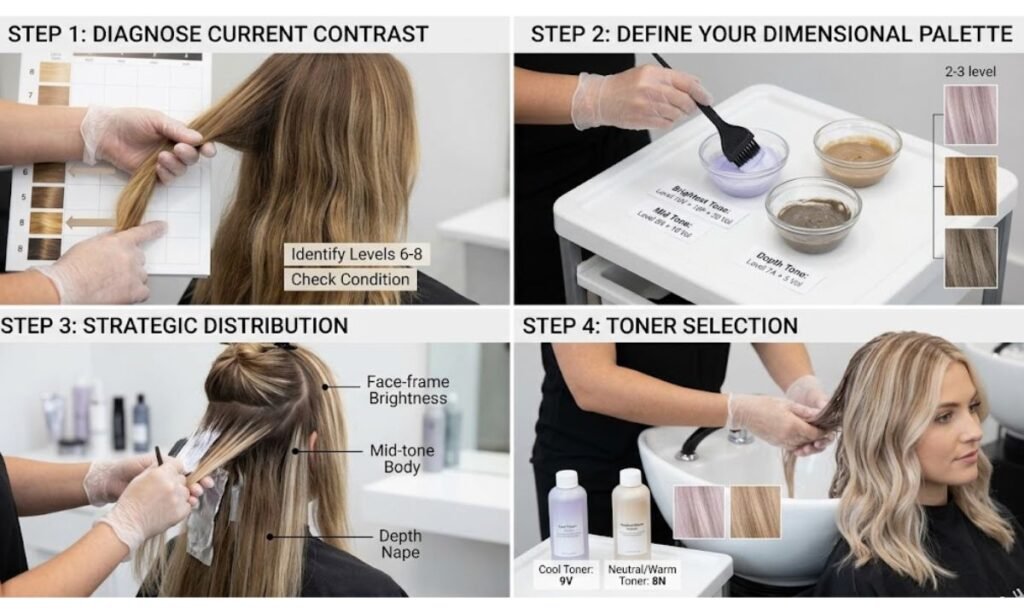
A dimensional blonde formula comes from four decisions: how much contrast the hair already has, which tones you want, where each tone goes, and which toner finishes the look. Always follow the manufacturer’s instructions for the specific product line you’re using, and do a strand test when in doubt.
Step 1: Diagnose Current Contrast
Before mixing anything, assess the hair as it is now.
- Level range: Identify the lightest and darkest areas on a 1–10 scale. A flat blonde usually spans less than one level.
- Condition: Check for dryness, breakage and elasticity, especially on previously lightened ends.
- History: Look for color build-up, box dye, or henna, which can lift unpredictably.
- Underlying pigment: Note whether the hair lightens to orange, yellow-orange, yellow or pale yellow.
Step 2: Define Your Dimensional Palette
A good dimensional blonde uses a small palette of tones that sit close to each other. A common rule is to aim for a 2–3 level difference between the lightest and deepest tones.
| Palette Role | Level Placement | Purpose |
| Brightest Tone | Lightest level (e.g. 9–10) | Face-framing pieces and ends; adds brightness |
| Mid Tone | 1–2 levels deeper (e.g. 8) | Main body of the blonde; ties tones together |
| Depth Tone | 2–3 levels deeper (e.g. 6–7) | Lowlights and shadow root; creates shadow |
Step 3: Strategic Distribution
Where color goes is as important as which colors you choose.
| Area | Recommended Placement |
| Hairline and part | Brightest tone, finest sections for a soft frame |
| Crown and top layers | Mix of bright and mid tones; avoid heavy blocks |
| Underneath and nape | Depth tone lowlights for shadow and density |
| Mid-lengths | Blend zone between the root and brightest ends |
| Ends | Lightest tone, since the hair here is usually most porous |
Work in diagonal or V-shaped sections, alternate tones from section to section, and avoid placing the same tone in consecutive rows.
Step 4: Toner Selection
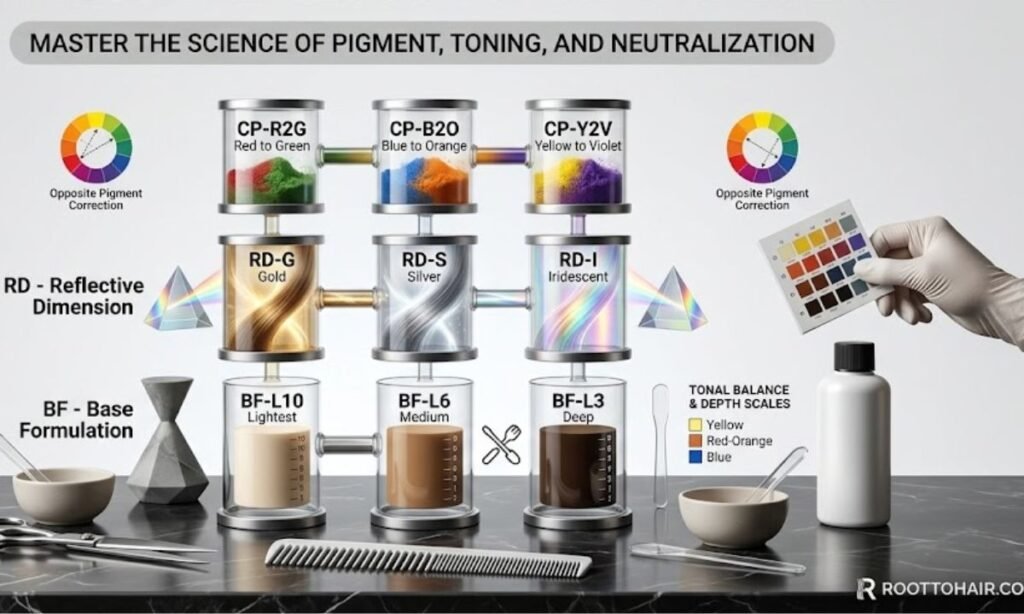
Toner finishes the formula by neutralizing unwanted warmth and unifying tones without flattening them.
| Underlying Pigment | Result After Lightening | Toning Direction |
| Orange (around level 6–7) | Warm, copper-like | Blue-based or ash toner |
| Yellow-orange (level 8) | Golden | Blue-violet toner |
| Yellow (level 9) | Light gold | Violet-based toner |
| Pale yellow (level 10) | Very light | Soft violet or pearl toner |
For dimension, use a sheer or translucent toner and consider using two different toners: a cooler tone on the brightest sections and a softer, warmer tone on the deeper ones.
What Mistakes Flatten Blonde Hair and How Do You Avoid Them?
Four mistakes cause most flat blonde results: using one developer volume everywhere, skipping lowlights, applying an opaque uniform toner, and ignoring underlying pigment.
| Mistake | What Happens | How to Avoid It |
| Same developer volume everywhere | Over-lifts some areas and under-lifts others, creating uniform or patchy color | Match developer strength to each section’s needs |
| Skipping lowlights | No shadow, so the blonde looks flat | Add 1–2 level deeper pieces |
| Opaque uniform toner | Covers dimension and creates a single solid shade | Use sheer toners and vary the tone |
| Ignoring underlying pigment | Brassy or muddy tones that won’t tone out | Lift to the correct level before toning |
1. Same Developer Volume Everywhere
Hair doesn’t lighten evenly across the head. Roots process faster because of scalp warmth, while ends are more porous and can over-process.
- Use a lower volume near the scalp where heat speeds up lifting
- Use the volume needed to reach your target level on the mid-lengths
- Be gentle on previously lightened ends, using a lower volume or a toner or gloss refresh only
- Apply lightener to sections in a sequence that accounts for these differences
2. Skipping the Lowlights
Many people think blonde means only lightening. In reality, the lightest pieces only look bright when something deeper sits next to them. Adding lowlights reintroduces the shadow that makes highlights pop.
3. Opaque Uniform Toner
A heavy, opaque toner applied over the entire head blends everything into one shade. Instead, use sheer, translucent formulas and apply them selectively, or use two tones in different zones.
4. Not Respecting Underlying Pigment
If you tone before the hair has lifted to the right level, the toner has to fight the warmth underneath and the result looks muddy, green-tinged or brassy. Lift first until the pigment is pale yellow or lighter, then tone.
How to make blonde more dimensional?
To make blonde more dimensional, add deeper tones beneath the lighter pieces, use finer sections for a softer blend, and let the root stay slightly deeper than the ends. The three simplest ways to do this are covered below.
Add Lowlights to Break Up Flat Color
Ask for lowlights 1–2 levels deeper than your current blonde, placed underneath and through the back and sides. This single change often transforms a solid blonde into a layered one without any additional lightening.
Use Babylights and Foilayage for Soft Depth
Babylights add fine, shimmering brightness, while foilayage (balayage painted onto foils) gives brighter lift with a soft, blended finish. Together they add multiple tones within the same area, so the color looks richer in motion.
Pair a Root Smudge with Lighter Ends
A root smudge deepens only the first inch or two near the scalp and melts into the lighter lengths. It creates instant depth, softens regrowth and extends the time between salon visits.
How to fix uneven blonde hair?
To fix uneven blonde hair, first find out why it’s uneven (uneven lifting, fading toner, banding or over-lightened ends), then correct it with targeted toning and selective, gentle lightening rather than re-bleaching the whole head.
Identify Why Your Blonde Turned Patchy
| Problem | Likely Cause | Typical Fix |
| Brassy or yellow patches | Toner faded or hair under-lifted | Re-tone with a violet or blue-violet formula |
| Dark roots with pale ends | Regrowth or banding from overlapping lightener | Root smudge or targeted root lift |
| Stripes or visible bands | Overlap during previous applications | Blend with babylights or a gloss |
| Dry, over-lightened ends | Repeated lightening | Gloss, bond repair, or trim |
| Muddy or grey cast | Toner too dark or wrong tone | Clarify and re-tone with a lighter formula |
Tone Brassy Spots with the Right Pigment
Choose the toner based on the unwanted tone: violet to neutralize yellow, blue to neutralize orange. Apply only to the brassy areas rather than the whole head to avoid over-toning the areas that are already correct.
Correct Banding and Dark Roots Without Over-Lightening
- Don’t pull lightener through previously lightened hair
- Blend the root with a smudge or a gloss that matches the mid-tones
- Add fine babylights to visually break up any hard lines
- Space lightening sessions out so the hair can recover
What is the most attractive blonde hair color?
There isn’t one most attractive blonde. The most flattering shade depends on your skin tone, eye color and natural hair color. As a general guide, warm blondes suit golden or olive skin, and cool or ashy blondes suit fair or pink skin.
| Skin Undertone | Most Flattering Blondes | Shades to Approach with Care |
| Warm / golden | Honey, golden, butter, caramel blonde | Very ashy or icy tones that can look washed out |
| Cool / pink | Ash, platinum, pearl, champagne blonde | Strong golden or orange-leaning tones |
| Neutral | Beige, sandy, soft champagne blonde | Few restrictions; most tones work |
| Olive | Honey, bronde, warm beige blonde | Very pale platinum without enough depth |
Warm Blondes That Flatter Golden Skin Tones
Honey, golden, butter and caramel blondes complement golden or olive skin because they echo its warmth. Add a deeper caramel lowlight or a soft root smudge to keep them from looking flat or yellow.
Cool and Ashy Blondes for Fair and Pink Undertones
Ash, pearl and platinum blondes balance rosy undertones and can look striking on fair skin. Keep a slightly deeper root or soft lowlights so the color doesn’t look stark or one-dimensional.
Trending Blonde Shades Worth Trying This Season
Trends move quickly, so check with your colorist for the latest, but several dimensional looks consistently remain popular:
- Butter blonde: a creamy, soft yellow-gold blonde
- Champagne blonde: a light, slightly beige blonde with a subtle shimmer
- Bronde: a mix of blonde and brunette tones with plenty of depth
- Honey blonde with lowlights: warm, rich and naturally multi-tonal
- Icy blonde with a shadow root: cool brightness softened by depth
Frequently Asked Questions
How many levels of difference does a dimensional blonde need?
Most dimensional blondes work best with a 2–3 level difference between the lightest and deepest tones. Less than that tends to look flat, while much more can look striped, particularly on fine hair.
Does dimensional blonde work on fine hair?
Yes. Fine hair often benefits the most, because contrast makes it look fuller. Use ultra-fine babylights, keep the level difference closer to 2, avoid heavy lightening and choose lower developer volumes to protect the hair.
How often does a dimensional blonde need touching up?
| Service | Typical Interval |
| Toner or gloss refresh | Every 4–8 weeks |
| Highlights + lowlights | Every 8–12 weeks |
| Babylights | Every 10–14 weeks |
| Shadow root + balayage | Every 12–16 weeks |
Actual timing depends on how fast your hair grows, how deep the root is and how much fading occurs.
Can you convert a flat blonde to dimensional in one session?
Often yes, if the hair is healthy and already light. Adding lowlights and re-toning can be done in a single appointment. If the hair is very light, damaged, or has built-up color, your colorist may recommend splitting the work across two sessions to protect its condition.
What maintenance products should you recommend?
- Purple or blue shampoo and conditioner (used occasionally) to keep brassiness down
- Sulfate-free shampoo to help preserve toner
- Bond-repairing treatments to keep lightened hair strong
- Deep conditioning masks weekly for moisture
- Heat protectant before any hot tools
- Gloss treatments between appointments to refresh shine and tone
What is the difference between dimensional blonde and solid blonde?
Solid blonde is one shade applied from root to tip. Dimensional blonde blends two or three tones, usually 2-3 levels apart, so the color looks layered and catches light from different angles.
Is dimensional blonde better for growing out roots?
Yes. Techniques like shadow root and balayage keep the root slightly deeper and blend it into lighter lengths, so regrowth looks soft instead of showing a harsh line. Many people can go 12-16 weeks between lightning sessions.
Can dark hair achieve dimensional blonde?
Yes, but it usually takes more than one session. Lifting dark hair too fast can cause damage and brassiness, so colorists often build the blonde gradually and keep deeper lowlights to preserve depth and hair health.
How do you keep dimensional blonde from turning brassy?
Use purple or blue shampoo once a week or as needed, wash with cool water, and choose sulfate-free products. A gloss or toner refresh every 4-8 weeks also helps keep the tones balanced.
What is the difference between babylights and balayage?
Babylights are very fine, foil-woven highlights that give a subtle, shimmery blend. Balayage is hand-painted in sweeping strokes for a bolder, more lived-in look with lighter ends.
These are different from the five FAQs in the article, so you can use either set or combine them. I can also write them in a schema-ready format if you plan to add FAQ markup to the page.
Conclusions
Dimensional blonde hair comes down to contrast, placement and tone. Avoid lightening everything to the same level, keep a 2–3 level range between your lightest and deepest tones, add lowlights or a shadow root for depth, and finish with a sheer toner instead of an opaque one.
Whether you choose highlights with lowlights, babylights or shadow root balayage, the result should look soft, multi-tonal and natural, and it will grow out far more gracefully than a flat, single-shade blonde. If your blonde hairs has already turned flat or patchy, a targeted toning and lowlight session is usually enough to bring it back to life without starting over.