
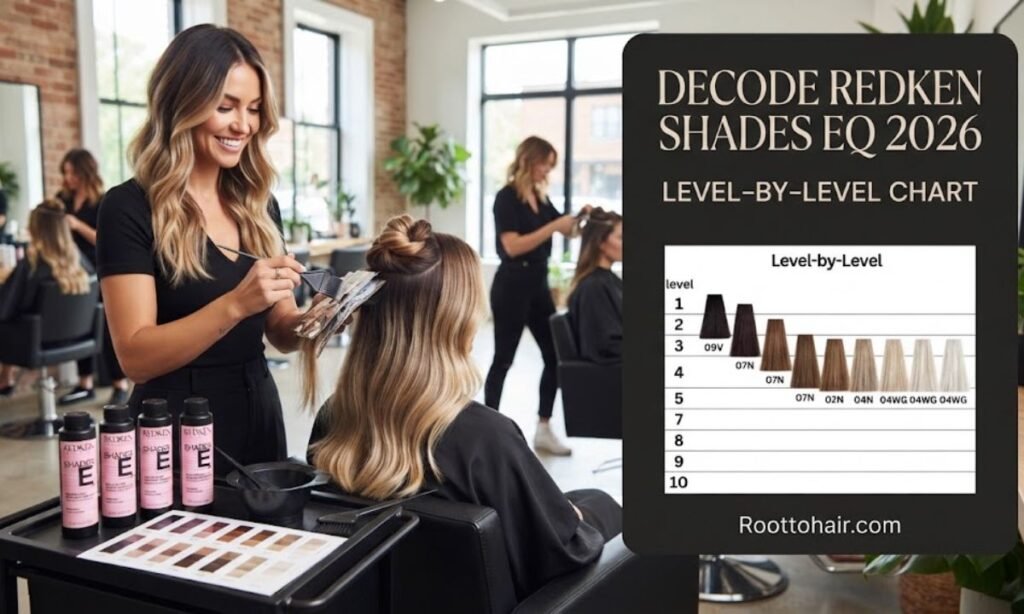
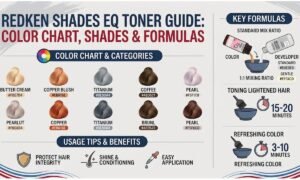
Redken Shades EQ color uses a clear level and tone system. This chart helps stylists match the perfect shade for every client.
Each level shows depth, from darkest black to palest blonde. Letters after the number reveal the tone family and warmth.
Learning this chart makes color selection fast and stress-free. Stylists can predict results before ever mixing a formula.
| Level | Depth Description | Example Shade | Tone Family |
| 1 | Darkest black | 01N | Natural |
| 4 | Medium brown | 04G | Gold |
| 6 | Dark blonde | 06GB | Gold Beige |
| 8 | Light blonde | 08P | Pearl |
| 9 | Very light blonde | 09V | Violet |
Example: 08P combines Level 8 lightness with the Pearl tone family, creating a bright, shimmery light blonde with a soft, cool finish that stays fresh and radiant between salon visits.
Quick Reference Guide: Levels, Tones, and Results
This quick guide helps stylists find shades fast. It pairs each level with common tones and expected results.
Use it during consultations to explain color options clearly. Clients can see exactly what their finished shade will look like.
Keep this chart handy for fast, confident formula decisions. It saves time and reduces guesswork behind the chair.
| Level | Tone Family | Shade Code | Result Description |
| 2 | Natural | 02N | Darkest brown, nearly black |
| 4 | Copper | 04C | Vibrant medium brown with copper shine |
| 6 | Red-Red | 06RR | Bold dark blonde with red reflects |
| 8 | Violet | 08V | Ash light blonde, cool and neutral |
| 9 | Pearl | 09P | Shimmery, radiant very light blonde |
Example: 06RR pairs Level 6 depth with the Red-Red tone family, creating a bold dark blonde Shades EQ with vibrant red reflects, perfect for clients wanting noticeable color with lasting impact.
What is Shades EQ and why does it dominate professional salons?
Redken Shades EQ is a gloss-based hair color system built for shining and tone. It works as a demi-permanent color, so it deposits color without lifting the hair. This gentle process keeps hair healthy while still delivering rich, vibrant results.
Salons love it because it works on every hair type. It blends grays, corrects brassy tones, and refreshes faded color. Stylists can also mix shades to create fully custom formulas for each client.
The secret to its popularity is the finish it leaves behind. Shades EQ seals the hair cuticle as it processes. This creates a glass-like shine that regular color often cannot match.
It also fades gracefully instead of turning brassy or dull. The color washes out evenly over several weeks. This makes root touch-ups and color maintenance much easier for clients.
Professional colorists trust it for its consistency and reliability. The formula performs the same way every single time. That predictability is why it remains a top choice across the industry Shades EQ in 2026.
| Feature | Shades EQ |
| Color type | Demi-permanent gloss color |
| Ammonia | Ammonia-free formula |
| Lifting ability | Does not lift or lighten hair |
| Shine level | High, glass-like shine |
| Hair health impact | Gentle, low-damage processing |
| Gray coverage | Blends and covers grays well |
| Tone correction | Neutralizes brassy and warm tones |
| Hair type suitability | Works on all hair types and textures |
| Custom formulas | Supports mixing for personalized shades |
| Fade pattern | Fades evenly without turning dull |
| Processing time | Fast, salon-friendly processing |
| Usage versatility | Works as a toner, gloss, or full color |
| Popularity | Widely trusted in professional salons in 2026 |
How do you read Shades EQ color codes?
Every Shades EQ shade uses a simple code made of numbers and letters. The first part of the code shows the depth level. Lower numbers mean darker shades, while higher numbers mean lighter shades.
After the number, you will see one or more letters. These letters show the tone or color family of the shade. For example, N stands for natural, while G stands for gold.
Shades EQ Some codes include a second number after a decimal point. This number shows the intensity of the tone. A higher second number means a boulder, more vibrant result.
Reading these codes correctly helps you predict the final color. It also makes it easier to mix custom formulas with confidence. Once you understand the pattern, choosing shades becomes fast and simple.
Learning this code system takes the guesswork out of color matching. Shades EQ Stylists can quickly compare shades and find the right fit. This knowledge is the foundation for mastering the entire Shades EQ line.
Tone families
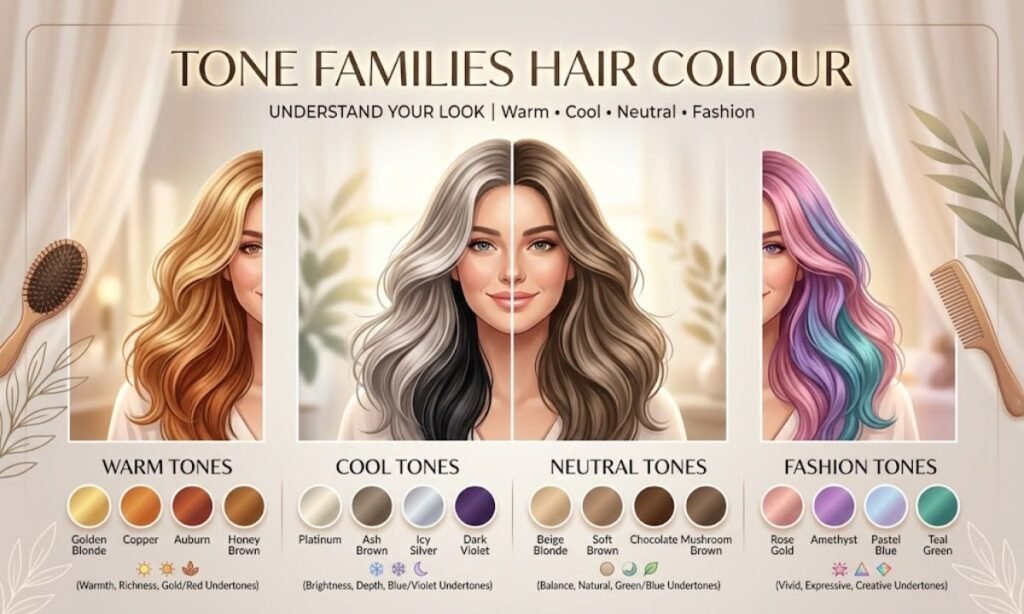
| Code | Family | What It Deposits | Primary Use | |
| N | Natural | Soft, true-to-life natural tone | Natural-looking, everyday shades | |
| NW | Natural Warm | Blended natural and gold warmth | Soft warmth without heavy gold | |
| G | Gold | Rich, warm gold pigment | Warm looks, golden blondes and browns | |
| GB | Gold Beige | Warm gold with muted beige balance | Soft, balanced warm neutral tones | |
| B | Blue | Cool blue pigment | Neutralizing warmth, ashy results | |
| V | Violet | Cool violet pigment | Canceling yellow and brass on blondes and grays | |
| VV | Violet-Violet | Intense violet pigment | Strong brass correction, cool blonde toning | |
| RV | Red-Violet | Red mixed with violet pigment | Rich, cool-toned red shades | |
| RR | Red-Red | Bold, saturated red pigment | Vivid, long-lasting red color | |
| R | Red | Warm red pigment | Classic red and copper tones | |
| C | Copper | Bright copper-orange pigment | Vibrant copper and warm red looks | |
| T | Titanium | Cool, smoky, gray-toned pigment | Icy, cool neutral tones | |
| P | Pearl | Soft, iridescent shimmer pigment | Adding subtle shine and cool brightness |
Example: Code: 08NW
- 08 → This is the depth level. It falls in the medium blonde range, so the shade is neither too light nor too dark.
- N → This shows the shade belongs to the Natural family, giving a soft, true-to-life base tone.
- W → This adds Warm undertones, blending gold warmth into the natural base.
Result: 08NW creates a medium blonde shade with a soft, natural warmth. It is not too golden and not too shy, making it a balanced, friendly, everyday color.
Another quick example: 06RR
- 06 → A darker level, landing in the light brown range.
- RR → Red-Red family, meaning bold, saturated red pigment.
Result: 06RR gives a vivid, long-lasting red shade on light brown hair, perfect for clients wanting a statement color.
Once you break down the number and letters separately, any Shades EQ code becomes easy to understand and predict.
Matching Client Hair Goals to the Right Level
Clients often describe goals in simple, everyday words. Translating those words into a level takes practice and skill.
A word like “natural” usually points toward mid-range levels. A word like “bright” often points toward higher levels instead.
This matching process keeps color consultations smooth and accurate. It also helps clients feel understood before the formula begins.
| Client Description | Best Level Range | Shade Code | Expected Outcome |
| “Something natural, not too different” | 4-6 | 04N | Soft, believable medium brown result |
| “I want it to warmer” | 5-7 | 05G | Golden warmth without heavy brass |
| “Bright but still soft” | 8 | 08N | Balanced, true light blonde finish |
| “As light as possible” | 9-10 | 09N | Very light, airy blonde result |
| “Cool, no yellow tones” | 8-9 | 08V | Clean, ash-toned cool blonde |
Example: When a client says they want “something warmer but still natural,” 05G fits perfectly. It sits at a light brown level with golden warmth, giving a soft, sun-kissed result that still feels true to their natural color.
What are all the Shades EQ shades organized by level?
Shades EQ shades follow a level system ranging from 1 to 10. Level 1 is the darkest, almost black shade. Level 10 is the lightest, palest blonde shade available.
Each level includes several tone families to choose from. This means colorists are not limited to just one option per level. They can select warm, cool, or natural tones within the same depth.
Organizing Shades EQ by level makes color matching much faster. Stylists can quickly narrow down options based on desired depth. Then they simply pick the tone family that fits the client’s needs.
This system also helps with formula planning and consultations. Clients can see a clear picture of how light or dark their result will be. It removes confusion and builds trust during the color process.
Below is a simple breakdown of the Shades EQ level system and what each range typically offers.
| Level Range | Depth Description | Common Tone Families | Best For |
| 1–2 | Darkest, black to darkest brown | N, NW, B | Deep, rich dark bases |
| 3–4 | Dark brown | N, NW, G, RR | Natural brunettes, red-brown looks |
| 5–6 | Medium to light brown | N, NW, G, C, RV | Warm brunettes, copper tones |
| 7–8 | Dark blonde to medium blonde | N, NW, G, V, GB | Everyday blonde shades |
| 9 | Light blonde | N, V, VV, P | Bright, soft blondes |
| 10 | Palest blonde | N, V, T, P | Icy, high-lift blonde finishes |
Understanding this Shades EQ level breakdown gives colorists a strong starting point. From there, they can fine-tune the exact tone using the letter codes. Together, level and tone create the perfect, personalized shade for every client.
Levels 1-3 (darks)
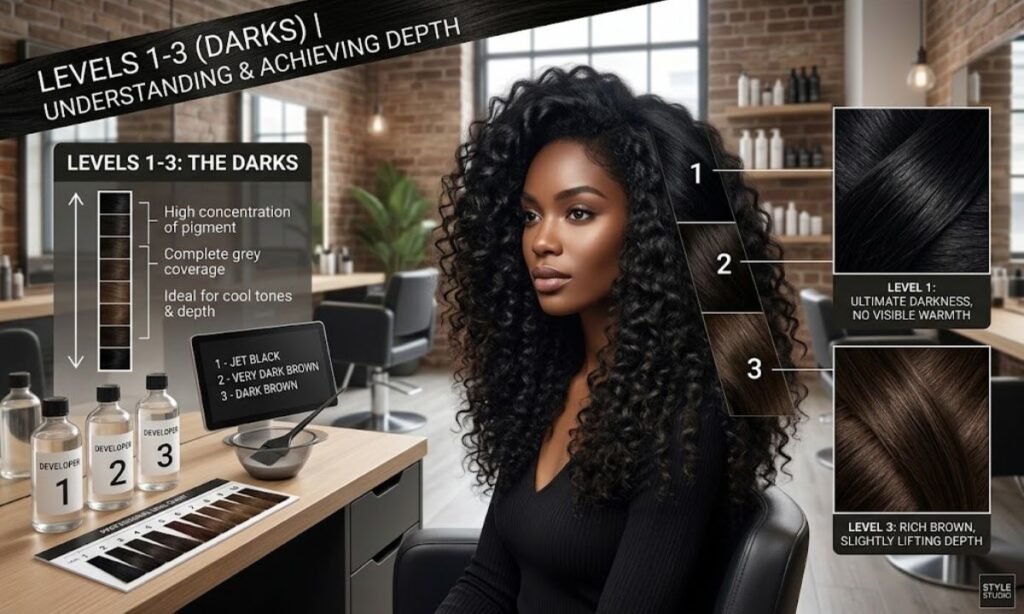
Levels 1 through 3 sit at the darkest end of the Shades EQ chart. These shades work best for deep, rich color results. They suit clients with naturally dark hair or those wanting a dramatic change.
Level 1 is nearly black, offering almost no visible undertone. Level 2 moves slightly lighter, still reading as a deep, dark shade. Level 3 opens more into a true dark brown range.
These darker levels are popular for low-maintenance color looks. They blend well with natural regrowth, so touch-ups are less frequent. This makes them a favorite for busy clients who want lasting results.
Tone families in this range still offer plenty of variety. Colorists can choose natural, warm, or red-based options. This allows for everything from soft, natural darks to bold, dramatic red browns.
Below is a breakdown of common shades found within Levels 1-3.
| Level | Shade Example | Tone Family | Result Description |
| 1 | 01N | Natural | Deep, true black with no visible undertone |
| 1 | 01NW | Natural Warm | Soft black with subtle warm depth |
| 2 | 02N | Natural | Darkest brown, nearly black finish |
| 2 | 02V | Violet | Cool, ash-toned darkest brown |
| 3 | 03NW | Natural Warm | Rich dark brown with soft warmth |
| 3 | 03RR | Red-Red | Bold dark brown with vivid red reflects |
| 3 | 03BG | Beige Gold | Warm dark brown with muted gold tone |
Example: 03RR
- 03 → Places the shade in the dark brown level range.
- RR → Red-Red family, delivering bold, saturated red pigment.
Result: 03RR creates a rich, dark brown base with vibrant red reflects. It works beautifully for clients who want depth with a noticeable pop of color, without going too light or too bold.
Level 4 (medium brown)
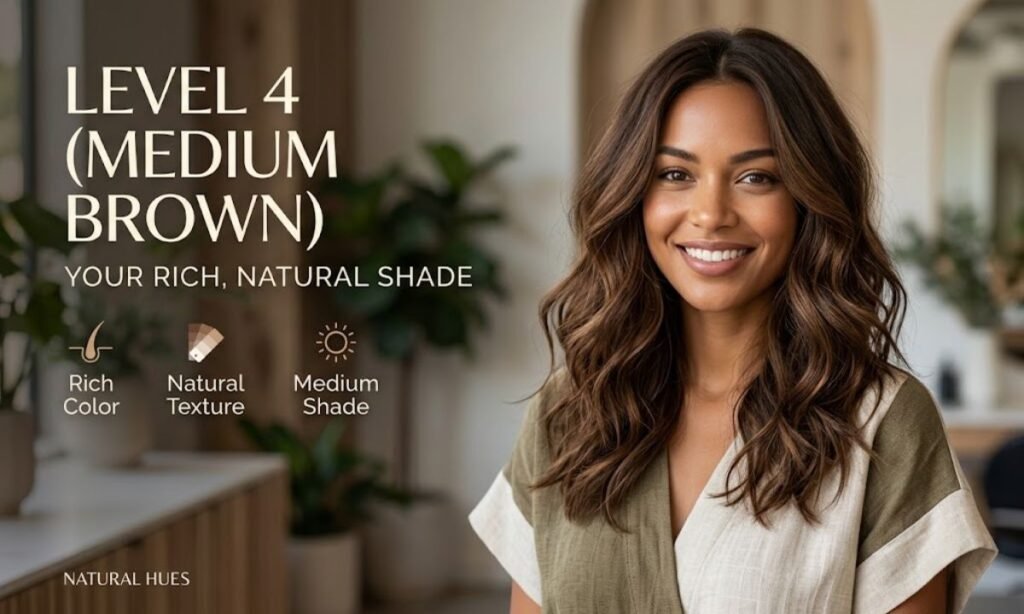
Level 4 sits right in the middle of the darker shade range. It creates a true medium brown result on the hair. This Shades EQ level works well for clients moving away from very dark colors.
Medium brown offers a soft, everyday look that suits many skin tones. It is dark enough to feel rich, but light enough to feel approachable. This balance makes Level 4 one of the most requested shades in salons.
Level 4 also blends gray hair with excellent, natural results. The medium depth hides regrowth better than lighter levels. This makes it a smart pick for low-maintenance color clients.
Tone families at this level offer warm, cool, and red options. Colorists can create anything from soft natural browns to vibrant copper looks. This flexibility makes Level 4 easy to customize for each client.
Below is a breakdown of common shades found within Level 4.
| Shade Code | Tone Family | Result Description |
| 04N | Natural | True, soft medium brown with balanced tone |
| 04NW | Natural Warm | Medium brown with gentle golden warmth |
| 04G | Gold | Warm, golden medium brown finish |
| 04C | Copper | Vibrant medium brown with copper shine |
| 04RV | Red-Violet | Cool-toned medium brown with red depth |
| 04V | Violet | Ash-toned medium brown, cool and neutral |
| 04BG | Beige Gold | Soft medium brown with muted gold beige |
Example: 04G
- 04 → Places the shade at the medium brown level.
- G → Gold family, adding warm, rich pigment.
Result: 04G creates a warm, golden medium brown shade. It works well for clients who want a natural-looking brown with a sun-kissed, warm glow, perfect for everyday wear.
Level 5 (light brown)

Shades EQ Level 5 creates a soft, light brown result on the hair. It sits between medium brown and dark blonde tones. This level suits clients wanting warmer, lighter everyday shade.
Light brown flatters most skin tones with ease. It offers depth without looking heavy or dark. Many clients choose Level 5 as a fresh, low-maintenance change.
This level also blends grays smoothly and naturally. It softens regrowth lines better than lighter blonde shades. That makes it a practical choice for longer wear between salon visits.
Tone families at Level 5 range from warm to cool options. Colorists can create golden, red, or ash-based light browns. This variety helps match almost any client’s desired finish.
Below is a breakdown of common shades found within Level 5.
| Shade Code | Tone Family | Result Description |
| 05N | Natural | Balanced, true light brown tone |
| 05G | Gold | Warm, golden light brown finish |
| 05C | Copper | Bright, copper-infused light brown |
| 05RV | Red-Violet | Cool light brown with red depth |
| 05V | Violet | Ash light brown, cool and neutral |
| 05NW | Natural Warm | Soft light brown with gentle warmth |
Example: 05C
- 05 → Places the shade at the light brown level.
- C → Copper family, adding bright, warm pigment.
Result: 05C creates a vibrant, copper-toned light brown. It suits clients wanting a warm, eye-catching shade that still feels natural and wearable.
Level 6 (dark blonde)
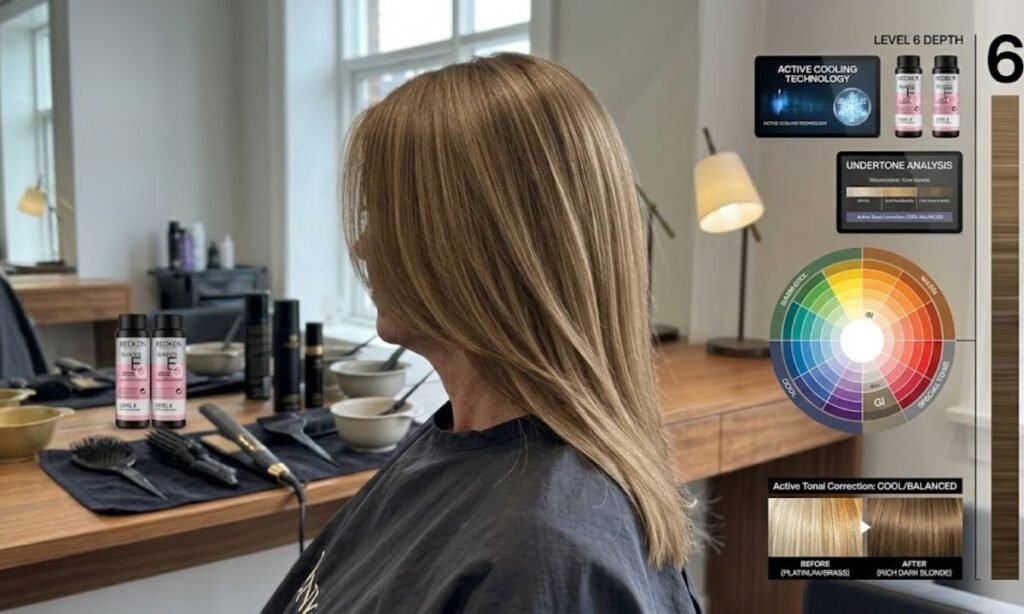
Shades EQ Level 6 marks the shift from brown into blonde territory. It creates a rich, dark blonde result on the hair. This level suits clients wanting a soft transition away from brown.
Dark blonde offers warmth and dimension without going too light. It works well for sun-kissed, natural-looking color. Many clients pick Level 6 for a versatile, everyday blonde shade.
This level still blends grays fairly well with the right tone. Warmer families help soften regrowth for a natural look. It gives clients a lighter finish with manageable upkeep.
Tone families at Level 6 offer both warm and cool choices. Colorists can build golden, beige, or ash-based dark blondes. This range makes it easy to match different skin tones and styles.
Below is a breakdown of common shades found within Level 6.
| Shade Code | Tone Family | Result Description |
| 06N | Natural | True, balanced dark blonde tone |
| 06G | Gold | Warm, golden dark blonde finish |
| 06GB | Gold Beige | Soft warm dark blonde with beige balance |
| 06V | Violet | Ash dark blonde, cool and neutral |
| 06RR | Red-Red | Bold dark blonde with vivid red reflects |
| 06NW | Natural Warm | Natural dark blonde with gentle warmth |
Example: 06GB
- 06 → Places the shade at the dark blonde level.
- GB → Gold Beige family, blending warm and neutral pigment.
Result: 06GB creates a soft, balanced dark blonde with subtle warmth. It gives a natural, sun-kissed look that is easy to wear and maintain.
Level 7 (medium blonde)
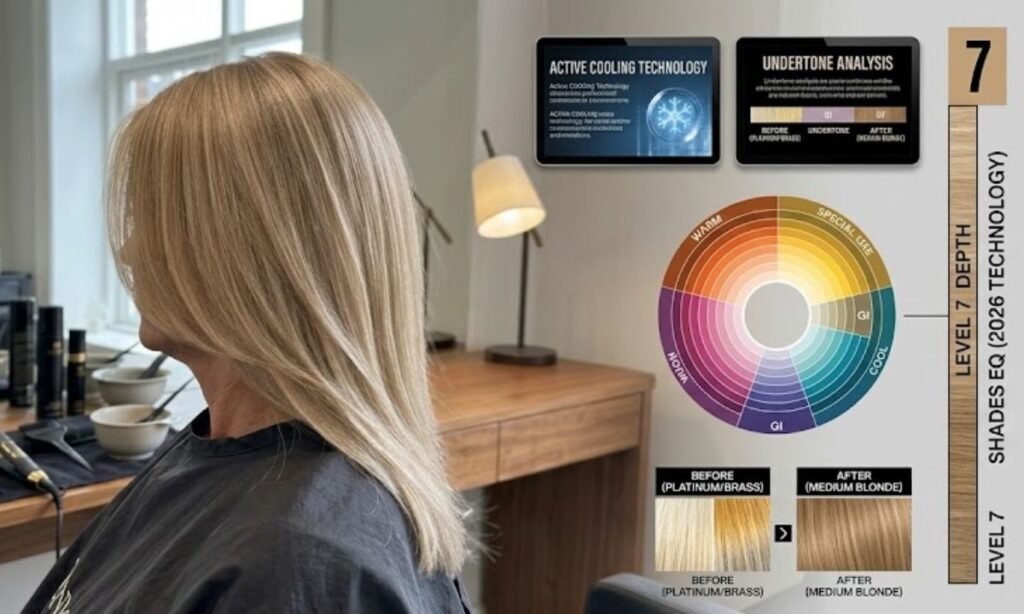
Shades EQ Level 7 creates a true medium blonde result on the hair. It sits right in the heart of the blonde range. This level suits clients wanting a classic, noticeable blonde shade.
Medium blonde offers brightness while still feeling soft and wearable. It works well for both warm and cool-toned looks. Many clients choose Level 7 for a fresh, eye-catching change.
This level requires a bit more upkeep for gray coverage. Lighter tones can show regrowth sooner than darker shades. Still, its versatility makes it a popular salon request.
Tone families at Level 7 range widely across warm and cool options. Colorists can create golden, beige, violet, or red-based blondes. This flexibility helps achieve almost any blonde look a client wants.
Below is a breakdown of common shades found within Level 7.
| Shade Code | Tone Family | Result Description |
| 07N | Natural | True, balanced medium blonde tone |
| 07G | Gold | Warm, golden medium blonde finish |
| 07GB | Gold Beige | Soft warm blonde with beige balance |
| 07V | Violet | Ash medium blonde, cool and neutral |
| 07VV | Violet-Violet | Intense cool blonde, strong brass control |
| 07RV | Red-Violet | Cool-toned blonde with red depth |
Example: 07VV
- 07 → Places the shade at the medium blonde level.
- VV → Violet-Violet family, delivering strong cool pigment.
Result: 07VV creates a cool, ash-toned medium blonde with strong brass correction. It suits clients wanting a bright, icy blonde finish free of warmth.
Level 8 (light blonde)

Level 8 creates a bright, light blonde result on the hair. It sits comfortably above medium blonde on the chart. This level suits clients wanting a noticeably lighter, fresher look.
Light blonde brings brightness while keeping a soft finish. It flatters fair to medium skin tones especially well. Many clients request Level 8 for a bold yet wearable blonde.
This level tends to show regrowth a bit faster than darker shades. Cooler tones help fight brassiness between salon visits. Regular glossing keeps the color looking clean and vibrant.
Tone families at Level 8 span warm, cool, and neutral options. Colorists can create golden, beige, violet, or pearl-based blondes. This variety allows precise control over warmth and shine.
Below is a breakdown of common shades found within Level 8.
| Shade Code | Tone Family | Result Description |
| 08N | Natural | True, balanced light blonde tone |
| 08G | Gold | Warm, golden light blonde finish |
| 08GB | Gold Beige | Soft warm blonde with beige balance |
| 08V | Violet | Ash light blonde, cool and neutral |
| 08P | Pearl | Shimmery light blonde with soft cool shine |
| 08NW | Natural Warm | Light blonde with gentle golden warmth |
Example: 08P
- 08 → Places the shade at the light blonde level.
- P → Pearl family, adding soft, iridescent shimmer.
Result: 08P creates a bright, shimmery light blonde with a cool, luminous finish. It suits clients wanting a soft, radiant blonde free of heavy warmth.
Level 9 (very light blonde)

Level 9 creates a very light blonde result on the hair. It sits near the top of the Shades EQ chart. This level suits clients wanting a bright, high-impact blonde look.
Very light blonde delivers a soft, airy finish with plenty of brightness. It works best on hair that is already lifted to a pale base. Many clients choose Level 9 for a striking statement shade.
This level needs consistent care to stay fresh and clear. Brassiness can appear quickly without the right cool tones. Regular glossing helps maintain a clean, bright finish between visits.
Tone families at Level 9 focus heavily on cool and neutral pigments. Colorists rely on violet, pearl, and natural tones for balance. This helps keep the blonde looking soft instead of yellow or brassy.
Below is a breakdown of common shades found within Level 9.
| Shade Code | Tone Family | Result Description |
| 09N | Natural | Soft, true very light blonde tone |
| 09V | Violet | Ash-toned blonde with strong brass control |
| 09VV | Violet-Violet | Intense cool blonde, maximum brass correction |
| 09P | Pearl | Shimmery blonde with soft cool radiance |
| 09NW | Natural Warm | Very light blonde with subtle warmth |
| 09T | Titanium | Smoky, cool-toned pale blonde |
Example: 09VV
- 09 → Places the shade at the very light blonde level.
- VV → Violet-Violet family, offering intense cool pigment.
Result: 09VV creates a bright, ash-toned blonde with strong resistance to brassiness. It suits clients wanting a clean, cool, high-lift blonde finish.
What are the 5 most-used Shades EQ shades in professional salons?
Some Shades EQ formulas earn a permanent spot on salon color carts. These shades work reliably across many hair types and requests. Stylists trust them because results stay consistent every single time.
Each favorite shade solves a common client concern with ease. Some fight brass, while others add warmth or bold color. This mix of functions make them daily salon essential.
Newer stylists often learn these shades first for good reasons. They offer predictable, easy-to-repeat formulas for busy salon days. Mastering them builds a strong foundation for custom color work.
Below is a quick look at five shades salons reach for most.
| Shade Code | Tone Family | Level | Why Stylists Love It |
| 09V | Violet | 9 | Strong brass control on very light blondes |
| 08P | Pearl | 8 | Adds soft, radiant shimmer to light blonde |
| 06GB | Gold Beige | 6 | Creates natural, sun-kissed dark blonde |
| 04G | Gold | 4 | Warms up medium brown without looking flat |
| 03RR | Red-Red | 3 | Delivers bold, vivid red reflect on dark brown |
Example: 08P
- 08 → Places the shade at the light blonde level.
- P → Pearl family, adding soft, cool shimmer.
Result: 08P is a salon staple because it brightens light blonde hair with a soft, luminous glow. It works well as a gloss after lightning, leaving hair shiny, cool-toned, and free of unwanted warmth.
09NB Irish Crème
Irish Crème is a soft, creamy blonde shade. It blends natural tones with a touch of beige.
This shade works great for clients who want warmth without brass. It looks smooth and buttery on light blonde hair.
Many stylists use it for a subtle, everyday blonde finish. It keeps hair looking soft, rich, and natural.
| Shade Code | Tone Family | Level | Result Description |
| 09NB | Natural Beige | 9 | Creamy, soft blonde with gentle warmth |
Example: 09NB combines Level 9 lightness with a Natural Beige base, creating a smooth, creamy blonde perfect for clients wanting warmth without heavy gold tones.
06N Moroccan Sand
Moroccan Sand is a true, natural dark blonde shade. It has no strong warm or cool pull.
This shade suits clients wanting a balanced, believable color. It blends easily with natural hair tones.
Stylists often pick it for low-maintenance, natural-looking results. It works well for subtle brunette-to-blonde transitions.
| Shade Code | Tone Family | Level | Result Description |
| 06N | Natural | 6 | Balanced, true dark blonde with no strong tone |
Example: 06N uses the pure Natural family at Level 6, giving a soft, sandy dark blonde that looks effortless and true to life.
09V Platinum Ice
Platinum Ice is a cool, icy blonde shade. It fights brass with strong violet pigment.
This shade suits clients wanting a bright, ash-toned finish. It keeps blonde hair looking clean and cool.
Stylists reach for it after lightening services often. It refreshes tone and removes unwanted yellow hues.
| Shade Code | Tone Family | Level | Result Description |
| 09V | Violet | 9 | Icy, cool blonde with strong brass control |
Example: 09V pairs Level 9 brightness with the Violet family, creating a crisp, platinum-icy blonde that stays cool and brass-free.
09GB Buttercream
Buttercream is a soft, warm blonde shade. It blends gold and beige for gentle richness.
This shade suits clients wanting warmth without looking brassy. It gives hair a smooth, buttery glow.
Stylists love it for soft, dimensional blonde looks. It pairs well with balayage and highlights work.
| Shade Code | Tone Family | Level | Result Description |
| 09GB | Gold Beige | 9 | Warm, creamy blonde with soft richness |
Example: 09GB blends Gold Beige tones at Level 9, producing a soft, buttery blonde with warmth that still feels light and wearable.
08N Mojave
Mojave is a true, natural light blonde shade. It stays balanced without heavy warmth or coolness.
This shade works well for clients wanting a soft, sunlit look. It feels light, natural, and easy to wear.
Stylists choose it for versatile, everyday blonde results. It suits many skin tones with ease.
| Shade Code | Tone Family | Level | Result Description |
| 08N | Natural | 8 | Balanced, true light blonde with soft finish |
Example: 08N uses the Natural family at Level 8, delivering a soft, sunlit light blonde that feels effortless and true to natural hair color.
How do you mix Shades EQ shades for custom results?
Mixing Shades EQ shades lets colorists build fully custom formulas. Combining two or more shades creates a unique, personalized result.
Stylists often blend a base shade with a corrective tone. This helps balance warmth, coolness, or intensity to match client needs.
Mixing ratios controls how strong each shade’s influence will be. Small adjustments in ratio can shift the final tone noticeably.
| Mix Example | Purpose | Result Description |
| 08N + 08V (equal parts) | Balance natural tone with cool ash | Soft, neutral light blonde with reduced warmth |
| 06GB + 06N (2:1) | Soften strong gold with natural tone | Subtle, warm dark blonde with less intensity |
| 09VV + 09P (equal parts) | Boost cool tone with added shine | Bright, icy blonde with soft shimmer |
Example: Mixing 08N with 08V in equal parts creates a balanced light blonde. The natural base stays soft, while the violet tone cancels out any unwanted warmth.
What are the most common mistakes when using Shades EQ?
Many stylists apply Shades EQ without checking hair porosity first. Overly porous hair absorbs color faster and can turn darker.
Skipping a strand test is another frequent mistake in salons. This step confirms tone and timing before full application begins.
Overlapping color on previously treated hair also causes uneven results. This often leads to patchy, inconsistent tone throughout the hair.
| Common Mistake | Why It Happens | How to Avoid It |
| Skipping strand test | Rushing the color process | Always test on a small hair section first |
| Ignoring hair porosity | Assuming all hair absorbs color the same | Check porosity before choosing formula |
| Overlapping on treated hair | Applying full formula each time | Focus new color mainly on regrowth areas |
| Incorrect processing time | Not following shade-specific timing | Follow exact timing for each formula used |
Example: A stylist skips a strand test and applies 09V directly to porous blonde hair. The result turns out darker and ashier than expected, showing why testing first prevents costly mistakes.
Frequently asked questions
Does Shades EQ cover gray hair 100%?
Shades EQ blends gray hair very well but does not offer full, opaque coverage like permanent color. It works best on gray hair up to about 30-50%, softening it rather than fully covering it.
How long does Shades EQ last?
Shades EQ typically lasts around 4 to 6 weeks. Since it is demi-permanent, it fades gradually and washes out evenly over time.
Can I mix shades from different levels?
Mixing shades from different levels is not recommended for depth accuracy. It is best to mix shades within the same level to keep predictable, consistent results.
What’s the difference between Shades EQ and a regular salon gloss?
Shades EQ is a specific demi-permanent gloss system with a wide shade range and reliable tone control. Regular glosses can vary in formula and often lack the same level of consistency and shining.
Are 07NB and 09NB the same tone at different levels?
Yes, both shades share the same Natural Beige tone family. The only difference is depth, with 07NB being darker and 09NB being lighter.
What does Redken Shades EQ level mean?
The level number in Shades EQ shows how light or dark a shade will be. Lower numbers mean darker results, while higher numbers mean lighter results.
How do I read a Redken Shades EQ color code?
A Shades EQ code starts with a number showing the depth level. It is followed by letters that show the tone family, like N for natural or V for violet.
What is the best Redken Shades EQ shade for blonde hair?
09V is a popular choice for blonde hair because it controls brass effectively. It keeps light blonde shades cool, bright, and free of yellow tones.
How long does Redken Shades EQ color last?
Redken Shades EQ generally lasts 4 to 6 weeks before fading. Results can vary based on hair porosity and aftercare routine.
What is the difference between Shades EQ levels 8 and 9?
Level 8 creates a light blonde result, while Level 9 creates a very light blonde result. Level 9 is noticeably brighter and requires more upkeep to stay brass-free.
Conclusion
Understanding the Shades EQ level chart makes color selection much easier. Each level and tone family works together to create the perfect shade. Once you know how the codes work, choosing colors feels simple and clear. This knowledge helps both new and experienced stylists work with confidence.
Shades EQ remains a top choice for its shine, safety, and reliability. It blends grays, corrects brass, and refreshes color with gentle care. Learning this chart gives you the tools for consistent, beautiful results. With this guide, mastering Shades EQ in 2026 becomes an easy, achievable goal.






























2 thoughts on “Decode Redken Shades EQ 2026 Level-by-Level Chart”