
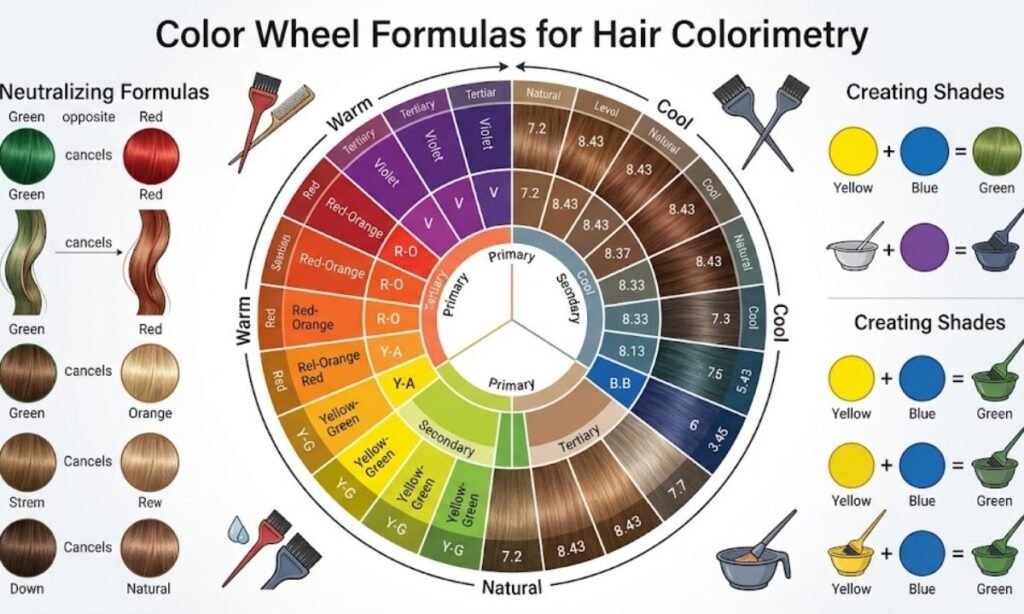
Getting hair color right isn’t luck. It’s about understanding the color wheel and how tones interact with each other. This is the whole idea behind Hair Colorimetry. It turns color choices into something you can predict.
Every shade you see comes from mixing a few basic colors. Red, yellow, and blue sit at the center of this system. Hair Colorimetry uses these primaries as its starting point. From there, secondary and complementary colors build on that base.
Once you learn the wheel, formulas make a lot more sense. You start seeing why certain colors cancel each other out. That’s the real value of Hair Colorimetry in daily salon work. It turns guesswork into a clear, repeatable process.
What Is the Color Wheel and Why Do You Need It in the Salon?
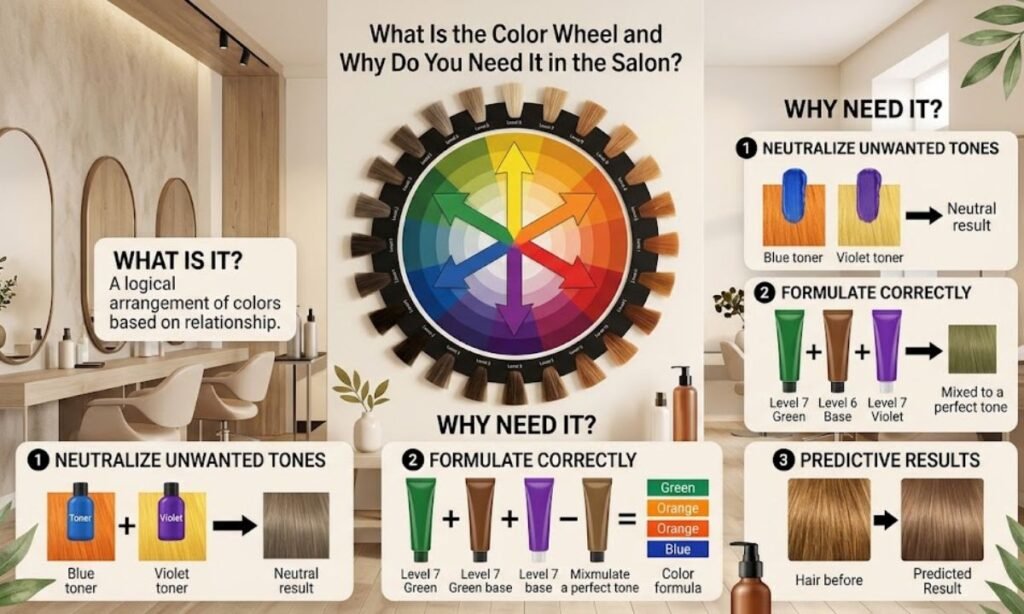
Hair Colorimetry is built on the color wheel, the visual map colorists used to predict how primary, secondary, and complementary tones will interact once they meet the hair shaft. Every accurate prediction in Hair Colorimetry — from a simple gloss to a full corrective service — starts with reading this wheel correctly, which is why Formulas for Hair almost always reference it first.
Best Tip: Keep a physical or digital color wheel at your station and check it before every formulation, not just corrective ones.
| Color | Position on Color Wheel | Type | Visual Effect | Where You See It in the Salon |
| Red | 12 o’clock | Primary | Warms and intensifies | Red-based fashion colors, corrective work |
| Yellow | 4 o’clock | Primary | Brightness and warms | Lightening results at levels 8–10 |
| Blue | 8 o’clock | Primary | Cools and deepens | Ash toners, blue-black formulas |
| Orange | Between red and yellow | Secondary | Adds warmth | Underlying pigment at levels 6–7 |
| Green | Between yellow and blue | Secondary | Neutralizes red | Green-based toners and pre-pigmentation |
| Violet | Between red and blue | Secondary | Neutralizes yellow | Violet shampoos and cool-blonde toners |
What Are the Primary Colors in Hair Coloring?
In Hair Colorimetry, red, yellow, and blue are considered the primary colors because they cannot be created by mixing other pigments, yet they combine to form every secondary and tertiary shade a colorist works with.
Recognizing how these three primaries behave on different hair levels is the foundation of Hair Colorimetry and directly informs which Formulas for Hair will neutralize or enhance a given result.
Best Tip: Identify which primary pigment is strongest in the client’s natural level before selecting a formula, since it determines your starting point.
| Primary Color | Role in Formula | Common Reflect | Underlying Pigment Match | Visual Effect |
| Red | Warming base or corrective target | Red, red-orange | Level 5 | Adds vibrancy, can appear brassy if unwanted |
| Yellow | Lightening and warming base | Gold, yellow | Levels 8–10 | Brightens can look dull or muddy if under-toned |
| Blue | Cooling and deepening base | Ash, blue-black | Level 1–2 | Neutralizes warmth, deepens overall tone |
What Are Secondary and Tertiary Colors in Hair Colorimetry?
Secondary and tertiary colors sit between the primaries on the wheel and give colorists the nuanced tools needed for precise correction and creative work.
Mastering these relationships is central to Hair Colorimetry because most Formulas for Hair rely on secondary or tertiary reflects rather than pure primaries alone.
Best Tip: When a formula looks “flat,” check whether a tertiary reflect would add the missing dimension.
| Color Group | Formula (Primary Mix) | Reflect in Hair Color | Visual Effect |
| Orange | Red + Yellow | Copper, warm gold | Adds richness at mid-to-high levels |
| Green | Yellow + Blue | Ash-gold neutralizer | Cancels red undertones |
| Violet | Red + Blue | Cool violet, mauve | Cancels yellow undertones |
Secondary Colors
Secondary colors form when two primaries combine directly, giving colorists orange, green, and violet as their main neutralizing and enhancing tools.
In Hair Colorimetry, these three secondaries are what colorists reach for most often when a client’s underlying pigment needs to be softened or brought forward.
| Secondary Color | Primary Colors Combined | Salon Application |
| Orange | Red + Yellow | Warming toners for brassy correction reversal |
| Green | Yellow + Blue | Neutralizing red or auburn undertones |
| Violet | Red + Blue | Neutralizing yellow in blonde services |
Tertiary Colors
Tertiary colors result from mixing a primary with an adjacent secondary, producing subtler shades like red-orange or blue-green that give formulators finer control.
These in-between tones are what separate a generic result from a customized one, since they let colorists, fine-tune reflect without overcorrecting.
| Tertiary Color | Formed From | Common Use in Formula |
| Red-Orange | Red + Orange | Copper-red fashion formulas |
| Yellow-Orange | Yellow + Orange | Warm blonde and honey tones |
| Blue-Green | Blue + Green | Deep ash correction on warm bases |
Mixing Hair Dye Color Chart
A mixing chart translates color-wheel theory into ratios a colorist can apply at the bowl, turning abstract relationships into repeatable Formulas for Hair.
This is where Hair Colorimetry becomes practical, since the chart shows exactly how much of each tone is needed to reach a specific, predictable result.
Best Tip: Always mix a small test strand before committing to a full-head application of a new formula ratio.
| Desired Shade | Base Formula | Primary Color Emphasis | Reflect in Hair Color | Visual Result |
| Warm Copper | Orange base + Red accent | Red-Orange | Copper, red-gold | Vibrant, warm, high-impact |
| Cool Ash Blonde | Blue base + Violet accent | Blue | Ash, violet-ash | Neutral to cool, muted warmth |
| Natural Brown | Balanced red-orange-yellow | Orange | Neutral-warm | Even, natural-looking depth |
How to Mix Hair Dye Colors for the Desired Shade
Mixing toward a target shade means starting from the client’s underlying pigment and adding the complementary or matching reflect needed to reach the desired result.
In Hair Colorimetry, this process depends on reading the natural level accurately before any Formulas for Hair are combined at the bowl.
| Target Shade | Starting Pigment | Color(s) Added | Expected Result |
| Cool Blonde | Yellow-gold | Violet-ash reflect | Neutralized, cooler blonde |
| Rich Auburn | Orange-red | Red intensifier | Deeper, warmer red-brown |
| Neutral Brunette | Orange | Green-based neutralizer | Balanced, natural brown |
Hair Dye Mixing Ratios and Color Formulas
Ratios matter as much as color choice, since even the correct reflect can be overcorrect or under correct if the proportions are off. A dependable formula documents both the color relationship and the ratio, which is what makes a result repeatable across appointments.
| Formula Type | Typical Ratio | Primary Color Focus | Visual Result |
| Standard Neutralizing Toner | 1:2 (toner to developer) | Complementary reflect | Balanced, corrected tone |
| Corrective Pre-Pigmentation | 1:1 (filler to developer) | Warm base rebuild | Restored depth before color |
| Fashion Vivid Formula | Manufacturer-specific | Primary or secondary emphasis | Bold, saturated reflect |
Underlying Pigment Chart
Underlying pigment is the natural warmth exposed as hair is lightened, and predicting it correctly is one of the most valuable skills in Hair Colorimetry.
Because every hair level carries a different dominant pigment, Formulas for Hair must be adjusted level by level rather than applied as a single universal recipe.
Best Tip: Always assess underlying pigments under neutral lighting, since fluorescent or warm bulbs can distort your read.
| Hair Level | Underlying Pigment | Desired Result | Corrective Color Needed |
| Level 1–2 | Blue | Neutral or ash black-brown | Minimal correction needed |
| Level 3–5 | Red | Neutral or ash brown | Green-based neutralizer |
| Level 6–7 | Red-Orange | Neutral to warm blonde | Blue-green neutralizer |
| Level 8–9 | Orange-Yellow | Cool to neutral blonde | Violet-based neutralizer |
| Level 10 | Pale Yellow | Pale, ash blonde | Violet or blue-violet toner |
Underlying Pigment at Different Hair Levels
Each hair level reveals a distinct underlying pigment as natural melanin lifts, moving from blue and red to darker levels toward orange and pale yellow at the lightest levels.
Recognizing this progression is essential in Hair Colorimetry, since the same Formulas for Hair will behave very differently depending on where the client’s natural level falls.
| Hair Level | Underlying Pigment | Formula Adjustment |
| 3–5 | Red | Add green-based neutralizer to base formula |
| 6–7 | Red-Orange | Add blue-green neutralizer to base formula |
| 8–10 | Orange-Yellow to Pale Yellow | Add violet-based neutralizer to base formula |
How to Neutralize Underlying Pigments in Hair
Neutralizing pigment means applying the complementary color directly across the wheel from the unwanted tone, cancelling it out rather than covering it up.
This is a core technical skill in Hair Colorimetry, since choosing the wrong complementary color can shift the result toward an entirely different unwanted tone.
| Unwanted Pigment | Neutralizing Color | Salon Application |
| Red | Green | Brunette corrective toning |
| Orange | Blue | Warm-to-cool blonde correction |
| Yellow | Violet | Brassy blonde correction |
Hair Color Formulation Calculator
A formulation calculator brings structure to Hair Colorimetry by combining the client’s current level, desired level, and underlying pigment into one predictable formula rather than relying on guesswork.
Colorists who calculate rather than estimate produce more consistent Formulas for Hair, which reduces both correction visits and client dissatisfaction.
Best Tip: Record every successful formula and its outcome so you can calculate future services from real data rather than starting from scratch each time.
How to Calculate Hair Color Formulas
Calculating a formula starts with identifying the level difference between natural and target shade, then selecting a developer volume and neutralizer strength appropriate to that gap.
In Hair Colorimetry, this calculation determines whether a single-process formula will be sufficient or whether pre-pigmentation is required first.
| Step | Factor Considered | Formula Impact |
| 1 | Level difference (natural vs. target) | Determines developer volume |
| 2 | Underlying pigment at target level | Determines neutralizing color needed |
| 3 | Percentage of gray or resistant hair | Determines formula ratio adjustment |
Hair Color Formula Examples for Different Hair Levels
Formula examples vary significantly by level, since a level 4 client and a level 8 client are neutralizing entirely different underlying pigments even when the desired outcome is similarly “neutral”.
Reviewing sample formulas across levels helps colorists apply Hair Colorimetry principles quickly during a live consultation.
| Hair Level | Sample Formula Focus | Reflect Achieved |
| Level 4 | Brown base + green-based neutralizer | Neutral brunette |
| Level 7 | Blonde base + blue-green neutralizer | Neutral-cool blonde |
| Level 9 | Pale blonde base + violet toner | Cool, ash-pale blonde |
How Do Complementary Colors Work for Neutralization?
Complementary colors sit directly opposite each other on the wheel and pairing them is the single most reliable neutralization method used in Hair Colorimetry. Every corrective Formulas for Hair strategy — from cancelling brassiness to fixing an overly ashy result — depends on correctly identifying which complementary pair applies.
Best Tip: When in doubt about which complementary to use, isolate the single strongest unwanted tone and neutralize that one first before layering additional correction.
| Unwanted Tone | Complementary Color | Visual Result When Applied |
| Red | Green | Neutral, muted brown |
| Orange | Blue | Neutral, muted blonde or brown |
| Yellow | Violet | Neutral, cool pale blonde |
The Proportion Rule
The proportion rule states that the amount of neutralizing color used should match the intensity of the unwanted pigment, since too little under-corrects and too much overcorrects into the opposite tone.
Applying this rule consistently is what allows Hair Colorimetry to move from theory into precise, repeatable Formulas for Hair.
| Pigment Intensity | Neutralizer Proportion | Resulting Tone |
| Light (subtle warmth) | Small amount of complementary | Soft, natural neutral |
| Moderate | Balanced 1:1 complementary ratio | Clean neutral result |
| Strong (heavy warmth) | Higher concentration of complementary | Fully neutralized, may need toner follow-up |
How Do You Apply the Color Wheel Step by Step in the Salon?
Applying the color wheel in a real service means moving through a consistent sequence: assess, identify, neutralize, and adjust. This step-by-step approach keeps Hair Colorimetry practical during a live appointment and ensures every Formulas for Hair decision is based on what the hair is actually showing, not assumption.
Best Tip: Walk through all four steps mentally before opening a single tube of color, even on routine services.
| Step | Action | Purpose |
| 1 | Identify underlying pigment | Establishes the starting point |
| 2 | Locate the complementary color | Determines the neutralizer |
| 3 | Choose the correct reflect | Refines the final tone |
| 4 | Adjust the proportion | Fine-tunes intensity of correction |
Step 1: Identify the Underlying Pigment
The first step is always assessing which pigment — red, orange, or yellow — is dominant at the client’s current or target level.
Getting this identification right in Hair Colorimetry prevents every downstream step from being built on an incorrect assumption.
| Hair Level | Likely Underlying Pigment | Assessment Method |
| Levels 3–5 | Red | Visual check under neutral light |
| Levels 6–7 | Red-Orange | Strand test before full formula |
| Levels 8–10 | Orange-Yellow | Compare against a level chart |
Step 2: Locate the Complementary
Once the pigment is identified, the colorist locates its direct opposite on the wheel, which becomes the core neutralizing ingredient in the formula.
This pairing is the mechanical heart of Hair Colorimetry, translating a visual assessment into an actionable color choice.
| Underlying Pigment | Complementary Color | Formula Role |
| Red | Green | Primary neutralizer |
| Orange | Blue | Primary neutralizer |
| Yellow | Violet | Primary neutralizer |
Step 3: Choose the Correct Reflect
After neutralizing, the colorist selects a reflection that gives the final result its finished tone, whether that’s a warm gold, a cool ash, or a soft neutral.
This is where Hair Colorimetry allows for creative finishing while still respecting the corrective work done in the previous steps.
| Desired Finish | Reflect Choice | Visual Outcome |
| Warm finish | Gold or copper reflect | Rich, warm final tone |
| Cool finish | Ash or violet reflect | Cool, muted final tone |
| Neutral finish | Balanced neutral reflect | True-to-level, natural tone |
Step 4: Adjust the Proportion
The final step fine-tunes how much neutralizer versus reflect is used, since even a correct color choice can look off if the ratio is wrong.
This adjustment is what separates a technically correct formula from one that actually matches the client’s expectations.
| Correction Level Needed | Proportion Adjustment | Result |
| Minor warmth | Small increase in complementary | Subtly neutralized, natural look |
| Moderate warmth | Standard 1:1 proportion | Balanced, expected result |
| Heavy warmth | Higher complementary ratio | Fully corrected, may need gloss to soften |
What Are the Most Common Mistakes When Using the Color Wheel?
The most frequent mistakes in Hair Colorimetry come from misreading underlying pigment, overcorrecting with too much complementary color, or ignoring how gray or resistant hair absorbs Formulas for Hair differently.
Avoiding these errors comes down to slowing down at the assessment stage rather than rushing straight to mixing.
Best Tip: Before finalizing any formula, double-check your pigment read against a level chart rather than relying on memory alone.
| Common Mistake | Cause | Correction |
| Overcorrection | Too much complementary color applied | Reduce neutralizer proportion, retest on a strand |
| Under correction | Underlying pigment underestimated | Increase neutralizer or apply a second pass |
| Muddy or dull result | Wrong reflect chosen for the level | Reassess desired finish and reselect reflect |
| Inconsistent results on gray hair | Formula not adjusted for pigment-free hair | Increase pre-pigmentation or adjust ratio for resistant hair |
Frequently Asked Questions
Is the color wheel the same for all hair color brands?
In Hair Colorimetry, the color wheel logic stays universal across brands, though naming and numbering systems can vary.
Can I use the color wheel for fantasy colors?
Hair Colorimetry principles apply to fantasy shades too, using the same complementary and secondary color rules as natural colors.
How do I know exactly how much complementary to add?
Hair Colorimetry follows a proportion rule, where stronger unwanted pigment needs a higher ratio of complementary color.
Is neutralizing the same as toning?
In Hair Colorimetry, neutralizing cancels unwanted pigment, while toning refines and finishes the shade afterward.
Do cool blondes always need violet complementary?
Hair Colorimetry shows violet is usually needed for cool blondes, since yellow pigment dominates at high levels.
What is the best way to read a hair color wheel?
Hair Colorimetry teaches colorists to read the wheel by identifying primary, secondary, and complementary relationships first.
How does hair level affect color wheel decisions?
In Hair Colorimetry, each hair level carries a different underlying pigment, changing which formula and complementary color are needed.
Which complementary color cancels unwanted orange tones?
Hair Colorimetry identifies blue as the direct complementary color that neutralizes unwanted orange undertones.
Can the color wheel help with hair color correction?
Hair Colorimetry relies heavily on the color wheel for corrective work, guiding which tones to neutralize or rebuild.
How do primary and secondary colors work together in hair colorimetry?
Hair Colorimetry combines primary colors to form secondaries, giving colorists more precise tools for formulation and correction.
Conclusion
The color wheel isn’t just theory. It’s a practical tool you use every day at the chair. Hair Colorimetry turns that tool into real, working formulas. Once you understand it, color choices stop feeling random.
Every level, every pigment, every reflection connects back to this system. That’s what makes Hair Colorimetry so valuable in the salon. With practice, reading the wheel becomes second nature. And your formulas become more accurate, every single time.



































3 thoughts on “Color Wheel Formulas for Hair Colorimetry”